Nishchay AG once wanted to invest in his friend’s company. There was a small obstacle: he had bought a car and had no cash left to put in. The friend was Misbah Ashraf. The company was Marsplay. A few years later, the two would build a business around helping other people put money aside. Entrepreneurship occasionally has the manners of a practical joke.
The missed investment belongs to the history of a friendship, rather than a grand founding revelation. Nishchay and Misbah stayed in touch, explored business connections, and eventually became co-founders of Jar. Its proposition was deliberately modest at the point of entry: start saving in gold with a small amount. Behind that modest invitation sat a question about how people begin doing something they already know they ought to do.
Money is full of such questions. Knowing that saving is useful does surprisingly little to arrange the next deposit. A person can have an income, a bank account and a phone full of payment apps, yet remain some distance from a regular saving habit. Nishchay’s career had taken him through the systems that make transactions possible. Jar would ask him to think about the hesitation before one.
Before the app, a shop
He was born and brought up in Hassan, Karnataka, and helped in his father’s shop. He and his cousin Vivekananda Hallekere grew up in a joint family. Their parents ran kirana stores, the neighbourhood shops where a business is conducted across a counter and familiarity has commercial value. In that setting, customers come with particular needs rather than convenient demographic labels.
There is a useful education in watching those encounters. A shopkeeper deals with the size of a purchase, the timing of payment, the confidence of a returning customer. A decision that looks straightforward from outside may contain a household’s entire argument with its budget. Later, a phone screen has to accommodate some of the same considerations, with considerably less help from a familiar face.
Nishchay studied engineering at Malnad College of Engineering in Hassan. His account of choosing the subject is refreshingly unceremonious: there was a good engineering college nearby, and relatives had studied there. He has said that a good arts college might have sent him in another direction. The future engineer did not require a childhood prophecy. Geography and a sensible option did the work.
That leaves room for a more interesting kind of ambition: one that develops through experience. His education gave him a way into technology. His family background gave him familiarity with everyday commerce. Neither needed to announce itself as preparation for a financial-services company. The connections became apparent later, when the questions he was trying to answer changed.
A coffee with consequences
A campus placement brought him to Bengaluru and an IT career. He describes working for nearly nine years in the industry, including time at Honeywell Aerospace’s Phoenix facility, followed by consulting at Accenture. His professional profile also lists NTT DATA and Infosys. Before the savings app came years of ordinary technical work: systems, projects and responsibilities that existed without a founder’s title.
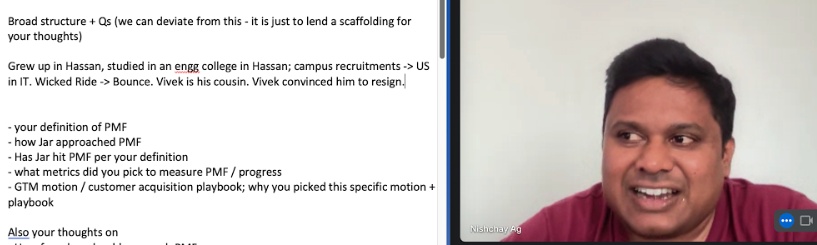
Then his cousin asked him for coffee. Vivekananda was building Wicked Ride, the motorcycle-rental business that became Bounce, and wanted help with its technology. Nishchay recalls being pressed to resign from his corporate job that very day. The conversation supplied an unusually direct recruitment process. Coffee is generally sold as a stimulant; this cup seems to have done rather more than advertised.
At Bounce, his responsibilities expanded across engineering, supply and monetization. That range matters because a consumer business rarely presents its difficulties in departmental order. A system has to work. A physical service has to be available. Somebody has to find a way for the operation to earn money. Experience in one part can expose an awkward assumption in another.
His early startup years also brought him into direct contact with customers. He describes spending weekends at stores handing over rented vehicles and talking to the people collecting and returning them. A booking could become a conversation. The customer might explain where they had heard about the business, what they wanted, and how the experience had gone. The software produced records; the encounter supplied context.
An investment he couldn’t make
Misbah had been building Marsplay, a community-led ecommerce venture. The two men explored possible collaborations while Nishchay was at Bounce. The car purchase that prevented an investment did not prevent a working relationship. After Misbah sold Marsplay in 2020, they teamed up on Jar in 2021. Friendship had given them time to discover a shared interest before there was a new company to name.
The interest was in people whose access to digital payments had run ahead of their access to saving and investing. Nishchay was drawn to financial inclusion while working on monetization at Bounce. The founders wanted to reach beyond the relatively small group already comfortable with investment products. That required attention to the person approaching a first deposit, rather than only the person choosing between established portfolios.
Jar was registered in January 2021. A beta followed within seven weeks, and the Android app became publicly available in May. Those dates give the origin story a practical shape. A friendship and a problem became a company, then a product, then something strangers could try. At each stage, the founders had to exchange a plausible idea for a more demanding form of evidence.
A savings app enters an intimate part of daily life. It asks for money, but also for permission to become part of a routine. An attractive screen can invite a visit. A useful product has to survive the following days, when the novelty has faded and the same household expenses remain. The recurring decision is where the original proposition earns its place.
The ten-rupee doorway
Jar’s early product offered round-ups, daily savings and one-time contributions. The round-up feature took a spend to the next ten rupees and put the difference into digital gold. It attached a saving action to something the customer was already doing. A later description of Jar’s beginnings emphasised the weeks the founders spent talking to their intended users before settling on how to make that first step easier.
“You can’t just design a cool product and expect people to start saving.”
Nishchay AG
Gold supplied familiarity. The product asked people to try a new method of saving in an asset they recognised. There is an important distinction between recognising something and having experience with a particular product that offers it. Jar’s design problem was to make that transition understandable, with an amount small enough to begin and an action simple enough to repeat.
An explanation of the design, rather than a projection of investment returns.
The current daily-saving offer starts at ₹10. Weekly, monthly and instant-saving options sit alongside it. The choice of cadence matters as much as the choice of amount: different incomes and routines make different demands on a product. The useful ambition is to fit into a person’s life with enough clarity that the next contribution requires less deliberation than the first.
The household habit behind that idea is older than the interface. Setting a little aside does not need an elaborate introduction. Making it available through a phone still requires payments, accounting and a service people can use repeatedly. The familiar action gives the product its opening. The engineering and operations have to make the opening worth taking.
Millions of beginnings
In an August 2024 interview, Nishchay described a progression from a little over six million users in FY22 to more than fourteen million in FY23, then twenty million as Jar entered FY24. He also described educational content in seven languages. His explanation kept returning to the same concern: financial products can become difficult to approach when the language and assumptions feel remote from the customer.
The engineering behind that growth had its own demands. He singled out Kotlin Multiplatform as part of Jar’s technology approach. The customer sees an app; the team has to maintain the machinery that makes the experience available. For someone with his background, the product’s apparent simplicity comes with a second view of the work underneath it.
Registered users measure reach. They do not tell us how many people save every day.
By September 2025, Jar said it had served thirty-five million registered users and that more than 95 percent were saving for the first time. It also reported profitability for January through March and April through June that year. The user figure describes the scale of introductions to the service. The two quarters describe a particular period in the business, rather than a permanent verdict on its finances.
Nishchay’s response to that milestone was still about the customer’s starting point. The people beginning to save were the reason to keep building. That is a useful discipline for a company with large numbers to discuss: a total can be impressive on a slide while saying very little about what made one person return tomorrow.
When savings become jewellery
Jar expanded into jewellery through Nek in February 2024. By December, Nishchay said that business had crossed ₹100 crore in annualised recurring revenue. The figure was a measure of the revenue pace at the time. Nek also gave Jar users a way to turn their digital gold savings into jewellery, connecting accumulation on a phone with an object someone could own.
This adds another chapter to the operator’s work. A saving balance and a jewellery purchase occupy different moments in a customer’s life, but the same person may arrive at both. Nishchay described offering jewellery to existing users without additional marketing expenditure. The business connection was specific: a relationship established through saving could support another purchase.
The personal story remains visible inside that expansion. He had moved between technical and commercial responsibilities before founding Jar. Now the company was moving between a recurring financial habit and ecommerce. The challenge grew in scope, while the underlying question remained familiar: what does a customer want to do next, and how much work should the product ask them to perform?
The engineer is still there
In a conversation published in June 2026, Nishchay said he had handled Jar’s customer care for its first three quarters. He also described a continuing fondness for inspecting database schemas, the structures that organise information inside software. These are two views of the same company: the person asking for help, and the system expected to answer reliably.
His account of leadership has changed with experience. He says empathy now plays a larger part in difficult conversations. He also set out an ambition for at least one hundred million people to be saving on Jar within three years. The target belongs to the future. The work that might bring it closer remains measured in individual decisions.
There is no need to tidy his route into inevitability. A local college, years in IT, a cousin’s coffee, a friendship that survived an investment he could not make: each chapter brought its own circumstances. At Jar, those experiences meet in a small invitation. Put a little aside. Find a reason to return. Build something that can keep showing up when the customer does.