A customer can want the shoes, place the order and still keep the money. Hosam Arab spent years running a business in which that was an everyday possibility. At Namshi, the online fashion retailer he co-founded in 2011, cash on delivery meant the purchase remained unfinished until the parcel reached its buyer. A website could do its job beautifully. The decisive moment still belonged to a courier.
For Arab, the payment choice became a question that outlasted the company. Namshi was fully acquired by Emaar Malls in 2019. Later that year, he and Daniil Barkalov founded Tabby. The next venture would deal with the part of shopping that had resisted the first one’s efforts: getting people comfortable with paying online. It is an unusually practical inheritance to carry out of an exit. Some founders leave with a new investment thesis. Arab left with a checkout problem.
By September 2026, Tabby was announcing a $233 million equity round at a $6.5 billion valuation. Those are conspicuous numbers. Yet they make more sense when placed beside the less glamorous work that came before them: selling fashion, arranging deliveries and trying to understand why a shopper kept choosing cash.
The résumé took the scenic route
Arab’s qualifications could have supported a comfortable corporate career. He studied electrical engineering at Queen’s University in Canada, then earned an MBA at Harvard Business School. His working life included engineering at Schlumberger and GE, advisory work and private equity. Before Namshi, he worked at Waha Capital in Abu Dhabi, managing its portfolio of assets.
The sequence looks tidy on a biography. His account of living through it is rather less tidy. He kept finding that the work did not suit him. Business school had not supplied the answer either. Eventually, entrepreneurship became the remaining option. An encounter with Zappos in the United States had shown him the possibilities of online fashion retail; meeting Rocket Internet helped turn that interest into a business.
The electrical engineer had arrived at shoes. It sounds like a sharp turn until you consider the problems involved. A retail website still has systems to build, processes to coordinate and failures to diagnose. The goods are more photogenic than industrial equipment, but they must reach the right person all the same.
Before a payment app, a room full of parcels
Namshi’s early business required more than putting brands on a screen. In 2012, its founding team described the work of convincing suppliers that the company was legitimate, explaining online shopping to customers and making deliveries across Gulf markets. The company offered free shipping and returns. Those policies gave buyers a reason to try an unfamiliar way of buying clothes.
There was an aquarium in the office, too, complete with colourful fish and sunken columns. Around it sat the less decorative machinery of a young retailer: grouped desks, laptops, buying teams and people arranging fulfilment. Fashion may invite glamour; an online fashion business invites someone to chase a package.
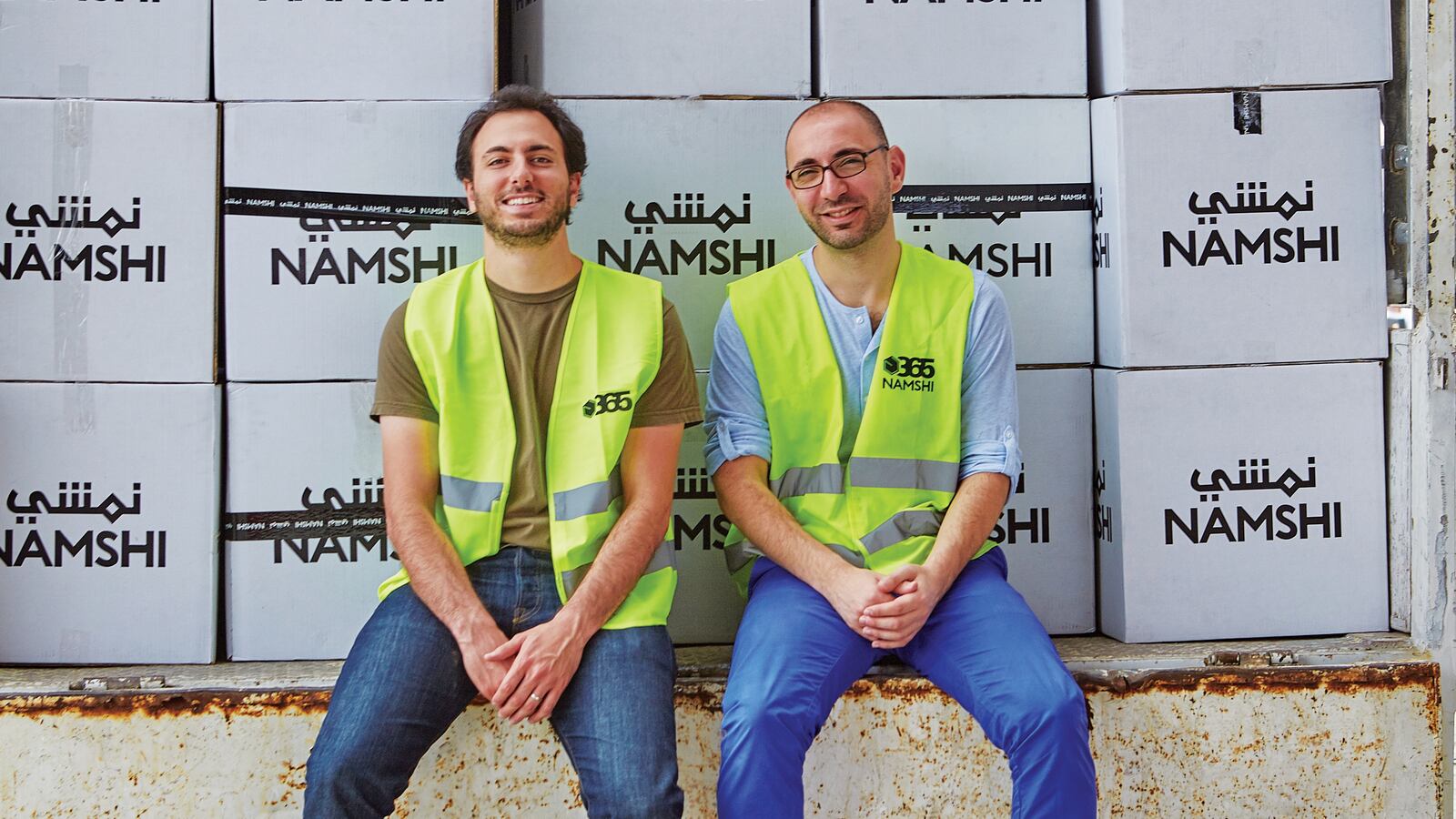
Cash on delivery added a particular complication. With no money committed at checkout, linking the parcel to the customer required follow-up. The team tracked orders and worked with couriers to make the connection. That context gives Arab’s later move into payments a different texture. He had encountered the payment method as a merchant, with goods already moving through a delivery network.
Namshi continued beyond his tenure. In February 2023, Noon completed its acquisition of the retailer from Emaar in a $335.2 million transaction. That later sale belongs to Namshi’s history, rather than to Arab’s departure in 2019. By then, his attention had moved to the new business growing out of the old difficulty.
Cash had a job to do
At Namshi, discounts for paying by card did not create a lasting change. When the incentive disappeared, customers returned to cash. Charging for cash on delivery did not solve it either. People paid the charge. Arab came to understand the preference as a response to uncertainty about the retailer, the delivery and the goods themselves.
That is a useful correction to the merchant’s view of the transaction. Cash created operational work for the seller while giving the buyer a way to wait. Tabby’s original premise came from that mismatch. The shopper needed an alternative that made the transaction easier to accept; the retailer needed an alternative to the costs and complications of cash.
The checkout sits between the retailer’s promise and the customer’s confidence.
In his early public advice, Arab emphasised the need to adapt a business model to the market where it would operate. A payment service could borrow an idea from abroad, but it still had to answer a local problem. He described bringing together international expertise and experience of the region’s digital economy. The combination mattered more than simply importing a familiar product name.
“make sure you’re solving for real problems in the markets you’re targeting.”
Hosam Arab on advice to founders, 2020
He has continued to argue for that specificity. In a January 2023 podcast conversation, he discussed why buy now, pay later could suit some markets better than others. The model, in his account, needed the right customers and circumstances. By that point, the programme described Tabby as serving more than three million customers and 5,000 businesses. The discussion was about fit as much as growth.
The colleagues inside the numbers
Arab’s public comments about the team have a more personal scale. He has described hiring fresh graduates who had little experience in Tabby’s industry, then watching them negotiate with large partners and bring retailers onto the platform. Their work exceeded both his expectations and their own. He drew a straightforward lesson from it: people could do more than they initially believed.
There is a practical complement to that view in Tabby’s September 2026 funding announcement. The round included an employee liquidity option. The company said it had been running share tenders since 2023 and had facilitated more than $100 million in share sales for current and former employees. Company value had become something employees could partly realise, rather than only a number attached to a future event.
Outside his own companies, Arab’s public investment record lists Alaan, Pluto and Opontia. He has also served on the advisory board of the Dubai Chamber of Digital Economy. These connections put him among the founders helping finance and advise other businesses, alongside the day job of running one.
Still, he has supplied a pleasingly unheroic footnote to the repeat-founder story. Asked what he would change, he answered with the time between his two ventures.
“I would have taken some time off between Namshi and Tabby.”
Hosam Arab
A holiday is an excellent idea. It is also remarkably easy to postpone when the next company is already taking shape.
A button becomes an account
The expansion beyond checkout became more concrete in September 2024, when Tabby announced an agreement to acquire Tweeq, a Saudi digital-wallet company founded in 2020. Tweeq brought a licensed spending-account business. The announced direction included accounts, cards and tools for managing money. Arab’s next problem was widening from how a customer paid for one purchase to how that customer handled money more generally.
In February 2025, Tabby raised $160 million at a $3.3 billion valuation. It reported more than 15 million registered users, over 40,000 sellers and annualised sales volume above $10 billion. The product list already extended to Tabby Card, the Tabby Plus subscription, Tabby Shop and buyer protection. The funding announcement explicitly connected the new capital to broader financial services and preparations for an eventual public offering.
More relationships to serve
In April 2026, a Stored Value Facilities licence from the Central Bank of the UAE gave Tabby permission to hold customer funds and offer spending accounts, cards and money-management tools. That permission changed what the service could become. A checkout option is something a customer visits when buying. An account can become part of the routine before and after the purchase.
Tabby Cash followed in July. At announcement, more than 150,000 people were already using it. The product offered an account without account or card fees, a cashback card and money transfers. The launch also came with a new visual identity, including hand-drawn characters called the Monions, depicting money doing everyday things. Even the money had acquired a small cast of characters.
Arab’s stated ambition was to make control over money easier. In a July interview, he also corrected an oddly persistent biographical claim: he had never worked at Careem. It is a small, revealing interruption in a conversation about the future of finance. Before expanding the business story, the founder had to repair his own résumé.
Bigger purchases, the same unfinished question
Saudi consumer and SME finance licences, announced in June 2026, opened another set of relationships. Eligible customers could finance purchases up to SAR 50,000 across as many as 12 monthly payments. The longer plans carried a fixed cost agreed upfront. Businesses on the platform could access working capital. A retailer using Tabby to accept payments could also become a customer seeking funding.
By September, the company reported 70,000 business partners and more than $18 billion in annualised transaction volume. It said it had been profitable since 2023. Blue Pool Capital led the new equity round, with HSG, Wellington Management and Arbor Ventures participating. The announced transaction remained subject to regulatory approvals. The valuation belongs to the company; it is not a statement of Arab’s personal wealth.
Each new product gives Arab another promise to keep. The original merchant needed a transaction to finish. The account holder needs money to be available. The business borrower needs financing to arrive on useful terms. As Tabby widens, the simple checkout question gathers more consequences.
Arab’s story began with someone wanting a pair of shoes and withholding payment until the delivery. It now includes people holding money, moving it and financing larger purchases. The distance between those moments is substantial. The customer’s expectation remains wonderfully ordinary: the thing promised should work.