Aayush Gupta’s job description contains a small rebellion against the usual language of startup growth. He says he leads the efforts at FamPay to do things that do not scale. In a business where the desired direction is generally up and to the right, that is an intriguing place to stand. It puts the conversation before the chart, and the individual before the audience segment.
Gupta belongs to the founding team at Fam, the Bengaluru payments company formerly known as FamPay. The distinction matters: Sambhav Jain and Kush Taneja are its founders. Gupta’s own work comes into focus through the people and projects around him. There are students organising events, teenagers learning about money, interns getting their first substantial assignments and, more recently, campus fellows invited to explain their everyday lives.
A career like this is easiest to understand by following the invitations. Come to an event. Apply for an internship. Learn how money works. Tell us what your campus is really like. Each creates a meeting between a company and a person who has something to contribute. A payments app may live on a phone. The work of understanding its users keeps finding reasons to leave the screen.
The question that came back
In March 2026, Gupta announced Fam Insight Partners. The starting point was a question about whether Fam actually understood student life across India’s campuses. He wanted attention paid to real choices and habits, alongside students’ aspirations and daily difficulties. The proposed mechanism was specific: a four-week campus fellowship, a ₹5,000 stipend and places for five students per city.
The fellows would help the company understand the lives around them. This was an invitation to people curious about culture, other people and the way products emerge from observation. Students were being asked to contribute knowledge of their surroundings, something they already possessed before a company gave it a programme name.
The appeal is easy to see. Campus life contains details that resist the tidy summary. A shared routine can look obvious to the people inside it and remain invisible to anyone building from a distance. Gupta’s announcement takes that gap seriously. A fellowship gives observation a duration and a role. Its value will depend on what happens after the observations arrive, but the opening question is a useful one to keep asking.
Before Fam, there were rooms to organise
Gupta attended IIT Roorkee from 2015 to 2019. His field is listed as Production and Industrial Engineering. Alongside that education came a set of organising responsibilities: head of operations at TEDxIITRoorkee in 2017, convenor of the institute’s E-Summit from late 2017 into 2018, and lead organiser of Startup Weekend in early 2018.
Operations is a wonderfully unromantic word for work that makes other people’s plans possible. An event needs more than an interesting idea. People have to know where to go, what happens next and who is responsible when the schedule becomes ambitious. The stage gets the photograph. The coordination makes the photograph possible.
Those campus roles place Gupta around entrepreneurship well before the later posts about Fam’s community and internships. They also give his career a practical beginning. The recurring setting is a group of people trying to make something happen together, with a finite amount of time in which to do it. Later programmes would change the subject and the participants. The basic problem of getting people involved would remain recognisable.
“Do things that don't scale”
Aayush Gupta’s description of his work at FamPay
A jury seat in Kohima
By February 2020, Gupta was participating in Ashoka Changemaker Day in Kohima as a member of FamPay’s founding team. The event brought together Ashoka Innovators, the Nagaland Board of School Education and Entrepreneurs Associates. Students had been encouraged to propose solutions to problems they had encountered.
Forty entries became ten pitches. The gathering included 1,500 students from 44 schools. Gupta served on the jury alongside participants including Ajit Singh, Hasina Kharbhih and Disha Shah. The three selected winners were to receive invitations to Ashoka’s national launchpad.
There is a pleasing reversal in that arrangement. Young people arrive with the ideas; adults take the seats and listen. The invitation begins with a problem the student has noticed, rather than a problem selected on the student’s behalf. Gupta’s later campus fellowship would return to a related territory: treating young people’s knowledge of their own surroundings as something worth bringing into the room.
A jury appearance is one episode, with its own limits. Here, it supplies an early point in a larger pattern of student-facing work. It also moves the story beyond Bengaluru, into a setting where participation meant standing up and presenting an idea to a considerable audience.
When a card has a personality
Gupta’s name also appears in the FamPay team credits for Supari Studios’ FamCard Me launch film, alongside Devarsh Thaker and Sambhav Jain. The campaign promoted a numberless doodle card. Its cast included an influencer, a footballer, a gamer and a DJ.
The credit places him within a collaborative piece of brand work. A film has directors, producers, performers, editors and a client team, each contributing to the result. The finished object can look effortless precisely because so many people have attended to its details.
The product’s presentation offers a useful piece of context for a youth payments company. A card is functional, but it is also something a person carries and shows. A doodle gives that ordinary object a little social life. Banking paperwork rarely gets invited to the party; something that reflects a person’s taste stands a better chance.
The campaign makes sense beside Fam’s broader focus on the next generation’s financial inclusion. It presents payments within recognisable interests and identities. That same attention to how people see themselves would surface in Gupta’s account of building an Instagram community.
The audience on the other side of the post
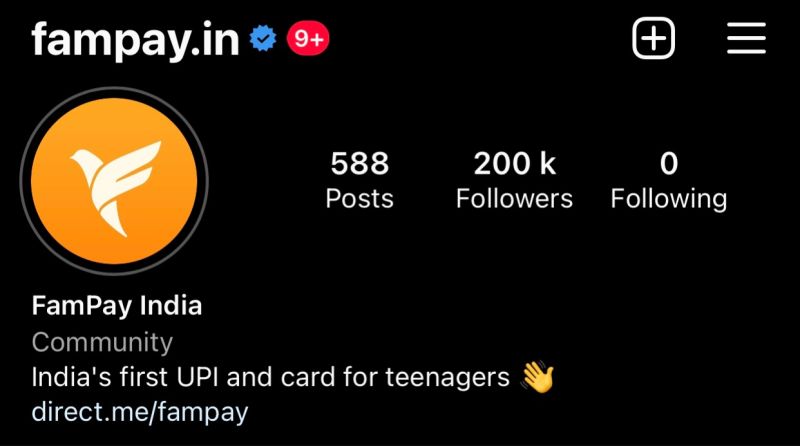
In October 2022, Gupta reported that FamPay’s Instagram account had reached 200,000 followers organically. He broke the climb into three stretches: two years to reach 50,000, another year to reach 100,000, then five months to double that figure.
He credited an in-house team, experimentation, attention to performance data and an effort to understand what teenagers liked and shared. The account followed hundreds of teens for inspiration. One of his instructions was simply to be human. He also named the people involved, giving a team effort the individual credits it deserved.
The figures describe a historical audience milestone. They do not measure payment activity, and the last stretch covers a different increase from the first two. What makes the account interesting is the combination of close observation and measurement. There is room for both in community work. The person watching the numbers still needs to understand why somebody would want to share the post.
A lesson with money attached
The same year brought a different kind of encounter with young people. Money 101, an inter-school financial-literacy competition organised by Up-Tix and sponsored by FamPay, included a webinar led by Gupta. Its subject was the basics of money and investment, including income and expenses.
More than 1,200 students from nearly 100 schools took part in the competition. It combined two webinars with two quiz rounds. Ayush Shete, a Grade X student at S. B. Patil Public School, won first prize and received ₹3,000 in his FamPay account.
That last detail gives the lesson a neat landing. Money had been discussed, tested and then received. For a company serving young people, education sits close to the product’s purpose. Being able to make a payment and understanding a financial decision are related parts of growing more comfortable with money.
Gupta’s participation adds teaching to a record already containing organising, judging and campaign work. The setting changes again, but the audience remains young people being given a reason to engage.
The application that became a first flight
Former intern Vikas Sharma tells another part of the story. He recalls seeing a Google Form in a recruitment post from Gupta, applying and progressing through interviews with Angad Singh, Peeyush Agrawal and finally Gupta. The offer took him to Bengaluru with accommodation, food and flights covered. It was his first flight, and the first in his family.
Sharma worked on an offline growth campaign in Kota, where his familiarity with the local coaching ecosystem helped him propose a plan. He also describes school financial-literacy work and outreach for NamasPay. In his recollection, the internship provided both responsibility and room to learn. He thanked all three interviewers for trusting a second-year student.
The episode brings a human scale to recruitment. A form is a small thing to publish. The journey it starts can be rather larger for the person filling it in.
Gupta’s 2023 summer internship announcement makes the surrounding programme more concrete: at least twelve weeks in Bengaluru, with roles in business development, sales, partnerships and marketing. It offered a stipend of up to ₹10,000, accommodation and a certificate. He also celebrated former interns, including people who had become full-time colleagues and others who had moved to different companies.
These accounts give the founding-team title its texture. There are campaigns to make, students to recruit, lessons to teach and questions to ask. Fam’s team page adds a playful descriptor beside Gupta’s name: organic farmer. It is a small joke in a career concerned with growth. The more substantial thread is attention: noticing who is there, what they know and what an invitation might make possible.