There is a number at which a lottery jackpot begins doing its own advertising. People mention it at lunch. Television anchors put it in the tease. The person in front of you at the convenience store buys a ticket, and suddenly you remember to buy one too. LT, the Phoenix agency then known as LaneTerralever, found that number in the Arizona Lottery's data: $200 million. Above it, extra media spending did not produce extra sales.
For an advertising agency, this is an awkward discovery. The client buys advertising. The agency places advertising. Yet the sensible recommendation was to stop adding fuel once the jackpot had become a self-propelled news event, and move the budget to smaller jackpots that actually needed help. The work is a neat introduction to LT because it reveals what the company sells beneath all the expected nouns - strategy, creative, media, public relations, data, content, websites and customer experience. It sells judgment about where attention becomes action, and where it quietly leaks away.
What if the first thing that fails is the obvious idea?
The Arizona Lottery account had a familiar brief: increase sales while the budget was shrinking, and make the brand relevant to younger and more multicultural audiences. LT began with segmentation research. It learned not only when paid media stopped helping, but what younger players wanted to know: where the money went. That changed the message. Instead of treating the lottery as pure fantasy, the campaign explained its support for education, public welfare, economic development and environmental programs. Research altered both the spend and the story.
This answers a surprisingly practical question about LT's work: what changed their mind? Evidence that contradicted the standard agency reflex. The loudest jackpots did not require louder ads. A public-benefit message mattered to people the old pitch missed. The company's best case studies follow that structure. A plausible first answer fails, behavior supplies a better one, and the execution is rebuilt around the awkward fact.
Research earns its keep only when it can cancel the thing everyone expected to buy.02 / A merger of handoffs
The old shop and the digital shop shared a client problem
LT's ancestry begins in 1962 with E.B. Lane, a Phoenix advertising and public-relations firm founded by Ed Lane and his family. Forty years later, Chris Johnson founded Terralever around technology, digital design and strategic counsel. The firms collaborated before they combined in 2013. Beau Lane led the merged LaneTerralever; Johnson became president, then CEO in 2019. The deal joined the people who made promises in media with the people responsible for what happened after a customer clicked.
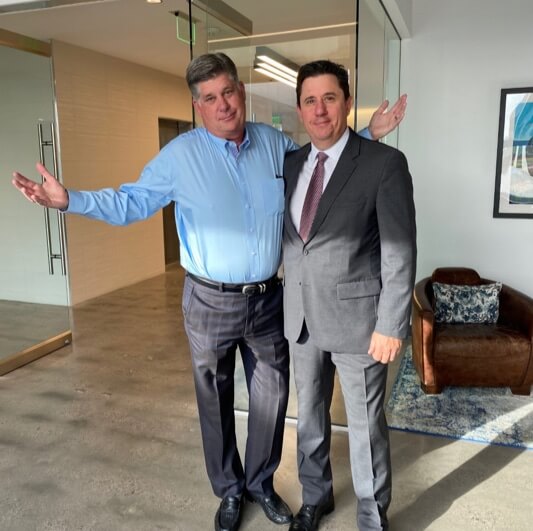
That union still defines the menu. LT researches customers, develops brands and campaigns, buys media, handles PR and social, produces video, builds websites and ecommerce systems, maps journeys, runs CRM and email, and measures performance. With sister consultancy Convince & Convert, it also sells deeper content, customer-experience and AI guidance. The customers are organizations with journeys complicated enough to punish a bad handoff: casinos selling an entire resort experience, healthcare systems moving anxious patients toward care, universities guiding applicants through enrollment, franchises balancing a national brand with local demand.
More tickets, fewer dollars, no winning record required
Consider the Phoenix Suns engagement. The team was coming off two dismal seasons. Empty seats were not a theoretical problem. LT segmented games, built awareness and nurture campaigns, and changed creative according to the opponent, day and expected demand. In the first season, the agency reports that single-game ticket revenue more than doubled from $890,000 to $1.9 million, with return on ad spend reaching 4.73.
Then came the useful constraint: a 25 percent budget reduction. LT applied a season of attribution data, moved money across the media mix and responded quickly to events. After the Suns made a draft pick, creative was live before 8:45 the next morning, less than twelve hours later. The published result was a 24 percent lower budget, 31 percent higher return on ad spend and an ROAS of 6.23. In the cost terms LT discloses, the engagement ran on less media money than the year before.
The first thing that had failed was the product story itself: the basketball team was losing. LT could not repair the standings. It could find other reasons to attend, distinguish a Tuesday game from a Saturday game, and stop treating every prospective buyer as the same fan. The tactic works when demand has more than one motive. It will not manufacture product satisfaction indefinitely when the underlying experience keeps disappointing people.

The ad can work perfectly and the next click can ruin it
For NextCare, a large urgent-care operator, the problem was not simply to make a handsome website. A sick person needed to find the nearest location, see an accurate wait, schedule a visit and get directions without thinking like a database administrator. LT connected location search to live information and limited a costly map API call to the pages that needed it. The agency says the architecture saved as much as 94 percent a month in API expense. It also reports increases of 128 percent in organic online appointments and 113 percent in direct online appointments.
For Barrow Brain and Spine, stakeholder interviews and market research led to a new name, voice, visual system and patient-centered website. LT reports increases of 600 percent in scheduled surgeries, 400 percent in appointment requests and 195 percent in online scheduling. Those are client-reported case-study outcomes, not controlled experiments. They are still revealing because the unit of work is not an ad, logo or page. It is the journey from uncertainty to the next useful action.
Where LT fits: between a narrow specialist and a global holding-company agency. It offers enough disciplines to own a connected journey, with the independence and vertical focus to work closely with a client's team.
Four moves that do not require hiring an agency
Give research veto power
Decide in advance which finding would make you cancel or redirect the obvious tactic.
Measure the handoff
Track the path from message to action. A good campaign cannot rescue a broken booking flow.
Segment the occasion
A weak Tuesday and a packed Saturday are different products, even when the seat is the same.
Count operating waste
API calls, staff work and technical debt belong in the marketing return, not in somebody else's spreadsheet.
These moves have conditions. Integrated work needs access to customer data, technical systems and the people who operate them. Attribution must be credible enough to move budgets. A client must tolerate research that rejects an executive's favorite idea. And one agency spanning research, brand, media and development must maintain real depth in each discipline; integration becomes a liability when it is merely a longer services page.
LT's own history is an exercise in editing. E.B. Lane acquired digital depth through a merger. The combined firm absorbed Cramer-Krasselt's Phoenix operation in 2016. In 2024, after years of people stumbling over “LaneTerralever,” it adopted the name clients already used: LT. In 2025, Chase Lane, Ed's grandson, became chief executive while Beau Lane and Chris Johnson moved to co-chairman roles. Chase came through the Air Force Academy, management consulting, higher education and casino supplier Light & Wonder rather than climbing only through advertising.
That handoff could have been presented as a family keepsake. It is more interesting as a test. “There's a weight that comes with stepping into something that's built over generations,” Chase has said. A third-generation leader inherits relationships and recognition, but also every habit made respectable by age. LT now publishes industry research on casino players, education and customer experience while expanding its national consulting reach. Its advantage will persist if those findings are allowed to make the agency uncomfortable.
Sixty-four years is not proof that every old idea worked. It is proof that enough of them were replaced.
Back at the lottery, the jackpot climbs past $200 million. The agency's clever move is to become quiet. That silence is not modesty, exactly. It is a wager that the job is to improve the result, even when the best-performing advertisement is the one you do not buy.