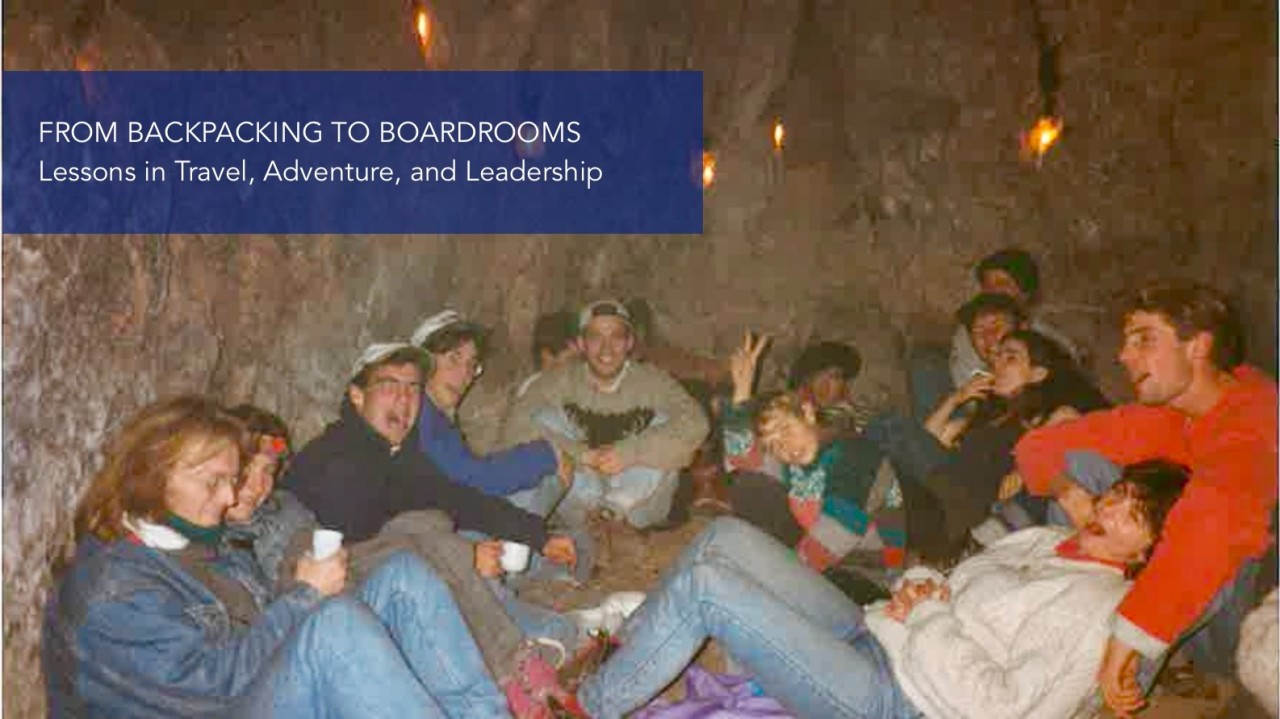
The useful detail in Sean Taggart's story is not that he once spent Christmas in a cave on Crete. It is what happened before and after. He had left university for a year, crossed 14 European countries with a backpack, slept where he could when hostels closed and banks were shut, and took odd jobs to stay moving. He picked oranges in Spain. He bartended in Ireland. In Athens, after his best friend climbed into a semi-truck bound for London, Taggart stood alone at the Port of Piraeus and had to decide what came next.
He found work at a youth hostel in the Plaka district. The job put him in the path of strangers arriving from everywhere, each carrying a different expectation of a place they had never seen. Taggart later wrote that travelling alone was when he gained confidence, found his voice and learned to connect with people from all walks of life. The cave came later: about 20 travellers sharing food, games and stories through Christmas and New Year's. It was improvised hospitality, held together by attention rather than polish.
That year did more than furnish anecdotes. It pointed him toward hospitality, where a feeling has to survive a thousand operational details. It also gave him a question that has followed him through three decades of marketing: why do some places stay with us?
The statistician enters the lobby
Taggart returned to Canada with a taste for travel and completed a degree in statistical science at the University of Western Ontario. It is an unusually revealing credential for a future brand executive. Statistics trains the eye to look for signal, to question the easy explanation and to separate a pattern from a hunch. His early work at IBM put that training close to the customer. He held database and integrated marketing roles and, before leaving, had provided senior leadership to a team of more than 30 marketing professionals.
In June 2001 he joined Fairmont Hotels & Resorts. By 2004, he had been named executive director of marketing services, responsible for direct marketing, guest data, relationship marketing and partnerships. This was before personalization became a default slide in every marketing presentation. Fairmont was trying to turn scattered knowledge of guests into a system: what they preferred, where they travelled, how frequently they stayed and what might make the next visit easier.
When better customer knowledge met direct marketing
Reported response rates for Fairmont direct-mail programs as the company deepened its guest information. The change represents a fourfold increase.The response rate on Fairmont's direct-mail programs rose from 0.5 percent to 2 percent as its guest information improved. A number like that can tempt a marketer to make the spreadsheet the protagonist. Taggart's comments at the time kept returning to service. Customer information could uncover revenue, certainly, but it could also help a hotel understand what a guest needed. Data was most useful when it made the stay feel less generic.
MapInfo provides us with a wealth of customer based information and helps us harness this knowledge to uncover new opportunities and revenue streams.Sean Taggart, while at Fairmont
His responsibilities grew with the hotel group. Over 16 years, Taggart progressed to senior vice president of marketing and interim chief marketing officer, with global responsibility across Fairmont, Raffles and Swissôtel. The portfolio covered 115 hotels and 26 residential properties in 34 countries. He developed Fairmont's guest loyalty program, worked across brand, digital, communications, insights, distribution and reservations, and took part in moments such as the opening of Fairmont Baku in Azerbaijan.
An education in crossing borders
By then, travel was both vocation and continuing education. Taggart has visited more than 50 countries across five continents. His own list mixes the grand with the wonderfully specific: sunrise at Angkor Wat, karaoke in Kunshan, a camel at the Great Pyramid of Giza, a run through Venice, skiing indoors in Dubai and swimming with sharks in the Seychelles. These are not presented as trophies. In his telling, each is a small exercise in entering a setting where he does not control the rules.
In 2012 and 2013, he turned that instinct into formal study through Duke University's Global Executive MBA. Residencies took him through Durham, London, Dubai, St. Petersburg, Delhi, Shanghai and Bangkok. He graduated as a Fuqua Scholar, a distinction for students at the top of the class. The program emphasized collaboration across cultures and emotional intelligence, ideas that fit the lessons of his hostel year with more disciplined language.
It was while traveling alone that I grew the most, gaining confidence, finding my voice, and learning to put myself out there and connect with people from all walks of life.Sean Taggart
There is a practical connection between those experiences and his work. Hotels are coordination machines disguised as effortless stays. A global portfolio cannot flatten local difference, yet it still needs a recognizable promise. The marketer has to translate between headquarters and the property, between a data model and a human welcome. Curiosity becomes operational: ask what is different here, then decide what should remain consistent.
From a stay to a life
In 2017, Taggart moved from hotels to Amica Senior Lifestyles as executive vice president and chief marketing officer. The category changed, but the central challenge was familiar. People were not comparing a residence only with another residence. They carried expectations formed by hotels, restaurants and every other service experience in their lives. Taggart argued publicly for segmentation, direct customer research and stories that reflected how individuals imagined their own lives.
He led Amica's rebranding, expanded marketing and sales capabilities, and used digital technology to improve operations and the customer experience. The product was more consequential than a hotel night, but hospitality still offered a useful lens. Design, food, service and local connection all made the brand real. A promise could not sit apart from the operation delivering it.
After a period leading his own Summit Commercial Strategy practice, Taggart joined Empire Communities in 2023 as the homebuilder's first chief marketing officer. The company was expanding across Ontario and the United States. It needed a brand that could travel across markets without feeling imposed on them.
Customer data at IBM
Database and integrated marketing made analysis part of the craft.
Global hospitality at Fairmont
Loyalty, digital systems and brand stewardship scaled across countries.
Experience-led transformation at Amica
A rebrand connected customer research, service and operations.
A homebuilder finds one voice
Empire Communities became Empire Homes amid North American growth.
Great Gulf
Homes, hospitality, commercial development and destinations meet.
The brand beneath the sign
The Empire work became visible in July 2025, when Empire Communities changed its name to Empire Homes. The new identity followed years of workshops across operating regions and external research into what buyers valued. Taggart and vice president Ashley MacLaren described the need for a unified strategy that could support every corner of a growing organization. The rollout included a redesigned website, signage, printed material, a clearer brand architecture and a rebuilt customer journey.
Their language focused less on a dramatic reveal than on partnership. Buyers wanted a builder that listened, understood and stayed beside them through the process. A digital experience mattered because it was one of the places trust could either accumulate or leak away. That is a useful way to see brand work: not as decoration around an operation, but as the pattern a customer notices while moving through it.
Segmentation is useful when it helps a team recognize needs and remove friction.
A promise travels through websites, signs, conversations, handoffs and service.
A common system should make room for the character of each market and place.
Memory, recommendation and repeat choice reveal whether an experience held together.
A larger map
In 2026, Taggart joined Great Gulf Group as chief marketing officer. The move gathers the strands of his career into one portfolio. Great Gulf works across residential living, high-rise projects, commercial development, hospitality and four-season destinations. In his announcement, Taggart pointed to Forma Toronto, Mandarin Oriental Residences in West Palm Beach, Taboo Muskoka Resort & Golf and LiveKillington Vermont. They are different products in different settings, connected by a question about how people choose to live, stay and experience place.
He wrote that some places stay with you: the ones you return to, discuss years later and remember because each detail seemed quietly considered. It reads like a job description, but also like the conclusion of the backpacking story. The hostel in Athens worked because it created connection among arrivals. The cave on Crete became memorable because strangers made a community in it. Fairmont turned guest information into recognition. Empire tried to make a sprawling builder feel coherent at every step.
Great Gulf gives Taggart a larger map on which to test the same instinct. A condo designed with Frank Gehry, a resort in Muskoka and a master-planned community cannot share one personality. They can share a quality of thought. The work is to make strategy visible in details without sanding away what makes a place particular.
Taggart's career has moved from measuring response to shaping environments where the response unfolds over years. Yet the statistician and the traveller remain present. One looks for the pattern. The other knows that a pattern is only the beginning, because every person still arrives carrying a story of their own.