Company Profile / Fintech · CPG Back Office
The Back Office That Decided Spreadsheets Were the Enemy
Alek Koenig left Affirm to build the financial plumbing for the soda, skincare and snack brands blowing up your Instagram feed. The pitch is boring on purpose: stop reconciling five systems by hand.
Every founder of a fast-growing consumer brand eventually meets the same monster, and it is not a competitor. It is a Sunday night, a laptop, and five browser tabs that refuse to agree with each other. A purchase order lives in email. The vendor bill sits in one tool. The payment goes out from the bank. A loan to cover the gap comes from somewhere else entirely. And the inventory count - the number the whole business actually turns on - is a spreadsheet that was last correct on Tuesday.
Settle was built to kill that Sunday night. The San Francisco fintech, founded in 2019 by Alek Koenig, takes the loop that every product business runs on - buy inventory, pay for it, restock, repeat - and puts it inside a single platform. Procurement, accounts payable, inventory management and financing, in one place, talking to each other. It is not a flashy pitch. That is rather the point.
01 / The ideaAn underwriter looks at consumer brands and sees a cash problem
Koenig did not arrive from the world of direct-to-consumer marketing. He came from credit. He started his career at Capital One and then spent years on the underwriting and credit team at Affirm, the buy-now-pay-later company, where the daily work is estimating who will pay you back and when. That background matters, because it shaped how he read the CPG boom.
The brands exploding across Instagram - the seltzers, the pimple patches, the protein powders - rarely fail because nobody wants the product. They stall because their cash is frozen inside inventory they have already bought but not yet sold. You pay a manufacturer today and collect from customers months later. Grow too fast and the gap swallows you. To an underwriter, that is not a tragedy. It is a market.
Settle is well positioned to transform how small businesses leverage their inventory and finance operations. Alek Koenig, CEO & Founder
So Settle started with the least glamorous job in the building - paying the bills - and treated it as a wedge. Get a brand to run its accounts payable through Settle, and Settle can suddenly see everything: who a brand owes, how much, how often, and how reliably the money comes back. That data is the raw material for a lending business. The invoice nobody wants to read turns out to be the most honest financial statement a brand has.
There is a discipline in that sequencing. Plenty of fintechs lead with the loan because lending is where the margin is, then scramble to earn the data that would let them price risk properly. Settle ran it backwards. It earned the boring workflow first, built up months of real payment behavior, and only then turned that behavior into credit. An underwriter would call that adverse-selection defense. A founder would just call it knowing your customer before you write them a check.
02 / The productFour jobs that used to need four logins
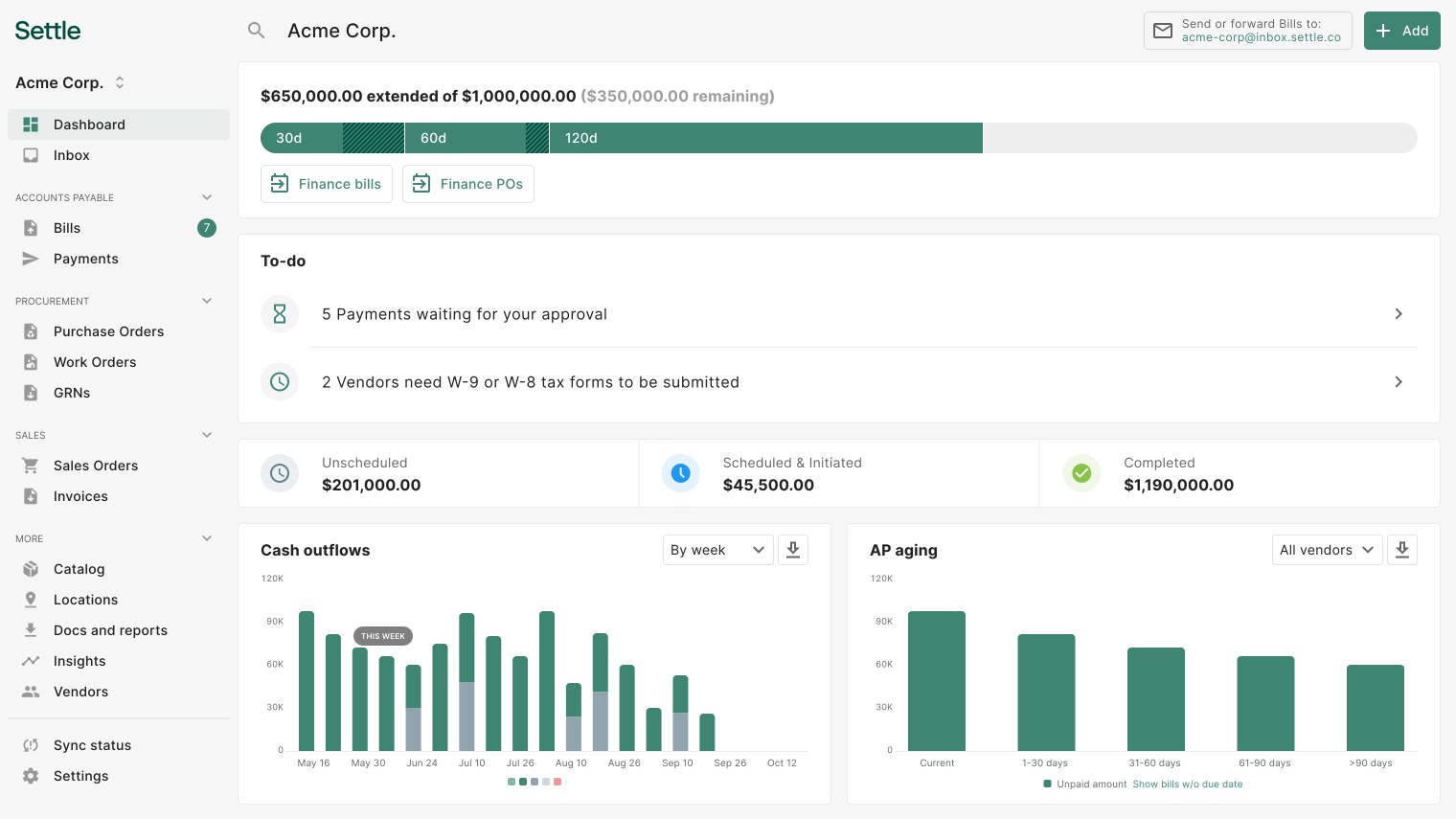
The clearest way to understand Settle is to follow one box of product through it. A brand creates a purchase order for, say, 10,000 units. Settle tracks the order, records the goods when they arrive, and calculates the true landed cost - not just the sticker price, but freight, duties and packaging folded in, so the brand actually knows its margin. When the vendor invoice lands, Settle runs an automatic three-way match, checking the bill against the purchase order and the receipt. If the numbers disagree, it flags them before a cent moves.
That matching step is not a footnote. By Settle's own account, the automatic three-way match surfaced an average of about $273,000 in vendor billing discrepancies per brand within six months - money that was quietly leaking out through duplicate charges, wrong quantities and price creep. It is the kind of number that makes a finance lead forgive a lot of onboarding friction.
Then comes the part that makes Settle a fintech rather than a workflow app: the money. Because Settle already sees the bills and the buying patterns, it can offer non-dilutive working capital - roughly $20,000 to $15 million - underwritten off that data, approved in days rather than weeks, and repaid on flexible terms of 30 to 120 days. A brand can finance the vendor bill tied to a purchase order and pay it back once the product sells, without handing an equity slice to an investor.
What you can actually do with it
Raise a purchase order, see your real landed cost before you pay, catch a wrong invoice automatically, pay the vendor by ACH or wire, borrow against that bill if cash is tight, and watch inventory and cash update in the same screen - instead of exporting four reports and reconciling them by hand.
03 / The turnBuying Turbine to see the goods, not just the invoices
For its first years, Settle could see a brand's money in fine detail but only glimpse the physical goods behind it. In October 2024 it fixed that by acquiring Turbine, an inventory-management startup, and folding its forecasting and real-time inventory tools into the platform. The same launch introduced a combined finance-and-inventory suite: SKU-level landed costs, AI-assisted demand forecasting, and auto-sync to Shopify and third-party logistics providers.
The strategic logic is worth stealing. A brand operator was, in Settle's telling, updating five separate systems every time a single SKU changed. Owning inventory alongside payables meant Settle could move from knowing what you owe to knowing what you hold and what you will need next. Proximity to the transaction - and now to the goods themselves - is the moat.
I don't look at the spreadsheet at all anymore - it all exists within Settle now. A Settle customer
04 / The customersThe brands already in your cart
Settle's roster reads like a screenshot of a Gen-Z shopping cart: Olipop soda, Rhode skincare, Starface pimple patches, Pat McGrath makeup, HigherDose infrared gear, plus Branch, Bubble Skincare, Arrae, Birddogs, Gruns, Madhappy and Ceremonia. These are not garage projects; they are brands scaling fast enough that cash timing becomes existential. That is exactly the customer Settle wants - past the earliest stage, growing, and feeling the squeeze of inventory that outpaces revenue.
Notably, Settle's own go-to-market has matured with its customers. Early on it sold to founders directly. As it scaled, it began selling to finance leaders and CFOs, and building channel relationships with accounting and fractional-finance firms that bring brands onto the platform. The product grew up, and so did the buyer.
The category framing helps too. Settle describes hundreds of high-growth consumer brands on the platform, and the through-line is a specific pain: the mismatch between when you pay for goods and when customers pay you. Serve enough of these brands and the data compounds. Settle is not underwriting one seltzer company in isolation - it is watching how an entire cohort of consumer brands buys, restocks and repays, which is a vantage point most banks lending into the same space simply do not have.
05 / The money behind the moneyTwo kinds of capital
A lending fintech needs two very different wallets, and Settle's funding history is a clean illustration of both. There is equity to build the company - a $15 million Series A led by Kleiner Perkins in 2021, followed by a $60 million Series B the same year, with Founders Fund, Activant Capital, Ribbit Capital and Max Levchin's SciFi VC across the cap table. And there is debt to lend out - a $280 million debt facility in 2022 and a $145 million credit facility from Silicon Valley Bank in 2023. One kind of money pays the engineers; the other becomes the working capital brands borrow.
06 / The competitionWhy bundle when everyone else specializes
Settle is surrounded, but from four different directions. On accounts payable and spend, it bumps into Bill.com, Ramp and Brex. On inventory and forecasting, it sits near Cin7, Cogsy and Inventory Planner. On CPG financing, it competes with Wayflyer, Parafin, Clearco and Dwight Funding. Each of those rivals is sharp at one thing. Settle's bet is that a consumer-brand operator does not want the best point tool in four categories - they want one loop that does not require them to reconcile between tools at all.
That is the wager: consolidation over specialization. It is a harder product to build and a stickier one to leave. If Settle is the tab where you buy inventory, pay for it, and borrow against it, switching away means rebuilding your entire back office - and giving up the lender who can already read your books better than your bank can.
Whether that bundle wins everywhere is still an open question. A brand with a great ERP and a cheap line of credit may not need it. But for the mid-market consumer brand growing faster than its cash can keep up, Settle is selling the one thing that stage of company never has enough of: time, and the money to buy more inventory before the last batch sells out.