Breaking
Order.co manages $500M+ in annualized spend
Named AI Procurement Platform of the Year, 2025
WeWork, SoulCycle & Hugo Boss buy through Order
17,000+ vendor network, one consolidated bill
Inc. 5000 fastest-growing companies, three times over
Average 5% savings via AI-powered sourcing
Order.co manages $500M+ in annualized spend
Named AI Procurement Platform of the Year, 2025
WeWork, SoulCycle & Hugo Boss buy through Order
17,000+ vendor network, one consolidated bill
Inc. 5000 fastest-growing companies, three times over
Average 5% savings via AI-powered sourcing
It is a Tuesday at a 100-location fitness chain, and somewhere a regional manager is buying paper towels. Not one order - forty of them, across a dozen vendors, each with its own login, its own invoice, its own polite reminder that payment is now overdue. Multiply that by every location, every category, every month. This is the quiet, expensive churn that Order.co was built to stop.
Buying for a business shouldn't require a spreadsheet, a prayer, and three people in accounts payable.
The premise, more or less, that started the company
Order.co is, by its own description, a spend efficiency platform - which is a tidy way of saying it runs the back office of buying. Procurement, approvals, payments, and reporting, normally scattered across email threads and a graveyard of browser tabs, get pulled into a single system. Today the company sits in New York's Flatiron district, employs roughly 270 people, and oversees more than half a billion dollars in annualized spend on behalf of its customers. That is a lot of paper towels.
The customers are not small. WeWork routes its accounts payable through it. SoulCycle centralizes purchasing across nearly a hundred studios on it. Hugo Boss and the cannabis retailer Canna Provisions are on the roster too. These are companies with real procurement problems - many vendors, many locations, many invoices - and Order.co's bet is that all of it should feel like a single checkout.
The Problem They Saw
Purchasing was a tax on competent people
Here is the inconvenient truth the founders fixated on: the actual buying is the easy part. The hard part is everything around it. Who approved this? Did we get the right price? Which of the eleven invoices from this vendor have we already paid? A finance team can spend more energy reconciling a purchase than the purchase was worth - which is, when you think about it, an elegant way to lose money.
Most software answered half the question. A marketplace let you buy but not control spend. An approval tool controlled spend but didn't touch payment. An AP automation tool handled invoices but never saw the order that created them. The work fell into the seams between products, and the seams are where finance teams quietly drown.
The work didn't fall through the cracks. The work was the cracks.
On why point solutions kept missing the problem
WeWork, doing the math one way, figured it would need to hire roughly 150 people in accounts payable just to keep up with its invoice volume. That is not a software problem anymore - that is a headcount problem dressed as a software problem. The pitch writes itself: what if the system matched the purchase order to the invoice to the payment automatically, and no one had to be employee number 150?
The Founders' Bet
Three founders, one stubborn idea
In 2016, Zach Garippa, Tom Jaklitsch, and Matt Garippa launched the company under a name almost no one could spell: Negotiatus. It came from "negotiation" - the romantic notion that in a good deal, buyer, payer, and vendor all walk away happy. It was a fine idea and a terrible word. People mispronounced it, misspelled it, and occasionally gave up halfway through.
The bet underneath the awkward name was sound. Build a guided B2B marketplace with the financial plumbing baked in - so that buying, approving, and paying lived in one place rather than three. Start narrow, with the purchasing teams who felt the pain most, then expand outward into payments and spend management as trust accumulated.
If we can delight users and bring order to their purchasing workflow while saving them money, it's a no-brainer.
- Jay Po, Stage 2 Capital, on backing the company
By January 2022 the idea had outgrown its name. Negotiatus rebranded to Order.co and raised a $30M Series B led by Stage 2 Capital, with a direct check from MIT's endowment and participation from Clocktower Ventures, Collaborative Fund, and Salesforce's former president and CFO, Mark Hawkins. The new name did two jobs at once: it described the product - bringing order - and it described the verb the whole thing revolved around. Also, blessedly, you could spell it.
The Product
One platform, doing the boring parts well
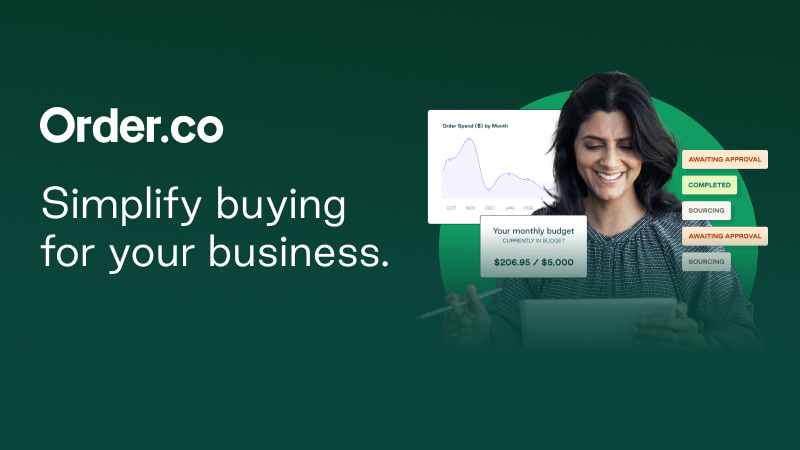
What Order.co sells is unglamorous on purpose. The magic is that the unglamorous things connect. You buy from a custom catalog or let an AI sourcing agent comb 17,000-plus vendors for the best price and delivery. The purchase hits your approval workflow. The invoice gets matched - purchase order, receipt, and bill, three-way reconciled - without a human squinting at PDFs. At month's end, the dozens of vendor invoices arrive as one bill, paid on the terms you prefer.
Procurement
AI sourcing across a 17K+ vendor network plus custom catalogs, averaging 5% savings on goods.
AP Automation
Automatic three-way PO matching and invoice reconciliation - no army of clerks required.
Spend Management
Custom budgets and approvals with real-time spend by user, location, cost center, or vendor.
Payments & Cards
Consolidated billing, virtual cards, and flexible net terms - pay one bill, your way.
AI Command Center
Agents that analyze spend, build optimized carts, track deliveries, and weigh vendor alternatives.
ERP Integrations
Direct hooks into QuickBooks Online, Sage Intacct, NetSuite, and the rest of the finance stack.
The AI agents anticipate and proactively resolve customers' most tedious procurement challenges.
- Zach Garippa, Co-Founder & CEO
The proof is in the dull, lovely details. SoulCycle, as it grew toward a hundred studios, used Order.co to centralize purchasing and pick up substitution options - and now earns more than $7,000 a month in rewards simply by buying through one system. WeWork got its three-way match and skipped the 150-person hire. None of this makes for a thrilling movie. It makes for a much calmer finance department, which is the same thing to anyone who has ever worked in one.
Order.co does not sell excitement. It sells the absence of a problem - which is harder, and worth more.
On the quiet economics of spend efficiency
The Mission
Simplify buying. Then keep simplifying.
The stated mission has barely moved in a decade: simplify buying for businesses. What has moved is the ceiling on what "simplify" means. In 2016 it meant a marketplace with fewer logins. In 2025 it means AI agents that read your spend trends, build the optimized cart, send the purchase order, and flag the cheaper vendor before you thought to ask. The destination is a procurement function that mostly runs itself, supervised rather than operated.
There is a competitive crowd here - Coupa, Ramp, Procurify, Airbase all want the same CFO's attention. Order.co's wager is that owning the whole loop, from sourcing to payment to reconciliation, beats owning one tidy slice of it. The seams, again, are the point.
The win condition isn't more software. It's fewer decisions a human has to babysit.
- The throughline from Negotiatus to the AI Command Center
Why It Matters Tomorrow
Back to that Tuesday
Return to the regional manager and the paper towels. In the old world, that order spawned a dozen logins, a dozen invoices, and a slow-motion reconciliation that someone in finance would untangle weeks later, by hand, possibly while questioning their career. In the world Order.co is building, that same order is a few clicks - sourced by an agent, approved on policy, matched automatically, settled in one bill the manager never has to think about again.
That is the whole company, really. Not the awards, not the funding rounds, not the agents - those are evidence, not the point. The point is that competent people stop paying a tax on competence. The buying gets out of the way. And the most expensive thing a growing business owns - the attention of the people who run it - goes back to running the business. Order.co's name turned out to be a verb and a promise. Mostly, it kept the promise.