He noticed one person clicking between forty browser tabs to order syringes. Then he built Vetcove so nobody would have to again.
Most founders chase glamour. Alexander Kates chased the thing nobody wanted to look at: the boring, expensive, tab-cluttered way veterinary practices buy their supplies. Today he is cofounder and CEO of Vetcove, a free ordering platform where a clinic, a shelter, a zoo or an aquarium can shop every veterinary vendor at once and watch the prices line up side by side.
The pitch is almost rude in its simplicity. Vetcove is, in Kates' own framing, Kayak.com for veterinary hospitals. You search once. You see distributors, manufacturers, compounding pharmacies, diagnostic labs and office-supply companies competing for the same order. You buy. The hours a practice used to lose to comparison shopping come back, and so does the margin.
What makes the company unusual is the price tag, or the lack of one. The platform is free to the practices that use it. That decision tells you something about how Kates thinks: get the tool into every clinic, remove every reason to say no, and let scale do the heavy lifting. By 2024 the company reported roughly 26.6 million dollars in revenue and a team that had grown into the hundreds.
He runs it from Miami, a long way from the Ivy League lecture halls and Fortune 500 boardrooms where he spent the first chapter of his career. The throughline is consistent. Kates has always been interested in the unglamorous machinery underneath a business, and in making it run faster.
Vetcove's customers are not only the obvious ones. Alongside everyday veterinary clinics sit zoos, aquariums and animal welfare organizations, the institutions whose ordering complexity is enormous and whose budgets are tight. For a nonprofit shelter, a few percentage points off the supply bill is not a rounding error. It is more animals helped.
The work is deeply unsexy and that is precisely the point. Supply chains do not trend on social media. But the people who keep animals alive spend a startling share of their week wrestling with procurement, and Kates built a business by taking that weight off their desks.
He did not get here by accident. Before the syringes and the stock alerts, there was a textbook, a network of executive students on four continents, and a Cornell degree he reportedly finished at the top of his class.
Vetcove is Kayak.com for veterinary hospitals - search once, see every vendor, buy the smart way. — the idea, in one sentence
Alex's father is an equine veterinarian. His practice ran five doctors, and somewhere in the back office an inventory manager held the whole operation together with sheer patience. Her job, day after day, was to click from one browser tab to the next - distributor, manufacturer, compounding pharmacy, diagnostic lab, office-supply vendor - building a single order across somewhere between thirty and forty suppliers.
Alex and his brother Mitch watched this happen and could not unsee it. Here was a smart person spending hours on a problem a computer should solve in seconds. The waste was not exotic. It was just hiding in plain sight, repeated in tens of thousands of practices across the country.
So the brothers divided the labor the way siblings sometimes do best. Alex would run the company. Mitch, a machine-learning engineer, would build the technology that made forty vendors behave like one. Vetcove was born in 2015 out of that frustration and that family table.
The founding story has no garage myth, no eureka in a coffee shop. It has an overworked inventory manager and two brothers who decided her afternoon was worth getting back. That is a more honest origin than most, and a more useful one.
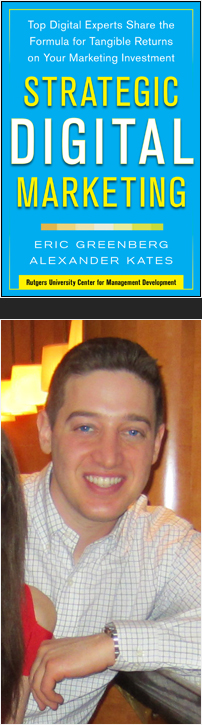
Long before he thought about backorder alerts, Kates was a digital strategist with a teacher's instinct. He co-wrote Strategic Digital Marketing, published by McGraw Hill in 2013, which became a bestseller in nine countries and found its way onto the syllabus of more than a dozen MBA programs. Plenty of marketers have opinions. Far fewer get graded on by graduate students.
He took that knowledge on the road. Through the GRX network and stints at Rutgers, Baruch, Syracuse and the Digital Marketing Institute, he trained executives from companies like Johnson & Johnson, Roche, Fujifilm-Sonosite, Microsoft and Verizon, on four continents.
His specialties read like a tour of the last decade of the internet: digital consumer behavior, mobile strategy, eCommerce, content, the Internet of Things, virtual and augmented reality, and gamification. It is an eclectic résumé that, in hindsight, was excellent preparation for building consumer-grade software for an industry that had been stuck with clunky tools.
The transition from teaching commerce to running it is not as common as it sounds. Kates made the jump and pointed all that accumulated marketplace knowledge at a single, neglected corner of the economy.
Figures from public company data and reporting. Bars are illustrative, scaled for comparison.
Make the tool free to the people who use it. Remove every excuse to say no. Let scale carry the business model.
Supply chains do not trend. That is exactly why fixing them is so valuable - and why so few people bother.
He runs the company; brother Mitch builds the machine learning. A clean split between business and code.
A bestselling author and longtime instructor, he applied a decade of marketplace theory to a real one.
Not just clinics - zoos, aquariums and nonprofit shelters, where every dollar saved means more animals helped.
The whole product is built around one act of mercy: never make a human do a machine's comparison shopping.
The mission is unglamorous and enormous: make the veterinary supply chain so efficient that the people caring for animals get their time, and their margin, back. — the aspiration behind Vetcove
Alex introduces Vetcove and walks through the founding story on The Veterinary Life Coach Podcast, Episode #113.