Sarah Hein’s company has a name that sounds as though someone paid a branding agency to suggest forward motion. The explanation is more companionable. Hein likes Houston’s March weather, and the founders happened to meet that month. “And we actually got together in March,” she explained. A company name, a meeting, a weather preference. The minutes practically wrote themselves.
That small origin suits a career built through introductions, workshops, overlapping jobs and the practical business of getting people together. Hein, the CEO and co-founder of March Biosciences, trained as a molecular and cellular biologist. Along the way, she became interested in what happens when an idea leaves the university and needs a company around it. Her working life has since crossed research, venture investing, operations and entrepreneurship education.
There is a temptation to arrange those roles into a tidy staircase. Her record suggests a busier building. Research and development positions overlapped. Teaching appeared alongside venture work. Before she was running March, she was helping other people learn how startups work. Houston supplied the institutions and introductions; Hein kept finding another reason to stay in the conversation.
The second education
Before Houston, there was the University of Wyoming. Hein completed a bachelor’s degree in molecular biology with honors in 2009, followed by a master’s in reproductive biology in 2010. She then moved to Baylor College of Medicine for doctoral study, completing her PhD in 2016. The academic sequence is straightforward. The interests she developed during it were less confined to the course catalogue.
While a graduate student, she joined Enventure, a community organized around life science entrepreneurship. She became a core member and helped launch its Foundations workshop series. The purpose was practical: give people in the Texas Medical Center community a more substantial education in starting companies. It was an early instance of a recurring interest in her career, making the mechanics of entrepreneurship available to people trained for something else.
Foundations is a nicely unglamorous name. It promises the part of the building that usually stays out of the photograph. That emphasis belongs in Hein’s story because her route into business included helping construct an educational program before she had accumulated the executive titles that now follow her name. She was learning a new profession while helping create a place for others to learn it.
In 2016, she also worked as a graduate teaching assistant at Rice University for a course on life science entrepreneurship. Her doctorate was ending, and the commercial questions had become part of her working life. The move into a venture fellowship at Mercury Fund followed. For a scientist interested in companies, it offered a seat on the side of the table where ideas must compete for money.
- 2009University of Wyoming
Bachelor’s degree - 2016Baylor PhD
Mercury venture fellowship - 2020TMC Innovation
Entrepreneur in residence - 2024March Biosciences
$28.4m Series A
Several jobs, one growing skill set
Hein helped found Courier Therapeutics in 2016. She served as director of development before becoming vice president of operations in 2019. In the same broad period, she was director of research at Resonant Therapeutics. Those are different sorts of responsibility: building a development program, managing operations and directing research. Together they put the business of science into her daily work from several directions.
Courier was later acquired by Valo. The acquisition became a milestone in her biography, but the jobs preceding it explain more about her preparation for March. Operations means a company has obligations beyond an interesting idea. Development means deciding what needs to happen next. Research supplies the questions and evidence on which those decisions depend. Her experience crossed all three.
She has described learning to reduce both actual risk and the risk other people perceive. The distinction is useful. A founder may understand why an approach can work and still need to show an investor why a specific obstacle is manageable. Between the large milestones are smaller decisions that require people, time and money. Her interest in that interval gives the executive résumé some texture.
It also helps explain why partnerships recur so often in her account of building March. A young company cannot assume that every capability it needs will be sitting inside its own office. Finding someone who already knows a difficult piece of the work becomes part of the design of the business. The introduction matters because the work attached to it matters.
The job that supplied the co-founders
In 2020, Hein became the founding entrepreneur in residence for a TMC Innovation accelerator. The title can sound as though entrepreneurship has finally been issued a comfortable chair. In her case, the position became the setting for another company. Through the program, she met Max Mamonkin and later Malcolm Brenner, the scientists with whom she would establish March.
By then she had seen startups from several positions: as a founder, an operator, a research director and a venture fellow. The residency brought those experiences back into an institutional setting, where people were considering which academic projects could become businesses. The connections that formed there were specific enough to become a founding team.
When Hein later described the company’s beginnings, she put experienced people near the start of the story. She spoke about mentors and early team members who understood the difficulties ahead. Her phrase for that knowledge was “where the rocks under the water might be.” It is an unusually useful image for business advice: the value lies in knowing the location of the thing you cannot yet see.
“When we started March we started with the people”
Sarah Hein
The residency is therefore more than a line between two employers. It links her earlier company-building experience to the collaborators who would shape the next venture. The story does not require a chance encounter to be dressed up as destiny. A program brought people into contact, and they found work they wanted to do together.
A prize, then a larger table
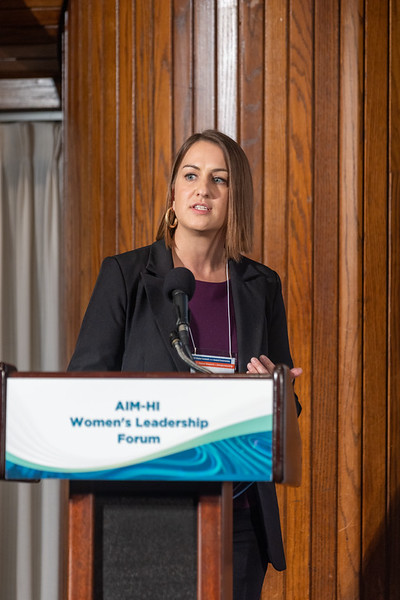
In October 2023, Hein and March received First Prize with Distinction in the AIM-HI Women’s Venture Competition. The organizers had received 71 applications from companies led by women in 15 countries. Recognition came at the National Press Club in Washington, D.C. For a Houston founder, it was an occasion to carry the company’s name into another room.
The following October brought a different kind of announcement. March closed a $28.4 million Series A financing led by Mission BioCapital and 4BIO Capital. Existing investors participated alongside new ones. A funding announcement can look like a single large number; inside the company, it also changes the group of people with whom the CEO works.
The financing announcement included new board members Cassidy Blundell of Mission BioCapital and Owen Smith of 4BIO Capital. Stefan Wildt, co-founder and CEO of Volnay Therapeutics, also joined the board as March announced a partnership with his company. Financing, governance and outside expertise arrived in the same announcement. The round put more than cash around the founding team.
Led by Mission BioCapital and 4BIO Capital.
That combination fits Hein’s earlier emphasis on finding people who have already encountered the obstacles. March had also established a partnership with CTMC in Houston. In her accounts of the company’s development, relationships with specialist organizations occupy real space. She discusses the business through the work those partners can help accomplish.
The classroom keeps appearing
The teaching thread continued after Hein became a CEO. She appeared among the speakers for the Gulf Coast Consortia’s 2023 development course. The 2024 Texas Life Science Forum placed her on a “Meet the Founders” panel about Portal Houston, alongside Bhuvanesh Dave and Derrell Porter. The setting changed from student workshops to professional panels, but she kept returning to rooms where people compare the experience of building.
There is a related detail in an earlier forum biography: she volunteered with the Prison Entrepreneurship Program, which helps incarcerated men prepare for economic independence after release. It belongs beside Foundations and the Rice teaching role because all three involve access to business knowledge. These are distinct activities, separated by audience and setting, with entrepreneurship education running through them.
Her public life includes explaining the work as well as doing it. A 2024 appearance on Building Biotechs covered her passage from academia into entrepreneurship and the use of partnerships in a young company. Later that year, she joined the Houston Innovators Podcast to discuss March’s growth and the local community around it. The scientist who sought out a startup education had become someone other founders could listen to.
A little room for growing things
The older forum biography also offers a less corporate inventory: coding, gardening, growing things, and time with her husband and dogs. These details deserve to remain pleasantly ordinary. Gardening need not become a theory of executive leadership. A person can run a company and also want something in the garden to survive the week.
Hein’s story has enough movement without improving those details into symbolism. Wyoming led to Houston. Doctoral work overlapped with an education in entrepreneurship. Workshops, venture work, research and operations preceded another founding team. The company bearing a month’s name grew into a business with outside investors, partners and a board.
Through those changes, her accounts repeatedly return to the people who make a next step possible. For someone whose job requires explaining complicated work, the company name remains disarmingly easy to explain. The founders got together in March. Houston offered agreeable weather. Then there was a company to build.
Keep the conversation going
- March Biosciences / Company website
- Sarah Hein / LinkedIn
- Watch / Building Biotechs conversation
- Listen / Partnerships and starting a company
- Listen / Houston Innovators, October 2024
- Read / A conversation with Hein, May 2025
- Read / The entrepreneur in residence experience
- Read / October 2024 financing announcement