By the time Bonnie Anderson took a company public, she had spent years moving sideways. A new business segment. A different technology. Another job that widened her experience without necessarily improving her place on an organization chart. The conventional career ladder has a certain elegance, provided you enjoy looking at the same wall. Anderson kept changing the view.
In 2013, she led Veracyte onto Nasdaq. A decade later, after handing over the chief executive’s job and leaving its board, she was preparing another company for its public introduction. PinkDx announced its launch in April 2024 with $40 million in Series A financing. Anderson had returned to the founder’s desk with a long apprenticeship behind her and another beginning in front of her.
Her career invites a question that the tidy executive biography tends to avoid: how much of getting ahead depends on being willing to go across? For Anderson, the detours were substantial enough to become the route.
The education between the job titles
Anderson graduated from Indiana University of Pennsylvania in 1980. She grew up in the town where the university stands. Much later, when invited to choose anyone for an imagined breakfast, she chose her parents. She credited the values they gave her with carrying her into a career she had never anticipated. The distance between that beginning and a public company boardroom can look considerable on a map of American business.
Her education continued inside Beckman Coulter, where she spent 18 years in leadership positions. That is a substantial stretch of a working life to devote to one organization. It also offered room to run different kinds of businesses, learn different functions and discover how an established company actually operates. Anderson eventually led an internal startup division, giving her experience of entrepreneurship with a corporate roof overhead.
She later worked as a strategic consultant to venture capital firms and young businesses. By 2008, she was co-founder and chief executive of Veracyte. The transition brought together two kinds of experience: running operations within a large organization and helping businesses that were still being formed. One required understanding existing machinery; the other required deciding what machinery to build.
“I was an opportunistic career developer.”Bonnie Anderson, 2014
That description is more revealing than the usual list of promotions. Anderson explained that she accepted lateral moves to learn unfamiliar segments and technologies. The next position did not have to be higher to be useful. Read that way, her time at Beckman Coulter becomes an accumulation of perspectives, each acquired before she needed to combine them in a company of her own.
Five million shares, and a much longer job
On October 30, 2013, Veracyte entered the public markets. It sold five million shares at $13 each, raising $65 million before expenses. The first trading day ended at $13.25. Those numbers provide a pleasantly compact account of an IPO: a price, a quantity and a closing bell. The work required to arrive there is rather harder to fit on a commemorative plaque.
Gross IPO proceeds, before expenses
Anderson had been chief executive since 2008. An IPO after roughly five years of company building made a visible milestone, but it also opened the business to a new set of expectations. Investors could now buy or sell their judgment of its future every trading day. Building the organization continued while the audience grew and the score became public.
She was attentive to the people standing beside her. Recalling the offering the following year, Anderson pointed out that her chief financial officer was also a woman and that much of the IPO team was female. In an industry whose leadership she described as predominantly male, the composition of that team mattered to her. The memory included who got to do the work, as well as what the transaction raised.
Her advice around that period was consistent with the commitment the job demanded. Mentors could be men or women; the useful qualities were trust, candid feedback and help developing confidence. Advancement required learning to take responsibility while remaining open to correction. It is a less glamorous prescription than having perfect instincts, and considerably easier for other people to put into practice.
Creativity can involve buying someone lunch
Fast Company included Anderson among its 100 Most Creative People in Business in 2015. Asked where she found inspiration, she described a social process: build a network, seek people who challenge your thinking and get comfortable approaching people whose achievements interest you. Lunch featured in the explanation. Apparently the calendar invitation can have its uses.
She also talked about recruiting board members with creative business experience. That is a revealing place to look for imagination. Boards are often discussed in the language of oversight and controls. Anderson’s answer gave them another function: bringing unfamiliar possibilities into the room. The people responsible for asking difficult questions could also help her consider different answers.
Her admiration extended beyond her own industry. She singled out Steve Jobs for the combination of vision, leadership and tenacity behind products that became part of everyday life. The attraction was to the entire undertaking: an idea, the framework supporting it and the persistence needed to make it useful at scale. Her own account of creative work was similarly populated by people, rather than solitary flashes of genius.
This gives a more practical meaning to her broad career. Moving into unfamiliar work supplies one kind of challenge. Inviting someone accomplished to lunch supplies another. Both require accepting that somebody else may see something you have missed. Anderson’s description leaves plenty of room for preparation, conversation and the occasional uncomfortable question.
Knowing when to hand over the keys
In May 2021, Veracyte announced that Marc Stapley would succeed Anderson as chief executive, effective June 1. She moved into the executive chair role. It was a staged handover, with the founder remaining available to advise her successor while responsibility for leading the business passed to someone else. The company she had helped create was continuing with a different person in charge.
Anderson’s own message at the time emphasized the culture of the organization and her confidence in Stapley. Her language was supportive of the team’s next stage. A founder occupies an unusual place in a company’s story: present at its creation, but eventually responsible for helping it operate beyond her daily direction. Succession makes that responsibility concrete.
By 2023, she had asked not to be considered for another board term. Her directorship ended that year. In a farewell message, she thanked Veracyte for 15 years and expressed enthusiasm for creating new things. The phrasing had the cheerful imprecision of someone who knows where her interests lie even when the next public announcement is still ahead.
- 1980Graduates from IUP
- 2008Becomes Veracyte co-founder and CEO
- 2013Leads its Nasdaq IPO
- 2021Hands the CEO role to Marc Stapley
- 2024PinkDx announces its launch
The sequence deserves to be read slowly. Giving up the chief executive’s position, stepping back from the board and starting again are distinct decisions. Anderson made them over time. Her next company arrived with the experience of those transitions attached, including the knowledge that a business can change shape enough to need different leadership.
A second company, with some familiar faces
PinkDx’s founding team included Giulia Kennedy and Tim McMeekan. Kennedy had been Veracyte’s chief scientific officer. McMeekan became PinkDx’s chief financial officer and chief business officer. Anderson took the roles of co-founder, chair and chief executive. The new enterprise brought complementary responsibilities together from the start, with an existing working connection between Anderson and Kennedy.
The April 2024 financing was co-led by Catalio Capital Management and The Production Board, with participation from Mountain Group Partners, Byers Capital and Mayo Clinic. In January 2025, a second close added $5 million, taking the Series A total to $45 million. Blue Venture Fund, Sandbox Clinical Ventures and BEVC joined the investor group.
April 2024 + January 2025 = $45 million Series A
The arithmetic is straightforward. The organizational task is less so. Capital gives a team resources and time; the team must decide how to use them. Anderson has described working with a three-year roadmap, connecting milestones to the financing needed to reach them. Her preference is to identify the problem first and organize the work around it. That approach gives the plan a purpose beyond reaching the next presentation.
The return trip to Indiana
There was another kind of return in 2023. IUP awarded Anderson an honorary Doctor of Science, and she delivered commencement remarks. Forty-three years after graduating, she came back as someone the university was asking its newest graduates to hear. In the ceremony photograph, the formal hood is being lifted into place while she smiles beneath her academic cap. Even a career measured in financing rounds occasionally requires help with the wardrobe.
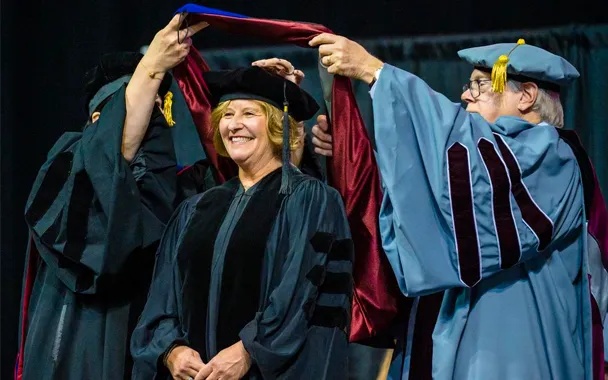
Her ties to the university had continued through service and giving. She and her late husband, Steve, donated $250,000 to its Imagine Unlimited campaign. The Anderson Rotunda in Kopchick Hall was named in memory of her parents, Edward and Donna Harbison. The family connection acquired a physical place on campus, in the town where her story began.
Today, Anderson leads PinkDx and remains involved in institutional leadership, including at Keck Graduate Institute. The available milestones describe someone who has repeatedly changed her relationship to work: employee, internal entrepreneur, consultant, founder, public company chief executive, chair and founder again. Her lateral moves belong in that account as much as the titles at the top. They supplied the experience she could take into the next unfamiliar room.