Before Yael Katz had a doctorate, a boardroom or a venture investor to persuade, she had an offer for parents: their children would learn to swim, or they would get their money back. A teenager selling lessons had given herself a rather unforgiving performance review. The customer could simply get into the pool.
The lessons grew into a summer camp. There were premises to rent, employees to recruit and flyers to distribute. The business helped pay for college. It is an unusually practical opening to the career of someone who would go on to study physics, earn a PhD and become a company founder. Long before the sophisticated models came along, there was a straightforward question: would somebody pay for the thing she could do?
Today Katz is the founder and CEO of Simbryo and the co-founder and former CEO of BrainCheck. Between the swimming lessons and those titles lies a career that includes Princeton research, web video, software entrepreneurship and the unglamorous education of raising money. The route has several turns. Looking at them together, you begin to see how much of her working life has involved getting separate people, ideas and skills to move together.
A summer business with grown-up obligations
A 2001 account of Camp H2O places Katz alongside her friend Rivka Eizik at its beginnings. The operation started with 40 girls and five employees. It subsequently became a licensed camp in Spring Valley, New York, with a program that combined swimming with activities including computer graphics, riding and hiking. The account describes an eight-week season serving 150 girls and employing 30 staff.
Those are the sorts of numbers that make a youthful enterprise sound rather less like pocket money. Thirty employees require organization. A summer program has a deadline that cannot be postponed into autumn because the founder is still refining the concept. Parents expect the camp to open. Children expect something to happen when they arrive.
There is a useful corrective here to the polished origin stories that begin with a pitch deck. Katz had already encountered the plain mechanics of a business: make a promise, find customers, assemble the people needed to deliver it. Whatever came later, this part of her education had a particularly demanding final exam. It involved other people's summer holidays.
Physics, languages and a tank full of questions
At the University of Pennsylvania, Katz studied physics and astronomy alongside Asian and Middle Eastern studies. Her subsequent training took her to Northwestern for a doctorate in biological sciences, with a focus on computational and experimental neuroscience, and then to Princeton for postdoctoral research. The combination spans subjects that university timetables usually keep a respectable distance apart.
That breadth becomes more tangible in the research itself. In 2011, Katz was the first author of a paper examining interactions among schooling fish. The collaborators included Kolbjørn Tunstrøm, Christos Ioannou, Cristián Huepe and Iain Couzin. Rather than beginning and ending with a convincing-looking simulation, the work used experimental observations to investigate the rules behind coordinated movement.
There is an everyday pleasure in the underlying question. A group of fish can turn together without anyone handing out an agenda. Explaining how that happens requires more than admiring the result. You have to investigate the relationships between individuals and the larger pattern those relationships produce. Katz's work belonged to that patient business of finding measurable interactions beneath an apparently effortless performance.
A second study, published in 2013, examined groups of 30 to 300 golden shiners. Katz and her collaborators identified three collective patterns: a loosely ordered swarm, a circulating mill and an aligned group moving together. The fish could shift between them. Group size, movement and disturbances helped shape which pattern appeared.
It is tempting to turn those fish into a management seminar. The comparison has limits: employees have opinions about compensation, and golden shiners have yet to request a revised equity package. Still, the research gives a precise glimpse of Katz's scientific background. She worked on how observable behavior emerges from many interacting parts, with experiments and quantitative analysis sharing the job.
The detour through the play button
Katz's commercial career included consulting and an early role at JW Player, the New York web-video technology company. She became vice president of ecommerce. A Rice conference biography describes responsibilities spanning marketing, strategy and operations. Those functions put her close to the work of bringing a technical product to a market and keeping the organization behind it moving.
Web video might look like a surprising destination after laboratory research. It also offers a fairly direct introduction to scale: a product has to function for users who will never meet its makers. Someone has to explain it, sell it and build a business around it. A clever piece of technology still needs a way into everyday use.
She also founded CountVision, a software venture for laboratory image analysis. Its tools addressed cell counting and fluorescence quantification, work that could otherwise require manual approaches or expensive hardware. Here was a more explicit meeting of her scientific and entrepreneurial experience: a recurring laboratory task, translated into a software proposition. The list of businesses begins to look less random when you pay attention to what each required her to make useful.
“Being an entrepreneur was not a conscious career choice.”
Yael Katz
A pitch is a conversation with consequences
BrainCheck was founded in 2015 by Katz and David Eagleman. The following year, it won Hatch Pitch. The event brought founders before corporate, angel and venture investors, with coaching and feedback built into the competition. Katz's photograph from the event captures the arrangement plainly: a founder on one side, people with questions on the other, and a clock keeping everyone honest.
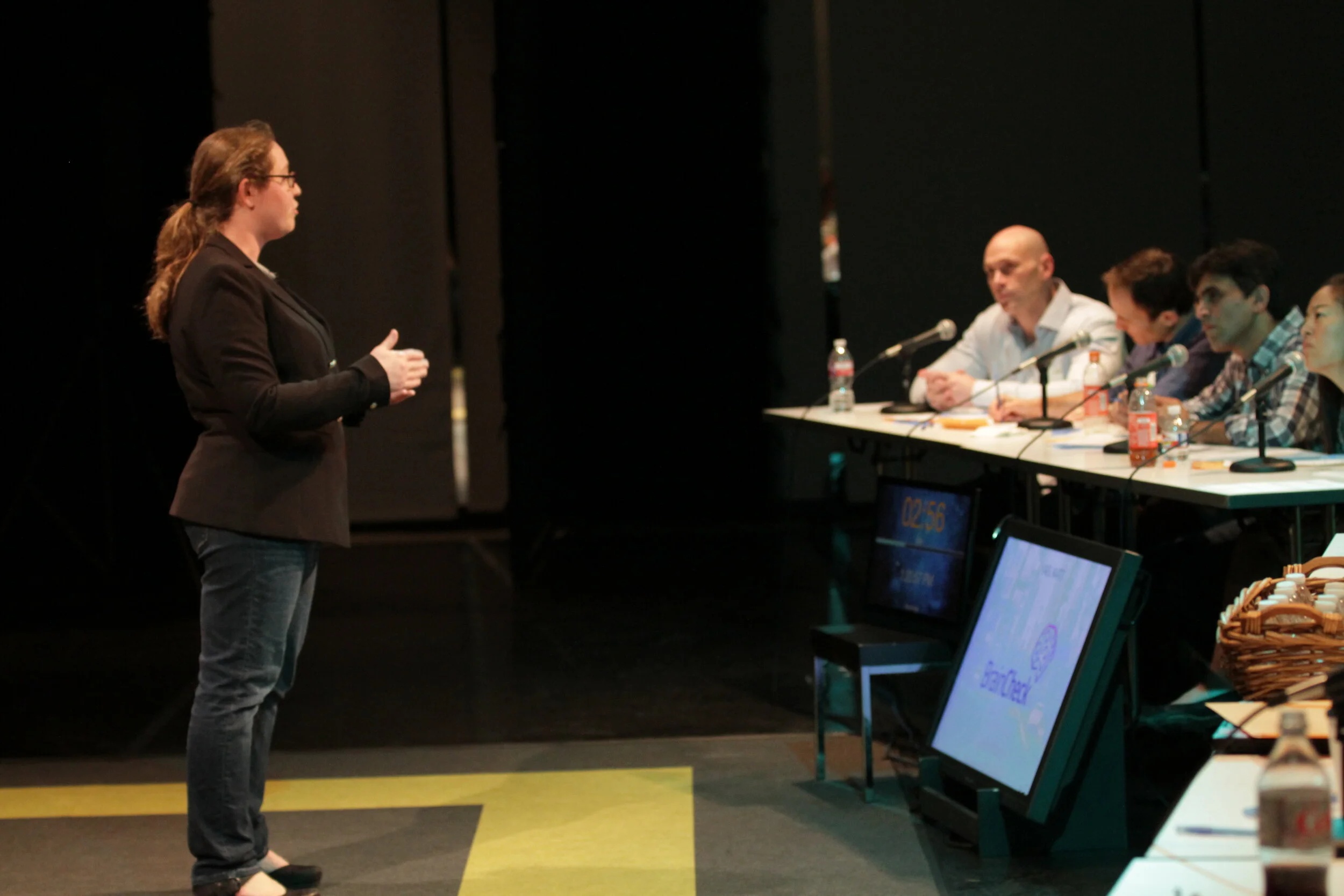
The connection extended beyond a prize. Hatch Pitch identifies BrainCheck among its winners that subsequently raised funding from someone involved in the event: Kerry Rupp of True Wealth Ventures. In 2017, the company announced a $1.5 million round involving that firm. A room assembled for a short presentation had become part of a longer business relationship.
By October 2019, BrainCheck had announced an $8 million Series A. In November 2021, S3 Ventures and Next Coast Ventures co-led a $10 million Series B, with other investors participating. These are company financing rounds, each tied to a stage in its development. They mark a change in the resources and expectations surrounding a founder's work.
- 2015BrainCheck founded
- 2016Hatch Pitch winner
- 2021$10m Series B
Learning which questions to ask
Fundraising also creates a need for fluency in unfamiliar subjects. Katz has credited Linda Spain, a former chief financial officer, with helping her understand term sheets and the basics of finance. Her account makes room for the person who explains the paperwork. That is a useful detail in a culture that tends to photograph the signature and leave out the hours spent understanding what it means.
Her public work later included a founder's perspective on boards at the 2022 Board Service Excellence Forum in Austin. The topic was how founders could work with their boards while building companies. It is a different kind of group problem from the ones in a Princeton tank, although the organizational challenge is recognizable: several participants, different information and a shared undertaking.
The progression also complicates the image of the entrepreneur as a solitary source of answers. Katz's career includes collaborators, employees, investors and advisers. Scientific papers record co-authors. A pitch competition supplies judges and coaches. A financing round introduces another set of relationships. The work repeatedly acquires more people, each bringing something the original idea cannot supply on its own.
Another beginning, with experience attached
In March 2023, BrainCheck appointed Kim Rodriguez as CEO. Katz's story continued with Simbryo, where she is now founder and chief executive. Its leadership team includes chief science officer Aryeh Warmflash and chief technology officer Scott Novich. The current company biography also describes Katz's work as an independent board member and adviser to ventures and startups.
Her academic connections continue too. A 2025 account of alumni from Couzin's research group lists her as an entrepreneur in residence at Rice University's business school. The scientist who moved into company building is now part of the setting in which other people consider making that move. Advice, in this career, has traveled in both directions.
In a 2026 business questionnaire, Katz's company described a small team expanding its customer base and hiring. Its prediction for the startup world concerned how far small teams could get with AI. After years of working across scientific and commercial settings, she was again considering how much an organization could accomplish with the people and tools available to it.
The swimming business makes a good place to return. Its promise had a visible test, and its expansion required other people to help deliver it. Much of Katz's subsequent career has taken place in more complicated surroundings, with longer timetables and less immediate answers. The practical obligations remain familiar: find something worth doing, persuade people to join you, and build an operation capable of keeping its word.