The most interesting thing about a cognitive test is the moment after it ends. A patient has tapped a screen, recognized some words, connected some dots. The software has produced a result. Someone now has to explain it, decide what deserves investigation, and make sure the next appointment actually happens. BrainCheck has built its business around that awkward interval between knowing a little more and doing something useful.
- A roughly 15-minute assessment supplies cognitive performance data for clinicians.
- Care planning connects results with patient history and caregiver observations.
- The latest expansion starts earlier: organizing existing records to help practices decide whom to review.
That makes this Austin company worth watching beyond the dementia field. It illustrates a familiar software problem with unusually human consequences: a completed task can leave the important work untouched. A memory score is useful. A memory score that reaches a clinician, prompts an appropriate conversation, and informs follow-up has a different kind of usefulness.
The customer they had to find
BrainCheck’s founders, neuroscientists David Eagleman and Yael Katz, brought scientific expertise to a problem that also required commercial humility. In an interview with investor S3 Ventures, Katz acknowledged that the company initially misjudged who its customers would be. She described learning the hard way and being fortunate to pivot. The lesson was explicit: assess market fit before developing and marketing the product.
“We are very lucky to have been able to pivot.”
Yael Katz · co-founder, in an S3 Ventures interview

The present customer is much easier to identify: a healthcare organization trying to fit cognitive care into a working day. Primary care practices, neurologists, psychiatrists, and researchers use the platform. BrainCheck reported more than 500 healthcare organizations using it in February 2026, naming UPMC, Bon Secours, and Springfield Clinic among them. It occupies the space between a quick screening conversation and the more elaborate work of specialist evaluation.
A score needs somewhere to go
At the center sits BrainCheck Assess, a digital battery built from recognizable neuropsychological tasks. Trails tests involve visual search and switching between sequences. Digit-Symbol Substitution measures speed and accuracy. The Stroop task asks the brain to overcome interference. There is something pleasingly modest about this: established tests, delivered through software, rather than an invitation to believe that a tablet has invented neuroscience.

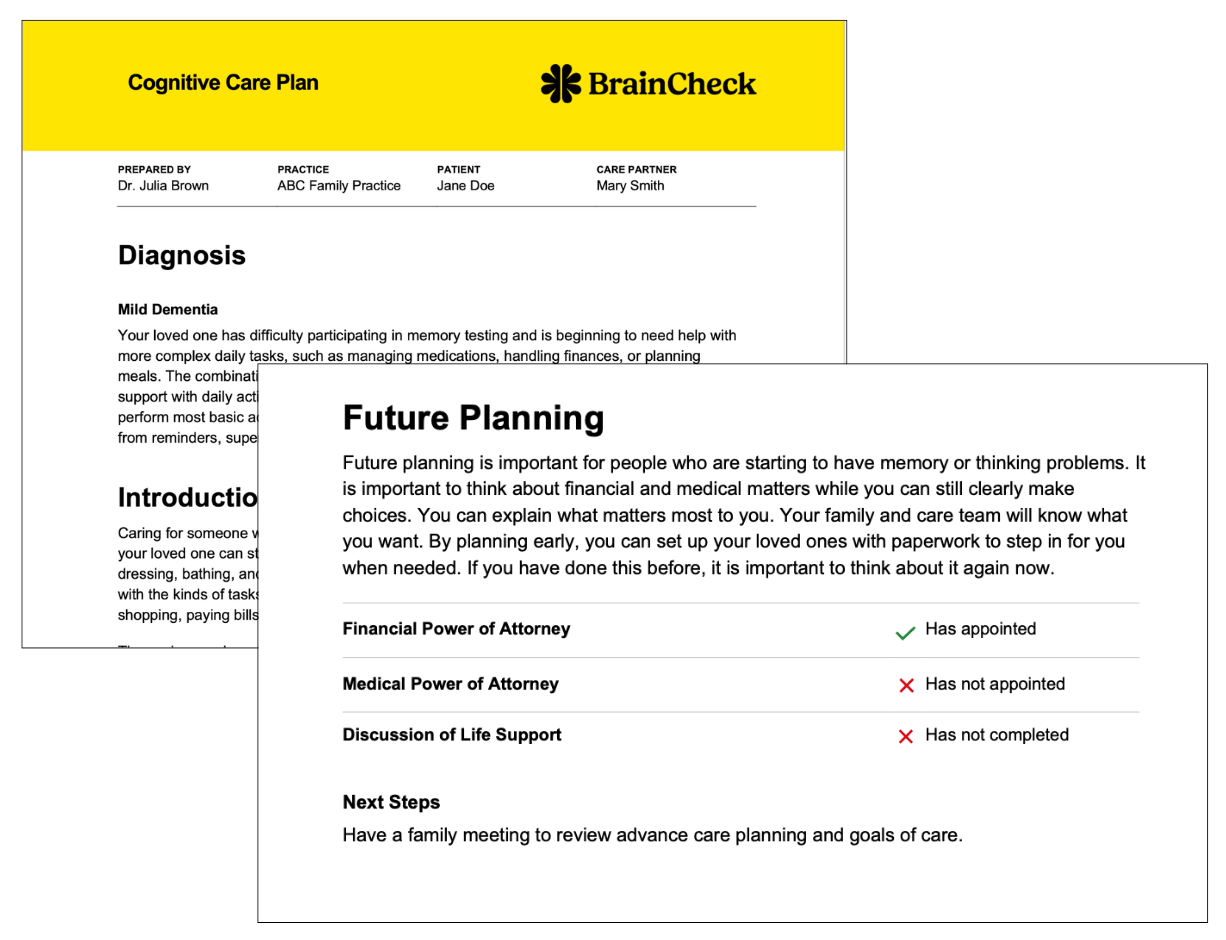
BrainCheck Screen offers a brief first look; Assess supplies more detailed performance data; Plan helps assemble recommendations from patient history, functional assessments, and caregiver input. A clinician can review and edit the resulting plan. Sleep, social activity, and daily functioning belong in that conversation because a person’s life does not arrive neatly packed inside a test result.
- 01 Screen
- 02 Assess
- 03 Interpret
- 04 Plan
- 05 Follow up
Clinical judgment connects the steps. A result alone does not complete the journey.
Assess is an FDA-registered Class II medical device. It is not intended to diagnose disease on its own; qualified healthcare professionals interpret it. Screen and Plan are not regulated medical devices. These distinctions are part of understanding the product: BrainCheck supplies measurements and documentation that support decisions, while responsibility for those decisions remains with the clinician.
Peer-reviewed studies in JMIR Aging and Frontiers in Psychology have examined the battery’s performance and its relationship to established cognitive assessments. That evidence gives buyers more to inspect than a demonstration. It does not make every low score an Alzheimer’s diagnosis, or every deployment equivalent to the conditions of a validation study.
The appointment book has a vote
The alternatives include familiar paper tools such as MoCA and MMSE, specialist neuropsychological assessment, and digital platforms including Linus Health. BrainCheck’s commercial emphasis is the connected workflow: assessment, documentation, care planning, and repeated measurement, with EHR integration. Different tools serve different purposes. A clinic choosing between them must consider what information it needs and who will act on it.
BrainCheck sells subscriptions to practices and health systems. A publicly accessible Clinical checkout lists $350 per month for ten test batteries, with additional batteries at $25 each. That is one listed plan, not a universal enterprise price. Its contractual terms place subscription and additional-service fees in the customer’s order. Software cost and reimbursement for clinical work are separate questions.
The appointment book supplies another cost: staff time. BrainCheck’s February 2026 adoption announcement expressly emphasizes trained staff, adequate time, and workflow integration. Among practices adopting in 2025, clinicians completed more than 15,000 assessments. Those numbers describe activity, not proof of improved patient outcomes. They also suggest why implementation support matters: buying software cannot assign a nurse, reserve a room, or arrange follow-up by itself.
There is a useful distinction here for anyone considering remote assessment. Moving the test outside the clinic can change where a patient completes it, but it leaves the interpretation and coordination work intact. BrainCheck’s care-planning tools let caregivers contribute information remotely and let teams share a written plan. That can make the handoff easier to organize. The practical question for a buyer remains wonderfully unglamorous: which member of the team will review the information, and when?
Before anyone opens the waiting-room door
In February 2026, BrainCheck announced another $13 million in financing, led by Next Coast Ventures with S3 Ventures and UPMC Enterprises participating. The stated uses included deeper integration, longitudinal monitoring, and AI-assisted clinical infrastructure. By July, it had launched Population Analytics, which organizes up to 40 factors from structured EHR information into a prioritized registry for clinician review.
That registry addresses a different bottleneck: where to begin. It does not diagnose dementia, calculate clinical risk scores, or recommend treatment. Prospective validation of BrainCheck’s methodology remains underway. Separately, its assessment is part of PREDICTOM, a seven-country European study enrolling 4,000 adults and scheduled to run through 2027. The published protocol describes an experiment, not its eventual verdict.
For other builders, the transferable lesson is to follow a customer’s work beyond the impressive first result. Find the handoff, the unanswered question, the person who must make time. BrainCheck’s approach depends on those people having the capacity to respond. Its promise becomes concrete when a measurement earns a next step, and somebody takes it.