Yogen Dalal could help computers talk to one another. His glucose meter proved less sociable. After a diagnosis of prediabetes, he wanted to compare his readings and understand their patterns. The information was there; getting a useful view of it was the trouble. Glooko grew from that frustration into a company whose specialty is making diabetes data easier to collect, share and use.
- The job: bring device readings into a view patients and clinical teams can use.
- The business: a free patient app alongside paid clinical and research services.
- The next move: hospital insulin-dosing software and pregnancy-specific care workflows.
01 / The network engineer and the glucose meter
Dalal’s previous work makes the origin unusually pleasing. At Xerox, he helped define networking protocols and played a central role in the 1980 Ethernet specification. He later helped found software companies and spent years investing in networking and enterprise software. Here was a man accustomed to information moving between machines, confronting a device that made his own information awkward to examine.
Glooko was founded in 2010 by Dalal, mobile developer Sundeep Madra and Chamath Palihapitiya, then a Facebook executive. Its early offer was wonderfully tangible: a logbook app and a MeterSync cable. In 2011, the app was free to download and the cable cost $39.95. Plug a compatible meter into the phone, and the readings could move without being typed in again. A modest accessory had a respectable ambition: retire a little daily drudgery.
The cable explains Glooko better than a grand declaration about digital health. It joined something a patient already used to something the patient could read and share. The company’s subsequent products keep returning to that same practical question: where does the information get stuck?
02 / The cable worked. The checkout was harder.
The early consumer test sold 8,000 cables over a year and a half. Patients liked the product, but many did not want to pay. That pushed Glooko toward providers and payers. The user’s enthusiasm had established demand; it had not settled who should fund the service.
By July 2013, Glooko had launched its first subscriber portal at Scripps Whittier Diabetes Institute. Then-CEO Rick Altinger described a sequence: win over patients, bring value to clinicians, and engage health plans and coaches. That sequence remains useful for anyone selling into healthcare. A person may do the work of managing a condition while a different organization buys the software that supports it.
“Our business model is to get patients to use it, like it”
Rick Altinger, then CEO · July 2013
A clinic has a different reason to buy from a consumer browsing an app store. It needs to see readings across a population, find people who may need attention and prepare for a consultation. Glooko’s shift gave the data an organizational purpose. Instead of asking each patient to purchase convenience, the company could sell a way for clinical teams to work with the information.
03 / Two hundred devices, one clinical conversation
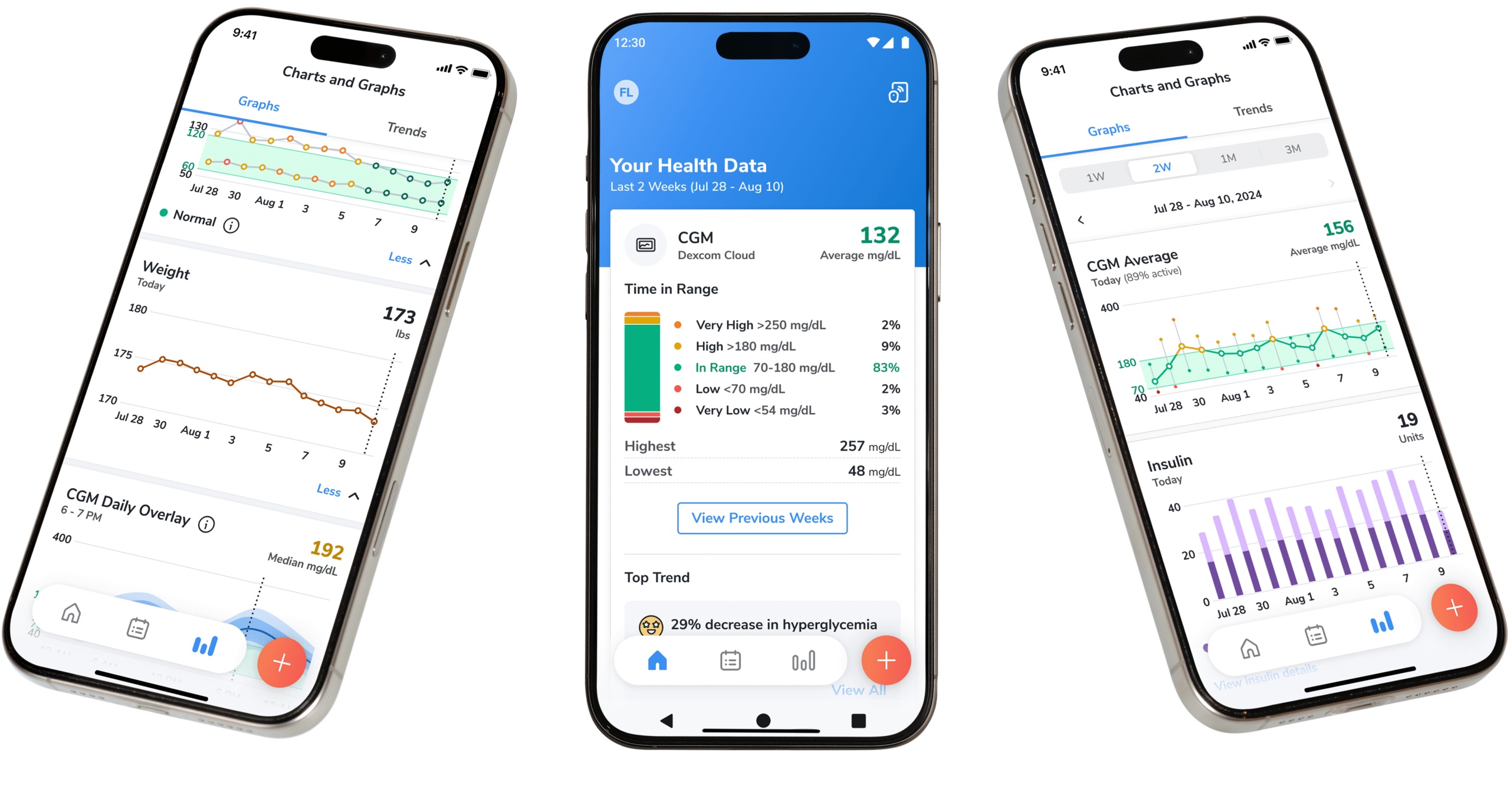
Today, Glooko says it integrates with more than 200 diabetes and health monitoring devices. Its patient app brings together glucose readings, insulin doses and other health information, with tools for logging meals, exercise and medication. The clinical platform supports data review and remote collaboration. A patient can share information between appointments; a care team can examine it without starting with a handwritten diary.
The next bottleneck is the medical record. In February 2025, Glooko announced its Patient Portal for Professionals in Epic Showroom, using SMART on FHIR technology to support access from the electronic health record. The practical attraction is fewer separate logins and manual transfers. Software earns its place when the clinician can reach it during the appointment.
In June 2026, Glooko announced an integration that delivers discrete insulin pump settings into EHR flowsheets. These include basal rates, insulin-to-carbohydrate ratios, correction factors and active insulin time. Glucose readings show what happened; pump settings add context about the therapy. Bringing both into the clinical workflow addresses a specific chore: finding device settings and transcribing them into the chart.
Pumps · pens
Organize · share
EHR workflow
Compatibility and connection methods vary by device and country.
This is Glooko’s competitive position: a specialist layer between devices, people and clinical systems. Tidepool also brings data from multiple diabetes devices together. Dexcom Clarity, Abbott LibreView and Medtronic CareLink offer alternatives within device ecosystems. The choice depends on the devices and tasks involved. A clinic using several manufacturers has a different purchasing problem from a patient who needs one sensor’s reports.
04 / A dashboard with several buyers
The patient app is free. Clinical organizations contract for services. Glooko’s provider subscription terms put fees in individual service orders and describe patient-based calculations, alongside implementation, integration and consulting services. There is no single clinic price on that terms page. The useful distinction is between installing a patient app and buying an operational service for a practice.
Life sciences companies form another audience. Glooko offers clinical trial data collection and management, remote capture from connected devices, recruitment tools and real-world evidence services. The same ability to gather readings from different devices has value in research, where investigators need information collected consistently across participants and sites.
Reported on Glooko’s 2024 financing page, alongside 10,000-plus clinics in 30-plus countries. These are cumulative figures across Glooko, Glooko XT and diasend, not a count of monthly active users.
The partner list also tells a story. Insulet and Novo Nordisk have been partners and investors. The company merged with diasend in 2016, then released a combined web analytics platform in 2018. In May 2026, mylife Diabetes Care expanded its agreement to make Glooko the primary data management platform for mylife products, with a transition from mylife Cloud. Connectivity can become part of another company’s product offering.
The expertise behind this business is a mixture of device integration, data presentation and clinical workflow design. Glooko’s public culture page gives that last part a human constituency: Glucose Gladiators, an employee group for people living with diabetes or caring for someone with it. The company says the group helps colleagues understand those experiences and improve its solutions.
05 / The $100 million turn toward the ward
Glooko announced a $100 million Series F in October 2024, led by Georgian with participation from Health Catalyst Capital, Canaan and other investors. It also appointed medical device executive Mike Alvarez as CEO. The financing announcement tied the money to device integrations, data insights, clinical research and broader product expansion.
One visible result followed in September 2025: the acquisition of Monarch Medical Technologies, maker of EndoTool. EndoTool supports inpatient insulin dosing and glycemic management. This brought Glooko into a setting with different users and decisions from an outpatient appointment. In the hospital, its software portfolio now includes patient-specific dosing guidance used by clinical staff.
Review the pattern
Glooko organizes compatible device data for patients and clinical teams.
Support the dose
EndoTool provides patient-specific insulin-dosing decision support in hospital care.
Glooko’s public notices describe the two solutions as currently independent.
In May 2026, Glooko announced FDA 510(k) clearance for EndoTool IV Cloud. It uses the same core dosing algorithm as the existing EndoTool IV solution, with cloud deployment designed to simplify maintenance and scaling. At announcement, U.S. commercial launch was expected before the end of 2026. Clearance and commercial availability are separate milestones.
The larger ambition is a connected pathway from home to hospital and back. Glooko’s current notices explicitly describe its diabetes management platform and EndoTool as independent solutions. That matters when evaluating the acquisition: an expanded portfolio is an achievement, while a connected patient journey still requires the systems and workflows to meet.
06 / Nine months is a very short product brief
Pregnancy supplies another test of the idea. In September 2026, Glooko announced GestationalCare, a module built for gestational diabetes and Type 1 or Type 2 diabetes during pregnancy. It was available in the United Kingdom at announcement, with U.S. availability planned for October. Its focus is the workflow around fast-changing patterns and a short clinical window.
GestationalCare organizes fasting and post-meal readings, flags signals such as missing data and supports engagement between visits and postpartum transition. Maternal-fetal medicine, OB/GYN, endocrinology, nursing and diabetes education teams are its intended clinical users. A general glucose chart becomes more useful when the software helps people answer the questions their particular care setting asks.
That is the recurring commercial logic in Glooko’s expansion. The company has spent years building connectivity. It can now apply that foundation to more specific workflows, from pregnancy review to pump documentation. The test for each addition is whether it removes work that clinical teams actually have to do.
07 / Start with the handoff
For a patient considering Glooko, the first practical step is to check the exact device model and connection method, then establish how to share with the care team. For a clinic, the questions multiply: which staff member reviews the data, how does it enter the chart, and who follows up when a pattern needs attention? A purchase becomes useful through those arrangements.
The lesson readers can borrow is to examine the handoff before designing another dashboard. Find where information is copied, where a login interrupts the task and where responsibility becomes vague. Then connect the product to the person who can act and the organization with a reason to pay.
The approach depends on supported devices, reliable uploads and a clinical team with time and responsibility to review them. An unsupported model, stale data or an unstaffed review process limits what the software can accomplish. More information can improve a conversation; somebody still has to hold it. Glooko’s original cable is gone from the center of the story, but the question it posed remains a good one: can the next person use what the last device knows?