A hospital can know a great deal about a person until the moment that person goes home. Then the view gets patchy. A prescription becomes a daily responsibility. A change in symptoms becomes a judgment call. For someone managing heart failure, the space between appointments can be where the trouble begins.
Health Recovery Solutions grew out of that problem. Its founding story begins with Jarrett Bauer’s grandmother returning to the hospital with heart failure. Bauer, then studying for an MBA at Johns Hopkins, began investigating readmissions. In 2012, he founded HRS with Rohan Udeshi and Daniel Priece. The question was practical: how could a care team stay close enough to help after discharge?
- The customer: healthcare organizations running care at home.
- The offer: monitoring technology plus the services needed to operate it.
- The test: whether a patient’s reading leads to useful, timely care.
A number needs a next step
The visible product is straightforward. PatientConnect brings monitoring, symptom questions, education, and communication into the patient’s home through tablets or mobile devices. Connected equipment supplies measurements. ClinicianConnect gives the care team a place to manage patients. CaregiverConnect brings family members into the loop. The arrangement turns an occasional conversation into a more regular exchange.
For the patient, this can mean taking a measurement, answering questions, reviewing instructions, or contacting the team without making another trip. For the organization, it means seeing information between visits and deciding whom to contact. The screen makes the exchange possible; the clinical response gives it a purpose.
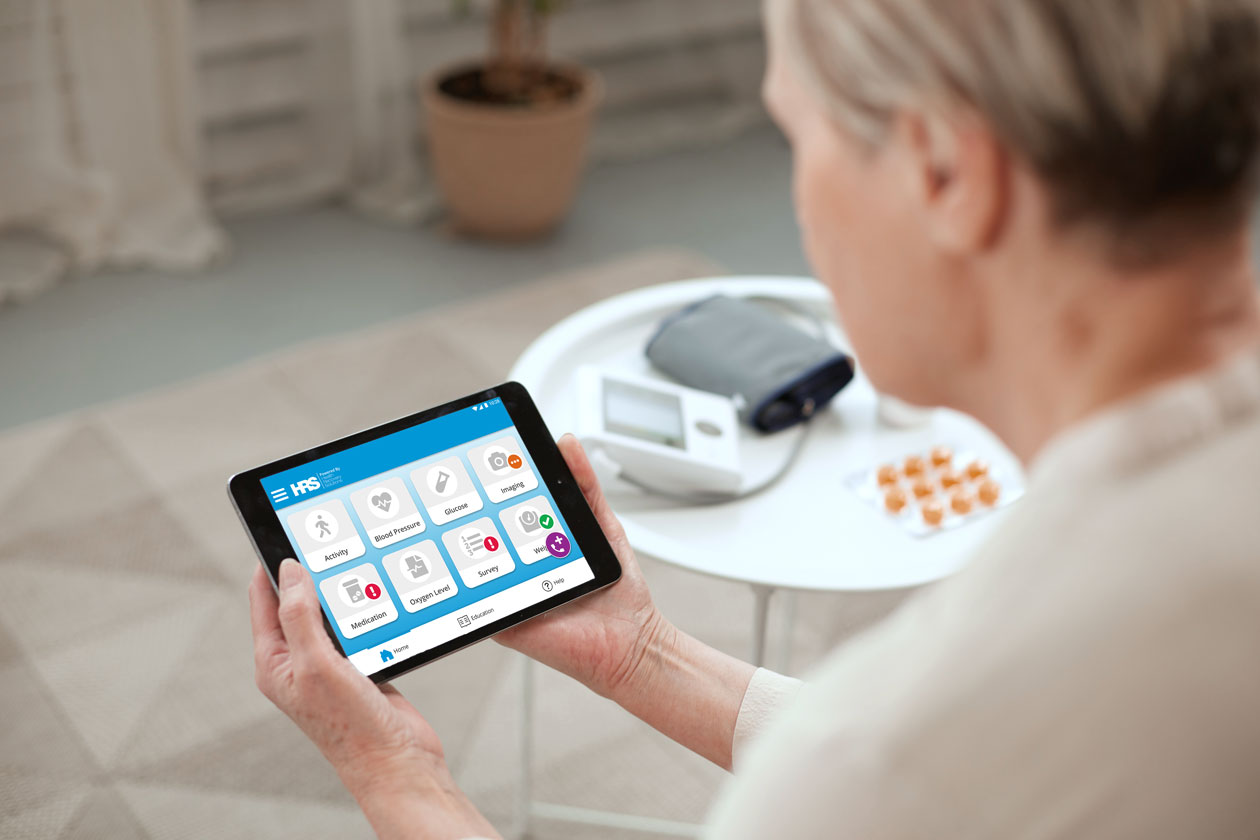
HRS also handles the chores a product photograph leaves out: provisioning equipment, shipping it, cleaning it, and preparing it for another patient. It offers patient onboarding, clinical support, analytics, and reimbursement guidance. These services reveal its market position. HRS sells to organizations that need an operating program, including hospitals, home health agencies, physician practices, community health centers, and payers.
- 01MeasurePatient at home
- 02ReviewClinical workflow
- 03RespondCare team action
- 04Follow upPatient support
Three patients. Then a care operation.
Frederick Health began its HRS program in 2017 with three patients. Its 2023 case study describes 510 patients monitored, five registered nurses, two licensed practical nurses, and a social worker. Monitoring sat alongside medication management, home visits, and education. The provider reported $2.3 million in pre/post savings and 96% patient satisfaction.
Read those results with the staffing attached. They describe a particular care program, with relationships and interventions around the devices. A before-and-after comparison cannot isolate the software’s effect. The useful lesson for another provider is to design the response and the patient support alongside the technology.
Frederick Health · January-December 2023 · Program-specific results, not a forecast.
There is a further wrinkle. A 2024 nonrandomized study of an HRS-equipped monitoring program for heart failure and COPD patients found no statistically significant difference in its primary combined outcome of death, hospital admission, or emergency care. Of 361 people offered monitoring, 140 enrolled. Participation itself was a hurdle. Remote care depends on the people who actually use it, and results depend on which outcome gets measured.
For a smaller organization, the first useful exercise may be tracing a single patient through the process. Who explains the equipment? Where does an unusual reading go? What happens when the patient misses a day? Each answer identifies work that must be assigned before adding more patients. A dashboard can display a gap in care; closing it requires an agreed responsibility.
Who pays for the person watching?
The commercial model makes room for different answers. HomeHealth Advantage is a software license with optional services. An agency can use its own clinical operation and add help with onboarding, monitoring, or logistics. PatientFirst Pinnacle goes further: a provider partner handles active alert monitoring and clinical billing, while HRS supplies technical services and equipment support.
A sensible budget therefore includes staffing, patient instruction, equipment handling, integration, and documentation alongside the technology. Reimbursement support helps organizations navigate payment; it does not remove the need to run the program. The buyer has to decide which responsibilities to keep and which to purchase.
Device choice creates another cost decision. In October 2024, HRS partnered with Smart Meter to add cellular measurement devices as a lower-cost alternative to its traditional Bluetooth setup. The announcement specifically addressed lower-acuity patients and access barriers. A less elaborate setup can be the appropriate one when the patient’s needs allow it.
Growth found the loose screws
HRS raised $10 million in growth financing in 2019, followed by a $70 million Series C in 2021 led by LLR Partners. Capital did not finish the product. LLR’s account describes technical debt, separate code branches, and a need to move from reactive development toward planned releases. It reports HRS first became cash-flow positive in the second quarter of 2022.
“shift from reactive development to roadmap discipline”
LLR Partners, describing its work with HRS
Customers supplied a less tidy view. KLAS’s 2023 research praised HRS’s partnerships but recorded concerns from some customers about development promises and the pace of innovation. Requested improvements included deeper EHR integration and better inventory management. Those complaints belong beside the company’s four consecutive Best in KLAS RPM awards from 2020 through 2023.
Alternatives include CareSimple, Optimize Health, TimeDoc Health, and Vivify Health. HRS’s case rests on the breadth of its technology and operational support. A buyer comparing vendors should examine the actual workflow: what arrives in the clinical record, who follows up, and how much extra work remains.

The discharge window gets longer
In March 2026, HRS acquired Rimidi, bringing diabetes and cardiometabolic expertise, continuous glucose monitoring integration, and clinical decision support into its operation. Rimidi founder Dr. Lucienne Ide became HRS’s chief medical officer. The deal followed the 2025 introduction of PatientFirst Pathways, its model for longitudinal care.
That sequence points toward a longer relationship with the patient, extending beyond recovery from an admission. The challenge remains wonderfully concrete. A measurement must reach someone, make sense in a clinical workflow, and lead to a useful next step. HRS has built a company around keeping those handoffs connected.