In 2007, Winnie H. Wan had a rather good reason to stay chief executive of ForteBio. The company had launched its first instrument, attracted investors and found customers. An entrepreneur could reasonably regard this as the moment to settle into the chair. Soon, somebody else would be sitting in it.
Joseph D. Keegan had become available after the sale of Molecular Devices, where he had been chief executive. ForteBio had not been hunting for a replacement. Yet an opportunity had appeared that did not fit the company’s immediate shopping list. Wan, its founding CEO, thought it deserved attention.
“Sometimes you have to grab the right person when they become available.”Winnie H. Wan · 2007
Keegan became president and CEO in September 2007. Wan remained on the board. The change gives her career a useful opening scene: a founder evaluating what the business could become, then accepting that its next stage might call for a different person at the desk. Company building, in this telling, includes knowing when to change the builder’s job.
There is something pleasantly unsentimental about it. The title was transferable. The work continued. For Wan, moving between roles had already become a recurring feature of a career that crossed laboratories, business school, corporate divisions and young companies.
A scientist learns another language
Her formal training spans Skidmore College, Yale University, Rockefeller University and Columbia University. She earned a bachelor’s degree at Skidmore, a doctorate at Yale, completed postdoctoral work at Rockefeller and earned an MBA at Columbia. Science and business appear together on the resulting résumé; getting them there required a change of direction.
Wan came from Hong Kong to attend Skidmore, her first trip to the United States. She studied chemistry and graduated in 1974. Later, during her postdoctoral period, she concluded that a future spent conducting laboratory experiments was not the one she wanted. Bringing scientific discoveries into commercial use interested her more.
In 1981, with no previous business background, she entered business school. A scientist can spend years acquiring the credentials to follow a particular route. Wan acquired another set to leave it. Her subsequent positions included product management and finance at Baxter Travenol and marketing at Hana Biologics in the Bay Area.
The distinction between understanding a discovery and finding a market for it would recur throughout her working life. A laboratory result comes with one kind of evidence. A business needs additional answers: who will use the product, what must be manufactured and how the organization will pay for the journey. Wan’s education gave her practice in more than one vocabulary.
Her later leadership résumé includes SyStemix, Becton Dickinson’s Cellular Imaging Systems division, GeneTrol BioTherapeutics, BEING Biopharma and OncoHealth. The recurring assignment was to help turn specialized work into an operating enterprise. That meant moving among people whose definitions of a finished product could be quite different.
Bachelor’s degree
Doctorate
Postdoctoral training
MBA
The money arrived before the machine
On October 26, 2005, ForteBio announced a $17.3 million Series B financing. The Vertical Group led the round. Existing investors Agilent Ventures, Alloy Ventures, Latterell Venture Partners and Versant Ventures also participated. Wan was president and chief executive, and the company was preparing to introduce its first product, Octet.
Her explanation of the funding was concrete. ForteBio needed to assemble its marketing and sales organization for the launch. It also intended to develop further applications and another generation of instruments. The machine and the means of selling it were being built together.
That sequence is a useful corrective to the tidy invention story, in which a device works and the world politely queues to buy it. An instrument company must also create an organization that can explain, deliver and support the instrument. A launch date is a deadline for several professions at once.
ForteBio commercially introduced Octet on November 29, 2005. Its first platform used BioLayer Interferometry to examine molecular interactions in real time, without detection labels. Consumable biosensors worked with an instrument to generate measurements. The platform could accommodate additional applications through changes to the biosensor surfaces.
The practical attraction lay in what researchers could measure and how conveniently they could measure it. Protein concentration and the behavior of binding molecules became questions the same platform could address. Underneath the technical language sat a familiar product ambition: make a demanding task easier to perform repeatedly.
An instrument’s promise has to survive the ordinary working day. Users need results they can interpret, a process they can repeat and supplies they can obtain again. Octet’s combination of a system and consumables made those everyday requirements part of the commercial proposition from the beginning.
Combined in ForteBio’s analytical systems
A wider door for the customer
In December 2006, ForteBio added Amine Reactive and Protein A biosensors to Octet. The new surfaces extended the system’s applications. The Amine Reactive option let customers couple their chosen target molecules directly to the sensors using familiar techniques. A platform became more useful by giving its users more choices.
Wan’s explanation emphasized that greater openness. The customer could bring a wider variety of proteins to the system. This was product development expressed through an experimenter’s freedom of action: expand what the user can put into the workflow, and the instrument has more work it can do.
The geometry of that business matters. A new instrument asks a customer to commit to a platform. Additional biosensors give that commitment further uses. The initial purchase and the later experiments belong to the same story, even though they occur on different dates and may involve different people.
By September 2007, ForteBio said Octet had been placed at a majority of the top 20 pharmaceutical companies, as well as numerous biotechnology businesses. Its first product had entered the market less than two years earlier. The company was now discussing the sort of leadership appropriate to a business with a growing installed base.
The announcement of Keegan’s appointment described Wan as the founding CEO who had built the business through its early phase. It also recorded her continuing board role. Her association with ForteBio therefore extended beyond the executive handover; the change concerned responsibility and experience, as well as the name on an office door.
A founder on the other side of the table
Wan’s later work includes board service, executive advice and mentoring. Her 2025 public biography lists boards including Inhalon BioPharma, Saccharo and Kryptos, along with Skidmore’s trustees and the advisory board of Santa Clara University’s Miller Center. The variety of assignments places her alongside both company leaders and institutions that develop them.
On March 27, 2025, she was scheduled to open the substantive talks at a financing webcast organized with Life Science Angels. Her session covered financing and lessons from her experience as a serial entrepreneur and angel investor. Other speakers addressed government funding, institutional investors, corporate investors and philanthropic capital.
The agenda makes an interesting companion to ForteBio’s 2005 financing announcement. One records the entrepreneur raising money for a launch. The other places her in front of entrepreneurs considering where their money might come from. Experience has changed sides of the presentation screen.
Her teaching connections also include a UCSF entrepreneurship course. Its 2020 syllabus assigned Wan the November 11 session on angel investing, identifying her as a Life Science Angels board director. The course separated angel investing from venture capital, intellectual property, team building and other subjects. Starting a company, apparently, requires a timetable as well as an idea.
Mentoring brings a different rhythm from running a company. An adviser can help examine a choice; the founder must still make it. Wan’s public roles place her within that exchange, where practical experience can be offered without occupying the chief executive’s chair. The next move belongs to somebody else.
Back where the questions began
In 2014, Skidmore gave Wan its Creative Thought Matters Award of Distinction. A photograph from the ceremony shows her between Alumni Board President Gail Dudack and college president Philip A. Glotzbach, holding the award. The institutional recognition arrived forty years after her graduation.
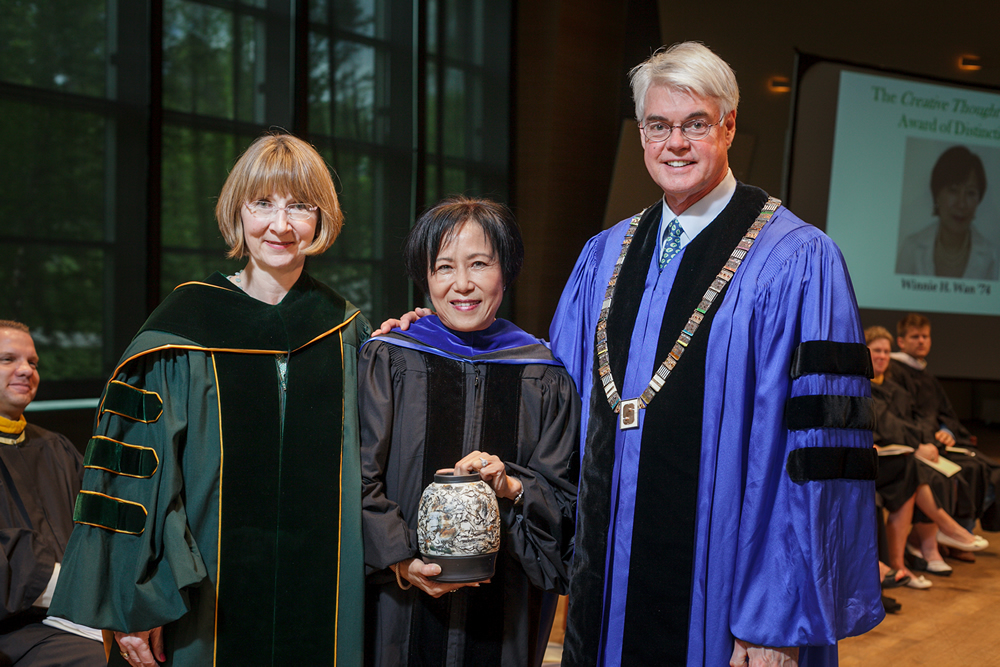
The relationship continued. Skidmore welcomed her as a new trustee at its October 2024 board meetings. Its 2026-27 trustee roster lists her in Woodside, California. The former chemistry student had become one of the people responsible for the college’s governance.
Then, on February 27, 2026, she joined the alumni judges for Skidmore’s Kenneth A. Freirich Entrepreneurship Competition. Eight finalist teams presented business plans and prototypes at the Tang Teaching Museum. The winning venture, Polar Athletics, proposed modular hockey gear designed for female athletes and received the $20,000 first prize.
The products were far removed from the instruments associated with ForteBio. The underlying business questions could travel: what problem does this address, who wants it, what has been demonstrated and what must happen next? A judge can cross industries more easily when the discussion moves from the novelty of an object to the work of building a business around it.
Wan’s career offers several versions of that work. Changing professional direction. Preparing a product launch. Extending a platform. Bringing in a new chief executive. Teaching investors’ questions to entrepreneurs. Her decisions make a company’s changing needs visible, with each stage asking something slightly different of the person who helped begin it.
The chair at ForteBio changed occupants in 2007. Nearly two decades later, Wan was again taking a seat across from people with an idea and a business plan. This time, the next company belonged to the students.