A camera can show you a room. Getting an insurance company to act on the picture is a more complicated achievement. Between the two sit measurements, estimates, software systems and people with quite reasonable questions about whether the new thing will make their day easier. Henriette Fleischmann built much of her working life in that interval. At Hosta AI, the company she cofounded with Rachelle Villalon, it became the business.
Her route there passed through automotive strategy, a fashion retailer and a coding classroom. The settings changed; the awkward business of turning a plan into something people could use kept reappearing. A future can look wonderfully tidy in a presentation. Then someone has to assign the work, connect the systems and persuade a customer to try it.
The future, with an organisation chart
At Porsche Consulting, Fleischmann worked on the less photogenic side of tomorrow’s cars. Connected and self-driving vehicles required thinking about what buyers might want years ahead. They also required industrial processes and organisational structures capable of delivering it. A prediction was only one part of the assignment.
Her consulting work included helping a truck manufacturer organise projects around strategic goals and limited resources. She also worked on coordinating the life cycles of current and future vehicle models. These are problems with dependencies: changing one decision alters the conditions for several others. The glamorous future still needs a calendar.
Asked about working in an industry long associated with men, she put the emphasis on measurable results. That answer is consistent with the work she described. The point was to make the client’s plans function, and to have something concrete by which to judge the result.
Her earlier career had begun as chief of staff to the CIO at Daimler Financial Services. Later came the Strategy Office at Peek & Cloppenburg. Automotive finance, consulting and fashion retail gave her experience inside established organisations before she began building smaller ones. The difference in company size would be considerable. The need to get other people moving in a shared direction would remain.
Nine weeks as a beginner
Before MIT, Fleischmann took a nine-week coding course at Le Wagon. A strategy executive learning to program is a useful picture: someone accustomed to discussing what an organisation should do, encountering a machine that insists on being told exactly how.
The bootcamp’s format helped inspire The Cohort, her leadership education venture. Its public introduction described her as founder and CEO and connected the concept directly to her experience of intensive learning. The organisation brought together leadership development and an appetite for teaching people through concentrated practice.
There is something pleasingly practical about borrowing an educational method from coding and applying it to management. Both subjects can produce impressive vocabulary long before they produce competence. A programme organised around doing makes the distinction harder to evade.
Her own education continued at MIT Sloan, where she completed her MBA in 2019 with an interest in AI and entrepreneurship. She had already studied business administration at Europa-Universität Viadrina and sales and marketing at Hochschule Wismar. This next classroom brought her closer to the technical founders whose work she wanted to help commercialise.
A room becomes a business problem
Villalon supplied the architectural and technical foundation for Hosta. She had worked on the problem of reconstructing interior spaces digitally and developed the underlying technology. Fleischmann brought experience in strategy and execution. They connected at MIT in 2019; Hosta launched in 2020.
The early product, Hopper AI, dealt with relationships inside a room. Recognising a window was useful. Understanding its place in a wall, alongside openings, surfaces and possible damage, made the information relevant to a property assessment. The ambition was to extract a structured understanding from ordinary images.
That distinction matters to Fleischmann’s part of the story. A technically interesting output needs a market where somebody has a repeated reason to use it. Property insurance offered recurring assessments and work that involved translating physical spaces into measurements and estimates. The room was the input. The business depended on what happened next.
Hosta took its name from the hardy plant familiar in New England. For a company dealing with damaged interiors, a little botanical durability seems an agreeable starting point.
The basement test
At Insurtech Boston in 2024, Fleischmann explained the proposition through a flooded basement. After the water has been removed, a homeowner still needs the insurance claim to move. Traditionally, that can involve arranging an adjuster’s visit and waiting for the assessment.
In the workflow she described, the carrier sends a link. The homeowner takes photographs. Hosta processes the images and supplies information for an estimate in systems such as Verisk Xactimate or CoreLogic Symbility. A desk adjuster can then work with that material. Her example described settlement within 24 hours or less, a use-case claim rather than a promise for every loss.
The appeal begins with an ordinary camera. No special sensor or separate app was required for the capture she presented. A homeowner has enough to organise after a basement floods without being handed an additional technology project. Removing a step can be a persuasive form of product design.
- 01PhotographA homeowner captures the space.
- 02InterpretSpatial AI analyses the images.
- 03ConnectData enters an estimating workflow.
- 04AssessAn adjuster works toward settlement.
A simplified view of the workflow she presented in 2024.
An AI panel with a working example
In November 2022, Fleischmann joined a panel at MIT’s Convergence conference on the promise and reality of AI and quantum computing. She appeared as Hosta’s cofounder and COO alongside researchers including Ike Chuang, Aram Harrow and Kalyan Veeramachaneni, with Jeffrey Grover moderating.
Her contribution brought a property assessment business into a discussion of technologies whose timelines and applications differed considerably. The panel considered where AI and quantum computing stood and what might come next. Hosta supplied an example of AI being directed at a current commercial problem.
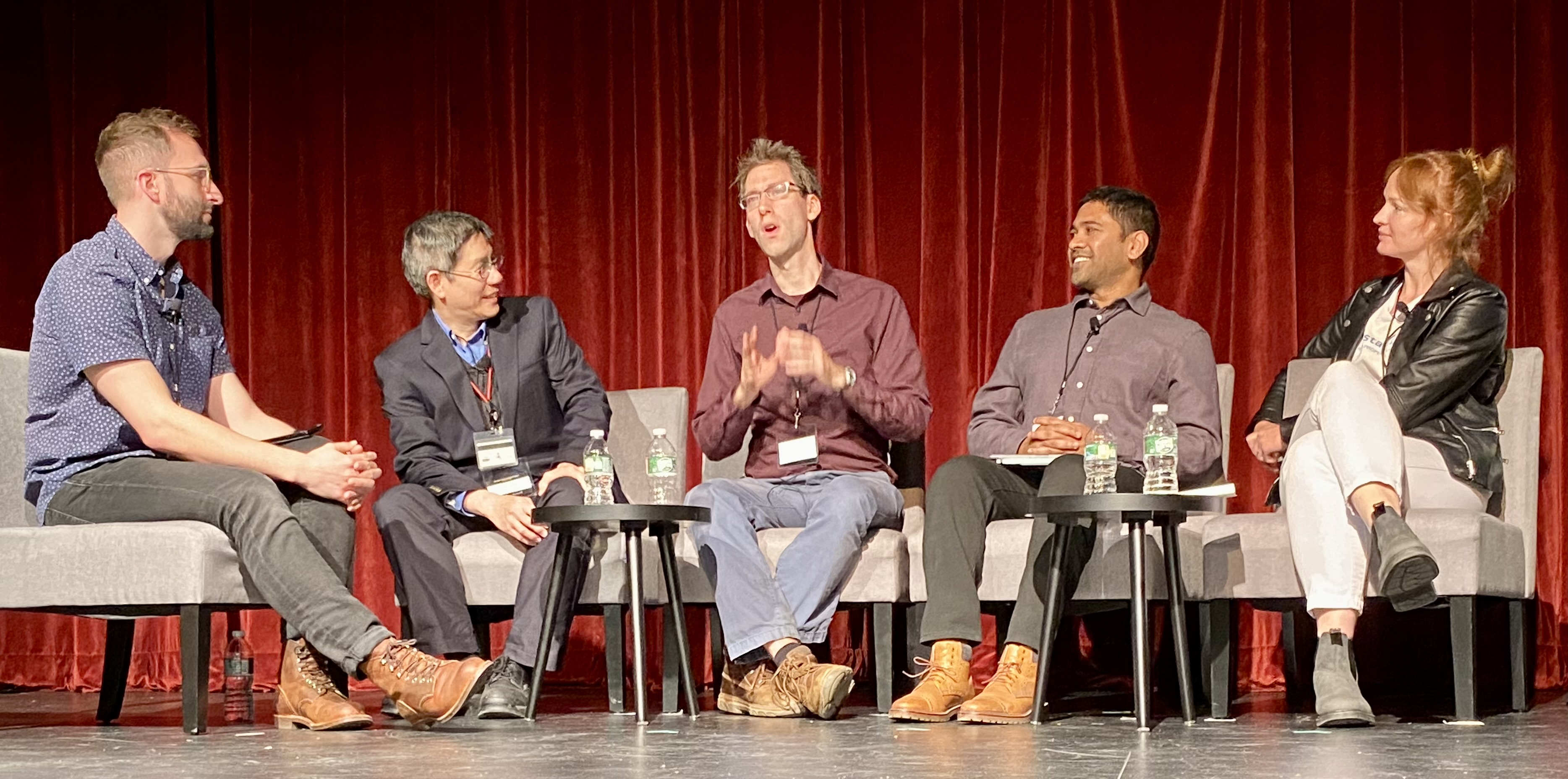
It is an apt setting for her career. Researchers can explain a capability and its limitations. An operator must also consider the route into use. Put the two conversations on the same stage and the questions become more interesting: which problem is ready, which customer is willing, and what must be built around the technology before it can help?
A partnership has to reach the desk
The 2023 collaboration with Crawford & Company gave those questions a concrete setting. The announced partnership connected Hosta’s remote assessment technology with a claims management business. Photos could become sketches, drawings, measurements and material identification for the people assessing a loss.
For Fleischmann, then identified as COO in the announcement, the capture experience mattered alongside the data. A link could guide the policyholder through taking the pictures on a smartphone. The resulting assessment was intended to help desk and field adjusting teams triage, estimate and settle claims.
There are two customers to keep in view here: the organisation buying a service and the person asked to provide its input. If taking the photographs is confusing, the sophistication of the analysis has less chance to matter. If the output cannot help an adjuster, a smooth capture process only takes the claim so far.
This is the sort of work that disappears behind the phrase “commercialisation”. The word sounds like a department. In practice, it includes understanding where information enters a process, who needs it next and how much friction each handoff introduces.
A company outgrows its first job descriptions
Fleischmann went on to serve as Hosta’s CEO. In October 2024, she announced a handover to Ingrid Flores and a move into an advisory role. Her account described the transition from research and development to a scalable product company as a particularly difficult part of the job. She credited colleagues across product, technology, operations and customer traction.
The handover gives her founder story an unusual centre of gravity. Founding a company creates an attachment to it. Running one means repeatedly asking what it needs next. Her announcement made room for continuing involvement as an adviser alongside a change in executive responsibility.
“You can, you will, you do!”
Her father’s advice, recalled by Fleischmann
Her advice to other entrepreneurs is similarly concerned with people and judgment. Bring in support early. Help colleagues grow. Be prepared to hire someone more senior when the company needs that experience. She also encourages founders to understand a market problem and test a solution quickly with potential customers.
There is encouragement in this outlook, but little invitation to sit admiring your own idea. Persistence has work attached. Her father’s compact injunction supplies the forward motion; customers and colleagues supply the useful corrections along the way.
A different kind of uncertainty
In October 2025, Fleischmann publicly announced joining Anadyr Horizon as founding chief operating officer. The new setting was strategic intelligence, with Arvid Bell, Ferenc Dalnoki-Veress and William C. Potter among the people she named. She described systems intended to model decision-makers under pressure and the consequences of interconnected choices.
That is a different proposition from assessing rooms. Her stated responsibility, however, returns to familiar territory: building the operational capacity to deploy a technical capability. The ambition belongs to the company; the operator has to organise the work that might make it useful.
Her career does not proceed in a straight line through one industry. It moves among places where new possibilities require changes in how people work. Cars need production plans. A property assessment needs a usable route to an estimate. A young company needs people who can take it beyond its first version. Fleischmann keeps finding herself near the point where a promising idea acquires responsibilities. That is where the interesting work starts.