Before the investment announcements, there was a basketball camp. Bill Powers was 21 when he started it. A camp makes a useful first business for someone who will spend much of his career selling: people have to turn up, somebody has to organize the day, and enthusiasm eventually has to cover the bills. Years later, working with MIT researchers on a business built around driving data, Powers would still be talking about the value of listening.
His route to Cambridge Mobile Telematics included radio sales, nightclub promotion, and technology companies. It has the pleasing untidiness of a career assembled through people and opportunities rather than a diagram. Today, as CMT’s co-founder and chief executive, he works in a field crowded with algorithms. His own explanations often begin with relationships. Even a very clever sensor needs someone willing to use it.
A basketball camp, then a different kind of pitch
Powers grew up in Boston. His early commercial life brought him into sports marketing, helping NBA players with deals, and then into clubs and radio. Each business had its own audience. A sponsor, a listener, and a nightclub customer bring different expectations to the exchange. The recurring task was to understand what another person wanted well enough to make an offer worth considering.
One opportunity came with an unusually discouraging sales pitch of its own. A mentor invited him to a meeting at Bessemer’s Boston office about a secret venture. Joining would mean a 50 percent pay cut; the business had six months of cash remaining. Powers took the opportunity. The company was Traffic.com. For someone learning to work with uncertainty, the offer supplied ample practice.
He subsequently held leadership roles at Access 360 Media and Swoop. The titles changed, but the work kept bringing him back to the distance between an interesting proposition and a customer’s actual problem. That distance would matter when he met the researchers behind CMT.
“Listen more than you talk.”
Bill Powers
The professors needed a customer
Hari Balakrishnan and Sam Madden had been working on mobile sensing at MIT before smartphones made the idea seem commonplace. Their CarTel project began in 2004. One experiment involved equipping Boston taxis to detect road conditions. A pothole could become data. A moving vehicle could describe the street beneath it. Boston, having supplied the potholes, was doing its part.
The researchers met a harder question when they considered a business: who needed the information enough to buy it? Traffic was one possibility. Insurance became another. Measuring how someone drove could help an insurer assess risk and give the driver useful feedback. Powers met Balakrishnan in 2009. He joined Balakrishnan and Madden to found Cambridge Mobile Telematics in 2010.
The three brought different experience to the same problem. Balakrishnan and Madden had developed the research; Powers had built a career around commercial relationships. Their partnership needed both kinds of work. Getting information from a phone and getting an organization to build a program around it were separate achievements.
The early business was supported by an NSF small-business grant and customer contracts. Powers also recalled putting financing on his credit card. By late 2011, the company had secured a State Farm contract; a mobile driving-measurement pilot followed in 2012. There is something usefully unromantic about that sequence. A grant buys time. A contract creates obligations. A pilot gives the customer a chance to decide whether the thing actually works.
For Powers, the smartphone offered a peculiar commercial opportunity. The same object that competed for a driver’s attention could help measure risky driving and return feedback. The proposition required people to change a familiar habit. A lecture about paying attention has plenty of competition, much of it arriving on the phone itself.
CMT worked through partners, including insurers, rather than relying entirely on drivers finding its name. That arrangement put a practical test on the business: its partners needed programs that worked for their customers. Powers’s emphasis on helping partners succeed fits this distribution model. The relationship continues well beyond the first sale.
When the numbers acquired more zeroes
In December 2018, CMT announced a $500 million investment from the SoftBank Vision Fund. The company was then working with customers in more than 20 countries. Its platform combined driving measurement with feedback, rewards, and other incentives. The investment was intended to support wider adoption and expansion into additional products and markets.
The sequence matters. The company had already launched products and built insurer relationships before that announcement. For a founder who had helped carry the early financing personally, the sum marked a change in the resources available. It also changed the scale of the decisions ahead. Finding a market and expanding through it require different forms of patience.
In June 2021, CMT acquired TrueMotion, bringing together two businesses that had developed smartphone driving technology. The combined operation would serve 21 of the 25 largest US auto insurers. TrueMotion chief executive Ted Gramer became CMT’s chief operating officer. Powers remained chief executive, responsible for a company whose reach now reflected the work of both teams.
The transaction also made the business broader than a score at the end of a drive. Driving data could support insurance pricing, feedback, and claims processes. That breadth placed Powers in familiar commercial territory: several customers might be interested in the same underlying technology for different reasons. Understanding the reason mattered as much as describing the technology.
Amodo followed in March 2023. The European telematics company adopted the CMT name, and its chief executive, Marijan Mumdziev, became managing director of Europe. Powers emphasized local market knowledge and relationships. The acquisition doubled CMT’s European team to more than 100 people. Expansion involved finding people who understood the market, alongside expanding the product’s reach.
By June 2025, Powers was discussing leadership at a roughly 500-person company. His conversation with Aleksandra Lemańska returned to attentive listening and avoiding destructive behavior at work. Those concerns become more demanding as the organization grows. There are more people who can hear a customer’s complaint, and more opportunities for each to assume somebody else has taken care of it.
A raceboat enters the picture
Sport, meanwhile, had found its way back into the story. In January 2025, CMT announced its role as official telematics partner of Team Brady for the second season of the UIM E1 World Championship, the electric raceboat series. The partnership would make CMT’s mobility platform available for pilot-performance insights. A business associated with ordinary driving had acquired a rather less ordinary setting.
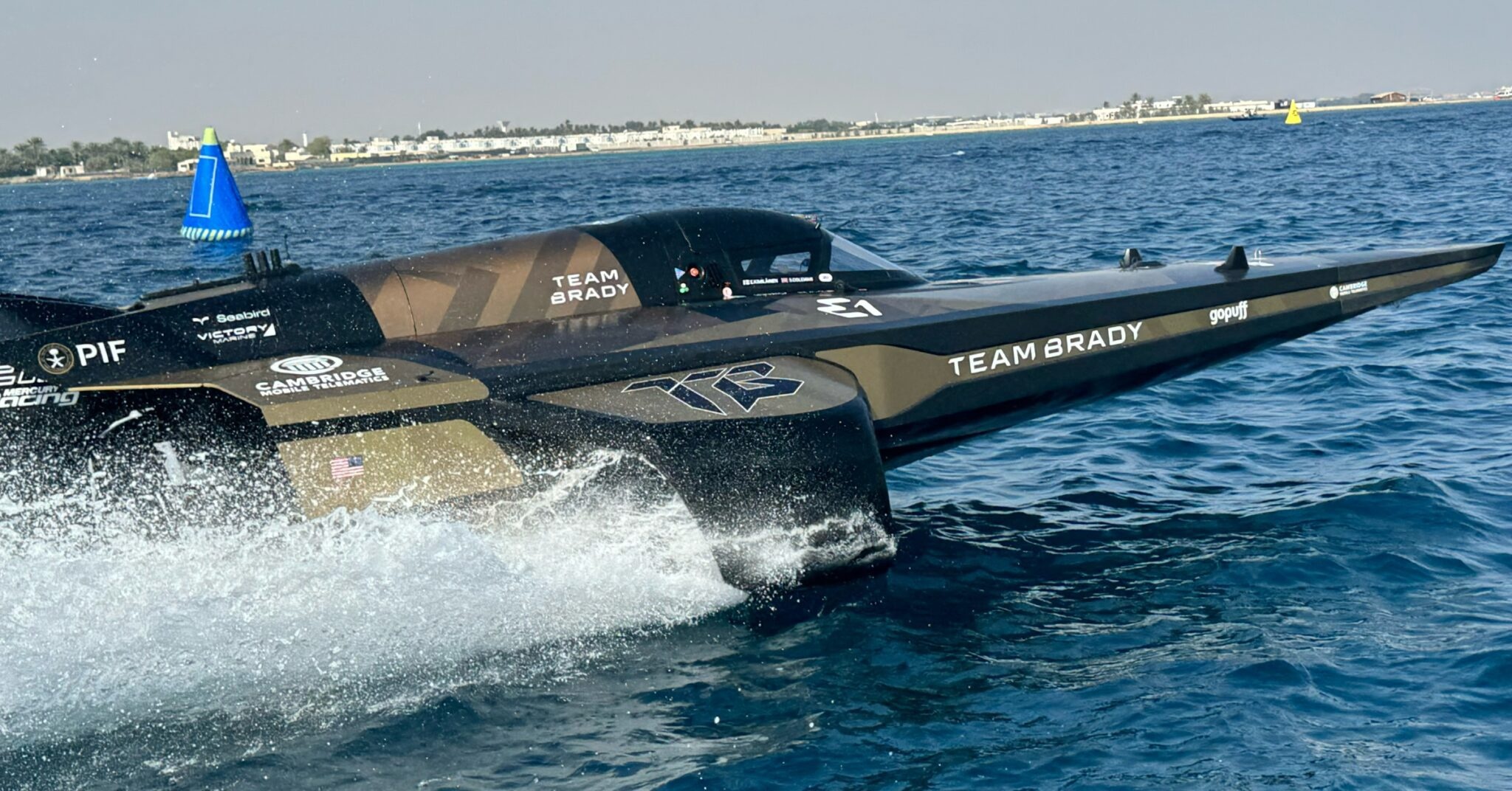
The connection extended beyond performance measurement. CMT’s Visionaries of Mobility events brought business partners together, including at the Monaco race weekend and in Las Vegas, where Tom Brady appeared as a keynote speaker. When the partnership was renewed that December, both organizations described plans to continue using the racing setting to connect customers and industry figures.
There is a recognizable line here from Powers’s earlier work in sport and media. People gather around competition. A gathering creates time for conversations that a sales presentation may never produce. Electric boats are an unusual venue for discussing insurance technology, but Powers’s career has never insisted on a single venue.
The pizza problem
In March 2026, CMT announced a $350 million strategic investment led by TPG and Allianz X, with State Farm participating. Long-term commercial agreements with Allianz businesses accompanied it. The announcement identified global expansion, real-time AI risk models, and adoption of a Universal Driving Score as priorities.
CMT then reported reaching 55 million drivers through 140 programs in 25 countries. Those are company-reported measures of reach, rather than a count of people personally recruited by Powers. They show how far the enterprise had moved from its first contracts. They also suggest why its next questions involve organizations, markets, and public acceptance as much as individual product features.
At ITC Vegas in 2026, Powers used pizza to describe one of those questions. People comfortably let an unfamiliar delivery driver arrive at their home, he observed, yet can hesitate when an insurer wants to measure their driving. His explanation centered on consumer trust. A promised benefit does not make the decision automatic.
He also warned about arrogance inside growing companies: the attitude that employees are doing customers a favor. Coming from someone whose earlier work involved persuading people to buy, the warning has a particular bite. Success can make a business less willing to perform the very work that helped it become successful.
His ambitions remain tied to safer mobility. In an October 2026 conversation with Gary Fowler, he discussed AI applied to the physical world of moving vehicles and driver behavior. The setting keeps changing: phones, connected cars, mobility services, and new forms of transport create new uses for measurement. A company built around that movement has little reason to expect the problem to stay still.
Powers has also argued that a wider purpose needs a functioning business beneath it. He established the Luke Vincent Powers Foundation to support disadvantaged children, and his language about work repeatedly reaches beyond commercial results. Yet he is explicit about the need for commercial discipline. A worthwhile intention still has to meet a customer, a budget, and a reason to continue.
That brings the story back to attention. Powers’s career has crossed several industries without losing its interest in what people will show up for, pay for, and trust. The camp needed participants. The research needed customers. The driving program needs a willing driver. Each is a person with a decision to make. Listening remains a sensible place to begin.