A phone in a moving car has an awkward reputation. It offers directions, then a message, then an irresistible invitation to look away. Cambridge Mobile Telematics starts with the same object and asks a different question: what else does this little machine know? Its sensors feel movement. Its software can register interaction. Together, those signals can help describe a trip that the driver remembers rather more generously.
CMT turns that description into something an insurer, a fleet operator or a road planner can use. Its central product, DriveWell Fusion, combines information from phones, vehicle sensors, connected cars and video. The business gets interesting when measurement becomes an intervention: a warning after a trip, a reward for improvement, or assistance after an impact. The phone acquires a second job. It becomes a witness with an incentive scheme.
- What it sells: driving analytics, risk scores, engagement tools and crash services for partner programs.
- Who buys: insurers and mobility companies, with fleets and public agencies also in the picture.
- The useful distinction: CMT combines sensing with incentives and claims workflows.
- The catch: feedback must be accurate, understood and used again.
A witness in your pocket
Imagine two motorists whose insurance applications look similar. One puts the phone away; the other keeps picking it up. A form completed at renewal has limited room for that difference. Mobile telematics makes it observable across trips. Speeding, hard braking and phone distraction become inputs to risk assessment, and drivers receive feedback about behavior they can change.
There are two audiences here. The enterprise buys the system. The driver encounters it through a branded program. CMT lists State Farm’s Drive Safe & Save, Nationwide’s SmartRide and Discovery Insure among its partnerships. You can be using its technology without having chosen an app with Cambridge in the title. That is a useful place for an infrastructure company to live: behind a familiar relationship.
The taxi before the insurance app
The origin is pleasantly less polished than an insurance pitch. In 2004, MIT researchers Hari Balakrishnan and Sam Madden began CarTel, a mobile sensing project. Working with Boston taxi companies, they studied traffic and road-surface conditions. The car was a moving instrument, gathering clues about the city as it went about its ordinary business.
In 2010, the researchers joined entrepreneur Bill Powers to form CMT. Its first mobile usage-based insurance product followed in 2012. The progression matters: first infer something useful from a moving sensor; then find an institution that can act on the inference. In an early interview, Balakrishnan recalled that smartphone-based driving measurement had initially been regarded as unreliable. Winning an insurer required more than an attractive screen. The measurements had to survive scrutiny.
The founding team still embodies that pairing. Powers is chief executive, Balakrishnan chief technology officer and Madden chief scientist. In a joint interview, Powers and Balakrishnan describe learning from rejection and identifying partners who understood the project. The public account suggests persistence shaped by feedback. Their experience makes listening to prospective customers part of the technical work.
The little square that knows the car
A phone travels with its owner. Insurance often follows a vehicle. Those are different units of observation. A family can share a car, a driver can switch cars, and a passenger can be the person tapping a screen. Before awarding a score, the system has some housekeeping to do.
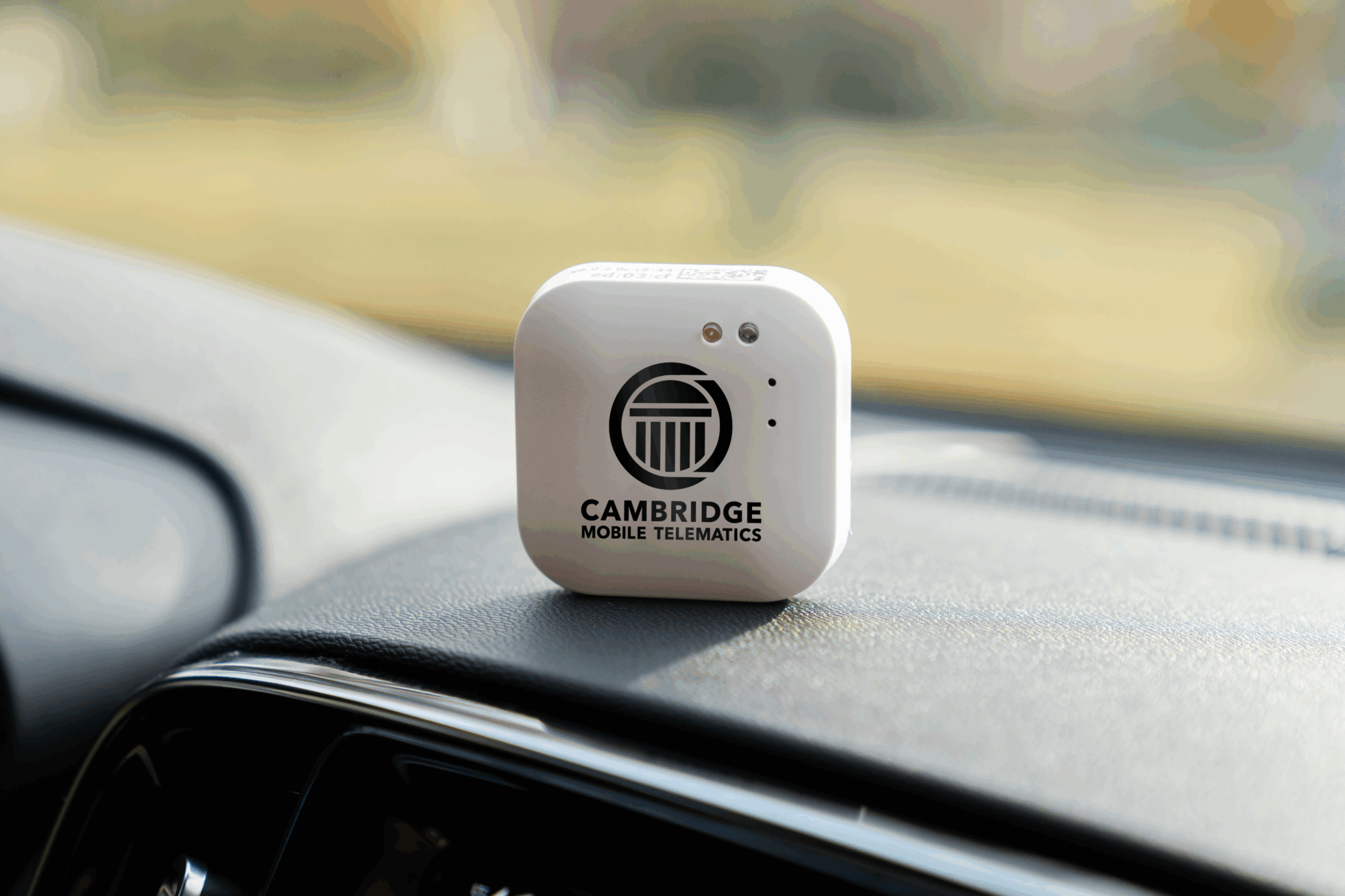
The DriveWell Tag supplies a vehicle-side reference. The roughly two-inch square sensor sticks to a windshield, uses Bluetooth Low Energy and records vehicle motion even without the phone present. Its published battery-life figure is four years under standard personal-line driving. The app identifies the driver; the Tag identifies the vehicle. Hardware earns its place by answering a question software alone may find awkward.
The wider platform brings those signals together with connected-vehicle and other device data. CMT’s 2022 connected-car expansion described a practical obstacle: manufacturers’ data arrived in separate formats, producing fragmented programs. Fusion gives partners a more consistent view across vehicles and devices. An insurer should not need an entirely different customer experience for each car in a driveway.
The insurer wants another visit
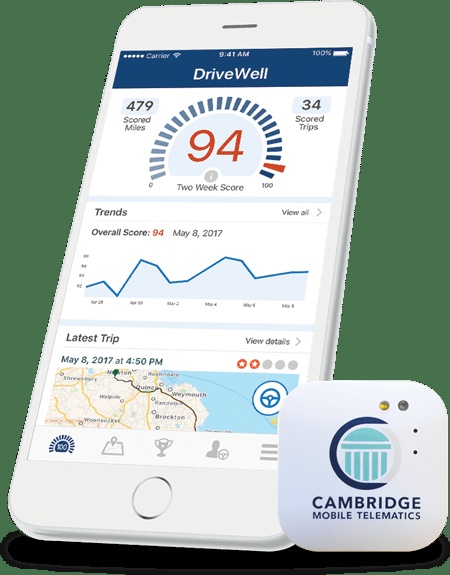
Insurance has an unusual customer-engagement problem. Many people would prefer never to think about their insurer. A claim supplies a memorable encounter, though seldom a cheerful one. CMT’s DriveWell Engage creates reasons to return earlier: trip ratings, trends, rewards, leaderboards and family sharing. Drivers can earn points redeemable for gift cards in programs that offer those features.
There is a commercial logic to the friendliness. The insurer wants better risk selection and fewer costly claims. The driver wants a lower premium, useful coaching or reassurance. A program can align those interests, provided its scoring feels credible and the reward feels worth the effort. CMT supplies the tools; its partners decide the insurance terms. A good score is no promise of a particular discount.
One public example makes the reward concrete. Kentucky’s spring 2025 teen-driving challenge used a CMT-powered app and offered four prizes totaling $5,000. That was the prize budget, not the cost of deploying the technology. The distinction matters. CMT’s business is enterprise software, analytics and hardware delivered through partners; the cost of an individual program depends on the commercial arrangement.
A driving score has to earn the next visit.THE ENGAGEMENT PROBLEM
The lesson a reader can copy is modest: choose a behavior people can recognize, return understandable feedback and make improvement worth repeating. A fleet manager might coach phone use rather than wave at a vague safety score. A parent might discuss one recorded trip with a teenager. The system is most useful when someone has both the authority and the patience to act on its findings.
A brake is not a confession
Hard braking can signal poor anticipation. It can also mean someone stepped into the road. Context changes the interpretation. CMT introduced DriveWell Atlas in October 2025, describing foundation models that learn patterns of force, motion and trajectory rather than relying entirely on separate classifiers for predefined events. Its stated aim includes distinguishing defensive maneuvers and harmonizing incomplete data. That is a product ambition, not permission to treat every interpretation as certain.
The less glamorous refinements are equally revealing. An October 2024 release improved driver/passenger classification, simplified Tag activation and addressed transfers to new phones. Claims Exchange added a combined view when two parties in a crash use CMT technology. DriveWell Crash & Claims supports detection, assistance and reconstruction; DriveScape adds video context. Each tackles a different point where raw motion alone is insufficient.
Continued participation matters too. CMT’s 2023 analysis of eight states found that initial distraction reductions after hands-free laws had faded: the early average reduction was 13%, yet distraction was 3% above the pre-law baseline by the end of 2022. Those observations concern legislation, not a failed CMT deployment. They do, however, challenge the comfortable assumption that one intervention changes a habit forever.
Trust is another operating condition. CMT says people opt into its programs, can opt out and that it does not sell driving data to third parties. The partner’s terms still deserve a read. Useful measurement requires the right trip, the right person and a working collection setup; crash response also needs an assistance workflow. Collecting a signal is only one part of delivering help.
The money follows the distribution
The financing has been substantial. SoftBank Vision Fund announced a $500 million investment in December 2018. On March 24, 2026, CMT announced another $350 million, led by TPG and Allianz X with State Farm participating. Together those two announcements amount to $850 million. Capital raised is not revenue, development cost or a price list.
“I want CMT to leave the world better than we found it.”WILLIAM V. POWERS · CMT CAREERS
Funding amounts, not revenue or program prices.
The 2026 deal also brought long-term agreements with Allianz entities for European insurance and mobility offerings. That is strategically more revealing than the headline number: capital arrives alongside a route to customers. Earlier acquisitions supplied another route. TrueMotion joined in 2021 and Amodo in 2023, adding operations, relationships and geographic reach.
CMT competes in insurance telematics, where OCTO also offers driving-risk scores and connected services. Fleet buyers have additional alternatives in video and management systems. CMT’s particular pitch combines multiple sensor sources with behavioral engagement and claims tools. Its latest DriveWell Fleet offering takes that approach into commercial-auto insurance, combining existing telematics-provider feeds with Tag Pro and Tag Max hardware.
September makes the point
The same measurements can describe a road as well as a policyholder. StreetVision, launched in September 2025, gives public agencies roadway-risk analytics and a way to assess countermeasures. Its appeal is timing: identify a behavioral pattern and inspect the effect of an intervention while it is still possible to adjust the work.
In September 2026, Admiral and CMT examined 152 million UK trips from August and September in 2023-2025. At 8 a.m. during the first week back at school, phone screen interaction was 7.2% higher than on the remaining September weekdays. The measure was specific: tapping a screen while driving above 9 mph. The study used aggregated, anonymized, opt-in data; it describes that observed sample rather than every British driver.
The finding needs no futuristic interpretation. School returns, traffic changes and familiar habits meet unfamiliar pressure. A company that began with taxis reading the road now gives insurers and communities a way to notice such mismatches. CMT’s proposition rests on what happens next: put the phone away, adjust a program, coach a driver, review a dangerous junction. The witness has done its job only when somebody listens.