A good insurance customer can be a remarkably boring character: gentle on the brakes, unhurried through corners, content to leave the phone alone. IMS has built a business around making that kind of boredom visible. Its software turns ordinary journeys into driving scores, coaching prompts, rewards and, when things go wrong, evidence of what happened in a crash.
The company sits behind the brands motorists recognize. Insurers buy its technology to price risk, communicate with policyholders and handle claims. Drivers get an app, sometimes accompanied by a small device in the car. The commercial proposition is easy to understand: fewer collisions can mean fewer claims. Getting someone to change a habit on the daily commute is the difficult part.
That makes IMS an interesting species of insurance technology company. Its work stretches from sensor engineering to the wording of a notification. A technically excellent driving score has limited value if its recipient never looks at it. An appealing reward becomes an expense if it changes nothing. IMS has to make the measurement and the motivation work together.
Before the score, a family story
The modern company has two histories. Canada’s Intelligent Mechatronic Systems, founded in 1999 by Otman Basir, developed connected-car technology and the DriveSync platform. Britain’s Trak Global, founded in 2009, brought its own telematics operations and experience selling insurance to drivers. Trak Global acquired the Canadian business in December 2018.
The British founders’ road-safety purpose had a painfully specific origin. On New Year’s Day 2007, Kamran Mahmoudzadeh lost his 18-year-old son, Anoush, in a road accident. IMS’s account describes how Mahmoudzadeh, Nick Corrie and Alan Cottrill made preventing death and serious injury central to their work.
Carrot Insurance gave that purpose a practical test. Developed from 2012, it rewarded young drivers for safer behavior and insured more than 130,000 customers over nine years. It received a Prince Michael International Road Safety Award in 2015. Operating the proposition meant dealing with real customers, including the gap between offering people feedback and persuading them to use it.

When Granite agreed to acquire Carrot, the arrangement also made IMS a strategic technology partner supplying hardware, software and professional services. The consumer business could change ownership while its supplier kept a role. That history helps explain why today’s IMS sells operating expertise alongside code.
The passenger in your phone
DriveSync is the underlying platform. It takes data from smartphones, plug-in devices, black boxes and supported manufacturer systems, then standardizes and processes it into usable driving information. IMS describes an event-driven cloud architecture built with Amazon Web Services. The practical benefit is flexibility: an insurer can choose sensors for its particular program.
OneApp provides the customer-facing layer. Insurers can configure a branded application, its navigation, messages and presentation of driving information. For companies with an app already in circulation, the OneApp SDK embeds telematics functions into existing iOS or Android software. That avoids asking customers to juggle another app solely to report journeys.
The distinction matters to buyers. They are choosing how much of the experience to assemble themselves, and how much to obtain from a supplier. IMS Labs adds professional help with program design and improvement. The business combines software, devices and services; its customers are organizations, while the people generating the data are often their policyholders.
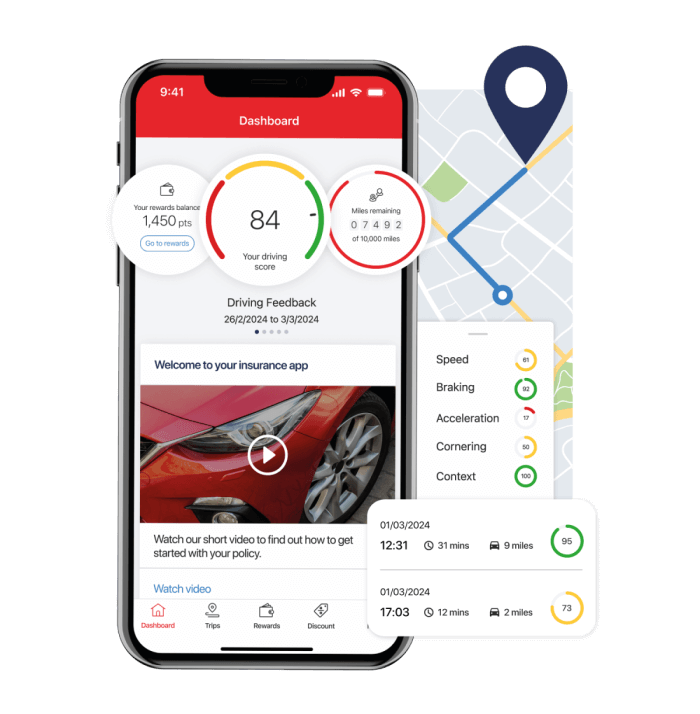
Usage-based insurance also covers different ideas. A mileage-based policy asks how far someone drives. A behavior-based policy considers how they drive. IMS supports both, along with commercial motor programs. Its expertise is in translating movement into information an insurer can use, then connecting that information to the driver’s experience.
Conceptual product flow. Capabilities depend on the selected program and sensor.
Why a reward needs an accountant
IMS’s Engagement Toolset sends messages through the app, email and SMS, triggered by driving behavior or events in the policyholder’s journey. It also supports coaching, digital gift-card rewards, audience segmentation and A/B testing. An insurer can adjust its intervention instead of sending every driver the same electronic lecture.
The economics deserve more attention than the confetti. IMS publishes an example in which reward spending equal to 1.7% of premium produced a reported threefold return through improvements in claims loss ratios. That is a company-reported program result, not a universal saving or the price of buying IMS software.
Its own product material is frank about the danger: badly executed engagement and rewards can become a substantial program cost. The useful lesson is to budget the incentive and measure the outcome together. App visits can show interest; they do not, by themselves, establish that an insurer has reduced claims.
There is a practical idea here for other businesses: connect feedback to a behavior someone can change, then test whether the message helps. A score without a clear next action leaves the customer to do the interpretation. Repeating that score more loudly does not solve the problem.
A jolt is not always a claim
When prevention fails, IMS Connected Claims takes over a different job. The product detects potential impacts, sends alerts and gives claims teams access to an Impact Portal. Its data can describe the journey before an incident and the impact itself, helping handlers investigate events rather than relying entirely on recollection.
The engineering problem is awkward. A system must notice collisions without treating ordinary jolts as emergencies. IMS describes a deliberately low event threshold, followed by detection algorithms that filter false positives. The aim is to capture useful incidents, including less dramatic ones, while controlling the noise reaching a claims team.
Alerts can arrive through email or an API. Professional services include process design, training and help interpreting claims data. This is where a dashboard meets the working day: an alert needs an owner, evidence needs interpretation, and the customer needs assistance. Buying detection technology alone does not complete that chain.
Telematics grows beyond the teenager
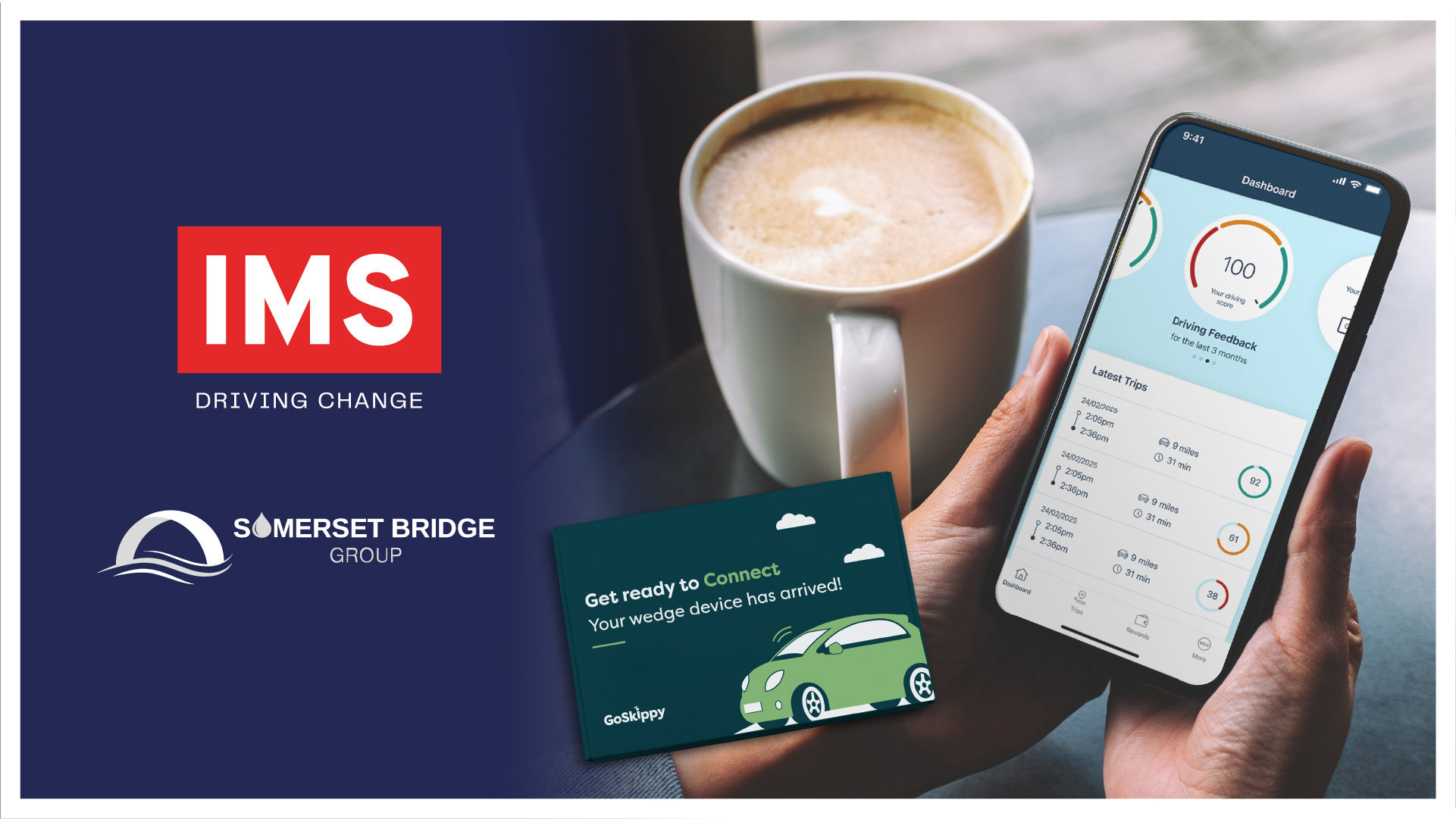
IMS’s 2026 announcements show how its market is broadening. In March, Somerset Bridge announced GoSkippy Connect, an app-based proposition using OneApp and a tailored Flexi Score model. It was designed for a broader personal-lines audience, accommodating varied journey patterns and post-pandemic commuting while remaining sensitive to unsafe driving.
Somerset Bridge described a planned rollout across tens of thousands of policies. That is a deployment ambition, rather than an achieved customer count. The distinctive detail is the scoring design: a product intended for a varied driving population needs to reflect the journeys that population actually makes.
January brought another application: Motability Operations’ Drive Smart initiative for Scheme customers with a driver under 30 on their lease. It combines OneApp with the Bluetooth Wedge device, offering feedback and educational content. The stated objective links safer driving to managing insurance costs within a vehicle-leasing scheme serving disabled people.
In February, IMS announced an integration with High Mobility that turns supported Volkswagen vehicles’ embedded data into driving-risk scores. Following a pilot, it became available for insurer evaluation, with driver consent. IMS presents vehicle-native signals as a complement to smartphone data. Coverage, data quality and commercial terms still determine where that combination makes sense.
The permission slip is part of the product
IMS’s own consumer research reveals a stubborn obstacle. In its UK sample, 72% were open to usage-based insurance in principle, but 62% were concerned about sharing personal driving data. Those responses can coexist. Liking the prospect of a tailored premium does not mean liking the prospect of being tracked.
IMS survey, April 2025. UK sample: 1,044 people aged 25-54. Separate questions; responses are not mutually exclusive.
The study covered more than 5,000 drivers across five countries; the UK participants were aged 25 to 54. Its findings should be read within that scope. They nevertheless expose a product problem that better sensors cannot settle: customers need to understand the exchange they are entering.
“Insurers must treat data access as a privilege, not a given.”Andrew Brown-Allan, IMS · January 2026
That is also a competitive issue. Cambridge Mobile Telematics and OCTO offer overlapping capabilities, including driving feedback and insurance analytics. IMS’s case rests on its combination of sensor choice, configurable experiences, claims tools and operating history. A buyer has to judge the whole program, including its explanation to customers.
Two batteries, and the work after launch
Some of IMS’s most revealing product detail is refreshingly physical. In September 2026, it described the Wedge’s two standard CR2477 batteries, replaceable by hand without tools in under five minutes, with roughly two years of battery life. Maintenance is an unglamorous consideration until thousands of customers need it.
The company also applies telematics to road-use charging, supporting programs that collect mileage information for transportation funding. That extends its expertise beyond insurers. Its road-charging history includes work in Oregon and other North American jurisdictions, with several collection methods suited to different program requirements.
Building this business required capital as well as algorithms. In August 2019, parent Trak Global Group announced more than US$50 million in growth capital through a significant minority investment from Three Hills Capital Partners. The stated uses included platform development, new services and North American expansion.
The lasting challenge is more ordinary than the financing announcement. Someone must install the app, understand the feedback, trust the data arrangement and find the experience worth continuing. IMS supplies much of the machinery. Its value is tested on the next journey, when a driver decides what to do differently.