The assay in six lines
- ForteBio's Octet measures molecular binding, affinity, kinetics and concentration in real time.
- A fiber-optic biosensor dips into a microwell; the sample does not travel through tubing.
- Customers span academic labs, biopharma discovery teams, process developers and regulated QC groups.
- Revenue comes from instruments, recurring biosensors and kits, software, service and compliance support.
- The company disclosed $42.3 million across its Series B and C rounds.
- After Pall and Danaher, ForteBio became part of Sartorius in 2020.
Picture two proteins meeting in a drop of liquid. One is a therapeutic antibody; the other is its target. They come together, stay for a while, then part. To a researcher, this is not romance. It is rate constants: how quickly they associate, how quickly they dissociate, and how tightly they bind. The awkward part is watching. For years, the standard performance involved labels, plumbing, or both. ForteBio's contribution was to look at the stage directions and ask why the sample had to move at all.
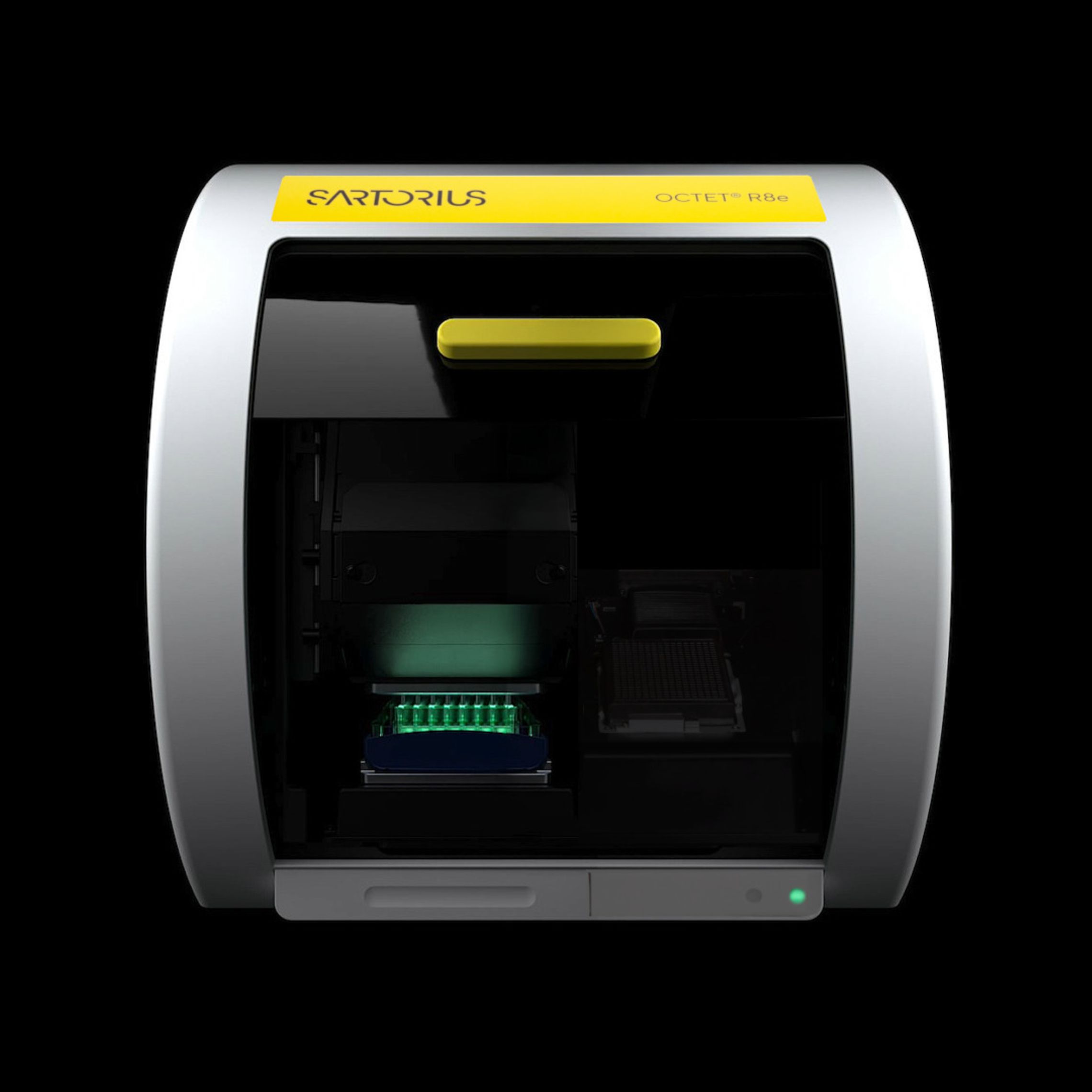
Its Octet platform put biological material into an ordinary multiwell plate and lowered fiber-optic biosensors into the wells. White light traveled down each sensor. Some reflected from an internal reference layer; some reflected from the biological layer on the tip. When molecules bound, that outer layer became optically thicker, shifting the interference pattern. The instrument followed the shift over time. No fluorescent tag had to be attached. No radioactive marker was needed. The sensor simply watched the layer grow and shrink.
The first thing to fail was the workflow
ForteBio did not discover that light could report a change at a biological surface. Its sharper insight was operational. In conventional flow-based interaction systems, samples and buffers travel through narrow channels. That architecture can deliver exquisite measurements, but it also brings pumps, tubing, cleaning cycles and serial work. The instrument spends time moving one sample after another. A clog or carryover problem is suddenly part of a scientist's day.
Octet reversed the traffic. Sensors moved among rows of wells while samples stayed where a liquid-handling robot expected them. Parallel channels could read several interactions at once. Crude cell-culture supernatant or lysate could often be analyzed without elaborate pretreatment. Because the sample was not consumed by a flow path, it could be recovered for another assay. The breakthrough, in other words, was partly a scheduling decision.
Keep the sample still. Move the inexpensive part. Let parallelism do the rest.
That is the copyable lesson. Look for the object in a workflow that everyone assumes must travel, be washed, or be custom-built. Then challenge the motion itself. ForteBio's design replaced a fluidic maze with a plate, a shaking stage and sensors that could dip. The change did not abolish experimental craft, but it moved effort away from instrument housekeeping and toward assay design.
A machine, followed by a habit
ForteBio was founded in 2001. Hong Tan is identified as founder and early CEO and CTO; Winnie H. Wan as co-founder and founding chief executive. In 2005 the company raised a $17.3 million Series B while preparing to launch its first Octet platform. The initial target was therapeutic antibody and protein selection - a corner of drug development with many candidates and an urgent need to rank them quickly.
A $25 million Series C followed in 2008, led by OrbiMed with MPM Capital and earlier backers. ForteBio said the money would support new products, global expansion and profitability. The stated cost of getting from launch into scale, at least in those two disclosed rounds, was $42.3 million. The price Pall paid to acquire ForteBio was not publicly disclosed.
The durable part of the model was not only the instrument. Every experiment needs a sensor surface that captures the right kind of molecule. ForteBio developed a menu of sensor chemistries for antibodies, His-tagged proteins, streptavidin-biotin work, small molecules and other applications. Sell the reader once; sell the vocabulary it reads repeatedly. Add analysis software, service, training and validation support, and the device becomes a platform.
From screening bench to quality-control room
Early discovery teams can use Octet to rank antibody candidates, map epitopes or screen fragments. Cell-line and process-development groups can quantify active protein directly from culture samples. Manufacturing and QC laboratories can adapt the same underlying measurement to ligand-binding, potency, impurity or lot-release assays. Sartorius now sells 21 CFR Part 11 software, qualification materials and validation services around the platform.
That widening matters. A clever research instrument can remain a departmental curiosity. A method that follows a molecule from discovery into regulated work becomes institutional memory. Sartorius says Octet products appear in more than 7,000 peer-reviewed publications and points to uses of BLI data in regulatory submissions involving medicines from companies including Pfizer, AstraZeneca and Roche. It is evidence of a method becoming familiar, not merely a machine becoming popular.
That last move was corporate pinball with an antitrust flipper. Danaher needed to divest assets to complete its acquisition of GE Biopharma, now Cytiva. Sartorius bought a group of businesses for $825 million. ForteBio accounted for close to half the acquired group's 2019 revenue and employed about 200 people worldwide at closing, according to Sartorius. The deal price covered several businesses, so assigning the entire $825 million to ForteBio would be fiction.
The alternatives still have teeth
Octet competes most directly with other BLI systems from Gator Bio and with surface plasmon resonance platforms such as Cytiva's Biacore, Carterra's LSA and Nicoya's Alto. ELISA and protein A HPLC remain alternatives for narrower quantitation jobs. ForteBio's pitch is strongest when a lab values parallel plate workflows, crude-sample compatibility, recoverable samples and less fluidic maintenance. High-throughput antibody work is an obvious fit.
Fluidics-free does not mean judgment-free. Weak surface chemistry, excessive ligand loading, non-specific binding, mass-transport effects or poor reference subtraction can still produce persuasive-looking nonsense. Very small molecules and specialized interaction problems may favor a different sensitivity range or an SPR workflow.
This is also what cannot be copied cheaply: a broad catalog of reliable surface chemistries, years of application knowledge, compliant software and a service organization that can help a customer turn a curve into a method. A startup can imitate a physical gesture. It takes much longer to become the lab's trusted answer when that gesture misbehaves.
What changed their mind?
Not one dramatic failure, at least not one preserved in the public record. The more interesting change was conceptual: stop treating the instrument's plumbing as inevitable. ForteBio moved the disposable sensor, arranged the samples in a familiar plate, and let optical interference report the encounter. That choice opened a path from a single clever measurement to parallel screening, recurring consumables and regulated assays.
The company name is now quieter than its product. Pall acquired ForteBio, Danaher acquired Pall, and Sartorius acquired ForteBio from Danaher. Yet Octet survived each ownership change. Products tend to endure when their central instruction can be explained in three words. Dip. Read. Decide.