In December 1998, Hong Tan walked out of a startup in Boulder into darkness and falling snow. He had been fired. The company was developing a high-capacity floppy disk, and Tan headed electronics and servo-control engineering. Twenty years later, he would remember the job less for the device than for a particular mismatch: management was preparing a factory while the product still needed work.
In Tan’s telling, the market was slipping away, financing was tightening, and the company had hired an outside firm to design a full-scale manufacturing facility. He objected. Six months after his departure, he recalled, the business closed. A factory is an expensive place to discover that your timing is wrong.
By the time he wrote about that episode on New Year’s Eve in 2018, Tan had spent eighteen years starting businesses himself. The memory had become a management reference point. His daily work, he explained, included avoiding the mistakes he had watched at that earlier employer. For an entrepreneur associated with an invention, it is a useful place to begin: with a product that never quite arrived.
A factory ahead of its product
The dismissal sits behind a career that eventually produced ForteBio and helped bring biolayer interferometry, or BLI, into laboratories. It also complicates the neat version of an inventor’s biography. Tan’s experience includes the awkward interval between designing equipment and making a business out of it. A promising mechanism leaves plenty of room for a badly sequenced company.
His objection in Boulder concerned the order of operations. Spending on manufacturing could not settle questions still open in development. That distinction would matter in later ventures, where he took responsibility for both technical ideas and the facilities that made their components. The attraction of a finished production line is understandable. It looks wonderfully decisive. Unfortunately, equipment does not acquire customers by looking decisive.
Following the light
Tan’s engineering education crossed institutions and disciplines. He earned a BSEE at Xi’an Jiaotong University, followed by an MSEE and doctorate at Auburn University. His subsequent work included data-storage companies such as Iomega, Seagate and Maxtor. He also worked on the control system for NASA’s High Energy Imaging Device telescope project. These were jobs concerned with making physical systems behave precisely.
In 2000, he founded Wave Crossing, a fiber-optic component business. It developed self-focusing lens technology for optical networks. Tan’s responsibilities extended into commercialization and the establishment of research and manufacturing facilities in China. The work joined a small optical component to the much larger problem of producing something useful in quantity.
ForteBio followed in 2001. The move carried optical engineering into a different setting: the measurement of molecular interactions. The customer’s question changed. Light remained a way to obtain an answer. Looking across the two companies, the continuity is easier to see in the hardware than in the industry labels.
Fiber-optic components
Optical biosensors
A return to BLI
The tip does the travelling
BLI makes a very small physical change observable. A sensor carries a layer of molecules at its tip. When a binding partner attaches, the optical thickness of that layer changes. White light reflected from the sensing region and a reference layer produces an interference pattern. Track the pattern’s shift over time, and the instrument can follow the interaction.
The measurement can show molecules associating and dissociating. How quickly does binding develop? How quickly does the partner come away? Those are different questions from simply asking whether something is present. A curve preserves the sequence of events, giving the experiment a clock as well as a result.
The physical arrangement matters as much as the optical principle. In the dip-and-read format, sensors enter samples held in microwell plates. Multiple measurements can proceed together. The format avoids the complex microfluidics used in some other instruments, and BLI does not require fluorescent or radioactive labels to produce its signal.
That makes the technology easier to understand as a piece of laboratory work. There are samples to prepare, surfaces to choose and measurements to interpret. The design organizes those tasks around a tip and a plate. At MIT’s Biophysical Instrumentation Facility, an Octet platform is available for concentration measurements and interaction kinetics. A founder’s technical proposal has become equipment researchers can book and use.
A company has to make the second one, too
Getting there took more than an optical insight. Tan later recovered an old ForteBio all-hands note and used Apple’s text recognition to extract it. The note recalled exhausted seed money, a departing partner and a venture investor who doubted the proposed fiber-optic biosensor could work. In Tan’s account, that investor’s firm later became a lead backer. Conviction can undergo a remarkable improvement when the evidence changes.
He also recalled bringing Winnie Wan aboard in the summer of 2003. Venture financing followed, and he assumed the CTO role after the first financing in 2004. The recovered note urged innovation across research, selling and manufacturing. It ends with an instruction that sounds useful well beyond a startup meeting.
“Let’s work not only hard, but also intelligently.”
Hong Tan, recalling a ForteBio all-hands note
The manufacturing work made that instruction concrete. Tan established and managed ForteBio’s Chinese research and production operations, where key components and millions of biosensors were produced. Each sensor had to carry the idea into another experiment. The first working example and the millionth usable component belong to the same invention, but they ask rather different things of its maker.
His experience with Wave Crossing had already put development and production in the same job. ForteBio gave that combination another application. The biography is often compressed to a founder’s name and an acronym. The fuller version includes facilities, repeatable processes and colleagues who understand the chemistry at the end of the optical system.
Back at the bench, with an alligator
Robert Zuk is one of those colleagues. An experienced developer of biosensors, Zuk worked with Tan at ForteBio and later co-founded Gator Bio with him in 2017. Tan serves as CEO; Zuk is the co-founder and CTO. Their collaboration links the earlier platform to a new company working on instruments, sensor surfaces and the software around the measurement.
Tan has given the company’s name a pleasantly literal explanation. When the cover of its first Gator Prime instrument opened, the shape reminded him of an alligator’s head. Laboratory equipment is usually asked to suggest precision and reliability. This piece also supplied a reptile. The first Prime instrument reached the market in 2019.
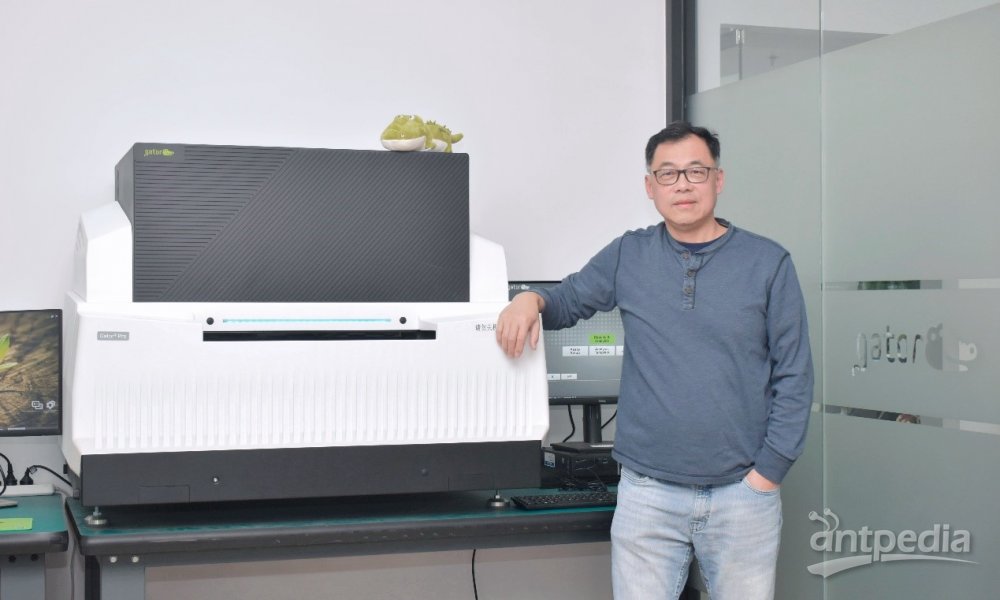
In that interview, Tan described an ambition to build a business with multiple analytical platforms. He also described the less picturesque work required to get there: teams, supply chains, sales channels and application material. Starting again meant rebuilding an organization around the technology. Familiarity with the underlying physics could help; it could not fill every role.
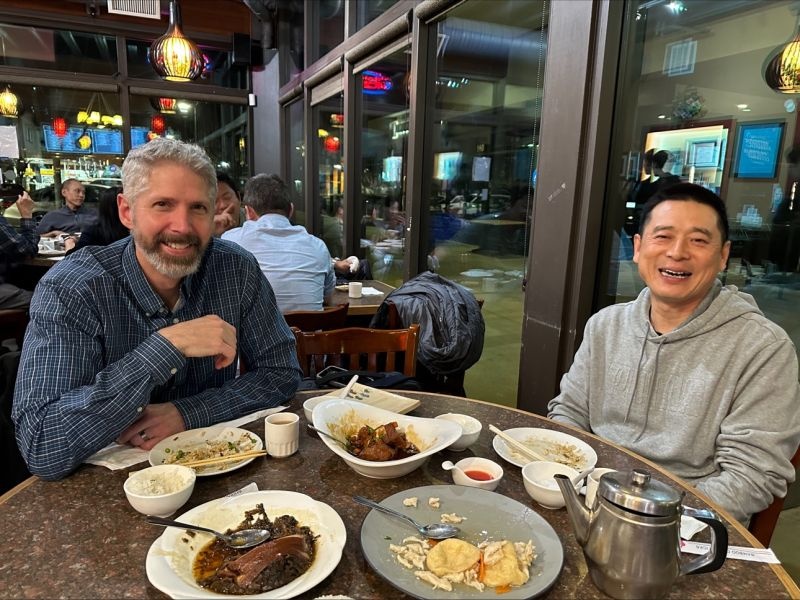
His public posts include smaller glimpses of that working world. He shared a dinner photograph of two ForteBio veterans now at Gator Bio, describing a conversation about the industry and future plans. In a Halloween post, he joked about Mario coming to help. The instrument business evidently has room for both long technical discussions and the occasional visiting plumber.
The queue after the algorithm
The recent partnerships show where his attention is going. In December 2025, Gator Bio and Monod Bio announced plans to incorporate one of Monod’s computationally designed NovoBody binding proteins into a biosensor. Monod would supply the binding protein; Gator would handle manufacturing, sales and marketing. The agreement puts protein design into the working surface of an instrument.
There is a useful circularity here. BLI can characterize the interactions of computationally designed molecules. A designed molecule can also become part of the tool doing the characterization. The physical experiment remains necessary in either direction. A proposed protein arrives with questions that a rendering or a prediction cannot settle on its own.
In February 2026, Gator Bio and Hudson Lab Automation announced another collaboration, this time integrating Gator instruments with plate-handling automation. The companies reported capacity rising from 400 manually processed samples to more than 1,200 per day, depending on the workflow configuration. That qualification belongs beside the number: throughput describes an entire sequence of tasks.
Samples per day. Company-reported figures; capacity depends on workflow configuration.
The collaboration addresses a practical consequence of generating more candidates: somebody must get them through the experiment. Moving plates, scheduling runs and coordinating instruments affect how much useful data comes out. The mechanical details have a way of reclaiming attention after the exciting presentation is over.
Tan’s career has repeatedly brought him to that junction. A component must become a product. A product must become reproducible. A measurement must fit into a day’s work. From the prematurely planned factory in Boulder to automated plate handling at Gator Bio, the sequence keeps mattering. He has changed companies and applications. The next usable instrument still has to be built.