For a person receiving treatment for a blood cancer, a respiratory virus can be more than an unwelcome visitor. Pulmotect has built its current clinical program around that predicament: patients whose defenses are compromised, an infection already detected, and the possibility of complications in the lungs. The company’s experimental answer comes through a nebulizer. Its target is the patient’s own lung lining.
- The idea: activate local immune defenses with an inhaled drug, PUL-042.
- The test: a Phase 2 study planning 100 cancer or stem-cell transplant patients.
- The catch: broad protection in animals still needs convincing evidence of benefit in people.
A different place to aim
The name sounds reassuringly ordinary: epithelial cells. These are the cells lining the airways, occupying the boundary between the outside world and the body. Pulmotect’s proposition begins here. The boundary has defensive machinery. Could a medicine prompt that machinery to respond more effectively when microbes arrive?
PUL-042 combines two synthetic molecules, Pam2CSK4 and ODN M362. They stimulate different members of the Toll-like receptor family, TLR2/6 and TLR9. The intended result is a local innate immune response, including antimicrobial peptides and reactive oxygen species. Think of a surface that can respond to an intruder, rather than passively waiting for help.
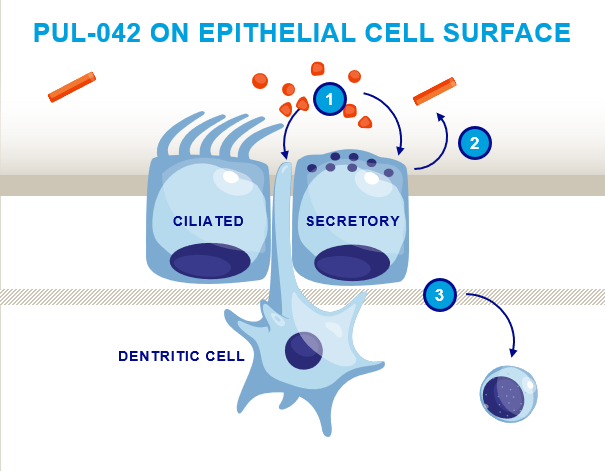
That helps explain the company’s phrase “pathogen agnostic.” The drug acts on the host’s response, potentially making its usefulness less dependent on a particular invader. Protection against viruses, bacteria and fungi has been demonstrated in animal models, including immunosuppressed animals. That breadth is the scientific attraction. Human clinical benefit is a separate question.
Pulmotect was founded in 2007 around technology licensed from MD Anderson Cancer Center and the Texas A&M University System. Its co-founders include Brenton Scott, Burton Dickey and Magnus Höök. The connection to respiratory biology runs deep: Dickey’s research concerns airway defenses, while work in scientific adviser Scott Evans’s laboratory led to the discovery of the lead compound.

The experiment that said: not so fast
In 2021, Pulmotect described redirecting resources from its cancer program toward COVID-19. A pandemic had supplied an urgent opportunity to test its approach. The Department of Defense awarded up to $6 million to help complete two Phase 2 studies. One examined people exposed to the virus; the other enrolled people already experiencing early symptoms.
The prevention study randomized 217 participants. It found no statistically significant difference on its primary endpoint, a measure of clinical progression. Only 12 participants tested positive during the study, including six positive at entry. An expansive premise had met an awkwardly small set of infections.
The separate, 101-person treatment study produced an encouraging signal: median time to respiratory symptom improvement was six days with PUL-042 and nine with placebo. That was a symptom finding in an exploratory program. It did not establish broad prevention or settle whether the drug could prevent serious complications in vulnerable cancer patients.
- Animal modelsProtection across pathogen classes
- Early human trialsTolerability and exploratory signals
- Current Phase 2Testing complications in a defined patient group
One hundred patients. Three viruses.
The next experiment is more specific. Pulmotect announced dosing in its cancer-patient trial in July 2025. The registry lists an actual start of June 27, 2025. Its August 2026 update still describes the study as recruiting, with 100 planned participants and estimated completion in May 2027.
Participants have hematologic malignancies or qualifying hematopoietic stem-cell transplants, together with documented parainfluenza virus, human metapneumovirus or respiratory syncytial virus infection. PUL-042 or saline placebo is administered three times over six days. Follow-up examines what happens as the infection unfolds.
The primary outcome uses a radiologic severity index to assess lower respiratory complications over 28 days. The score examines lung infiltrates across six zones. Secondary measures include oxygen use, hospitalization, viral shedding and adverse events. This gives the program a concrete question: does activating local defenses produce a measurable difference where these patients need it?
“This clinical trial is a key stepping stone in our development program with PUL-042.”Colin Broom, CEO / July 2025
The clinical problem also demands more than receptor expertise. CEO Colin Broom, who joined in September 2019, previously led Nabriva Therapeutics and served as chief scientific officer at ViroPharma. His background spans anti-infectives, oncology and pulmonary medicine. Pulmotect has assembled a team whose public biographies cover the distance from laboratory research to clinical operations and commercialization.
The price of asking properly
Two announced funding commitments support this chapter: an $8.9 million CPRIT grant awarded in 2023 and a $5.9 million Series C announced in September 2024. Fannin Partners led the equity round, with Axil Capital participating. Together, those figures describe $14.8 million of announced support for the program and further development. They are funding commitments, not an itemized trial bill.
2023
2024
This is a drug development business built around licensed intellectual property, private capital and public research support. Its prospective beneficiaries are patients; its current work happens through clinical research. PUL-042 remains investigational. There is no approved product here for a hospital buyer to add to a purchasing list.
A broad idea needs a narrow test
In the respiratory market, Pulmotect’s distinction is the point of intervention. Vaccines prepare immune responses; pathogen-specific drugs attack particular infections. Pulmotect is investigating whether local host defenses can offer another useful approach. Its own study compares treatment with saline, so it cannot yet claim superiority to a competing medicine.
The limits are practical. Early treatment in a selected population cannot establish rescue treatment for advanced lung damage. A favorable animal experiment cannot establish human efficacy. Tolerability cannot establish effectiveness. The company’s future possibilities in COPD, asthma and seasonal infections remain possibilities.
For other founders, there is a copyable discipline here: give a broad mechanism a defined population, a measurable outcome and financing matched to the experiment. Pulmotect’s lesson remains provisional. Its next useful contribution could be a treatment that helps vulnerable patients, or a clearer account of where the biology falls short. The trial has to be allowed to answer.