Before Sandeep Menon worked on products used around the world, he had a much smaller example of good customer service: his father's banker. Growing up in a small town in India, Menon saw a banker who understood the family's circumstances and could offer advice that fitted them. The relationship had something a database alone cannot supply. The person on the other side of the desk knew what mattered.
Years later, Menon would help market Android, Chrome and Google Pay. Then he would co-found Auxia, which uses artificial intelligence to decide how companies should interact with individual customers. The distance between those two worlds is enormous. The underlying ambition is surprisingly familiar: remember the person, understand the situation, make yourself useful.
Software has become very good at remembering. Making itself useful remains a more demanding assignment. Anyone who has received an enthusiastic promotion for something they bought yesterday can appreciate the distinction. Menon's career has brought him to that awkward space between having the information and knowing what to do with it.
The engineer who learned to find customers
Menon studied mechanical engineering at the National Institute of Technology Karnataka, then earned an MBA at INSEAD in 2006. His LinkedIn education entry records a place on the Dean's List. Before Google, he worked at SAP as a product management lead for mobile business solutions. The combination put engineering, product decisions and commercial questions in the same career.
At Google, one early responsibility was small-business marketing across Europe, the Middle East and Africa. He helped lead the global launch of Get Your Business Online, an initiative that helped more than a million businesses establish an online presence. Later, as country marketing director in India, his remit covered Google's marketing activity across the country.
Those jobs give his later work an interesting continuity. A small business needs a way to reach people online. A person coming online for the first time needs products that make sense in their circumstances. An enterprise with millions of customers needs to respond to each without treating everyone as interchangeable. Across those assignments, access is only the beginning of the problem.
His subsequent Google responsibilities included marketing for Android, Chrome, ChromeOS and Google Play. He became vice president of marketing for Google Payments and the Next Billion Users initiative, working on Google Pay and emerging markets. In describing that work, he has emphasized adapting products to people whose habits and experience differed from those of established internet users.
The lesson he carries into Auxia is practical: people should be able to use sophisticated systems without first acquiring the technical expertise behind them. A marketer should not need a second career in data science to ask a sensible question about a campaign. Software that requires everyone to become its specialist has rather misunderstood the arrangement.
A departure with four names attached
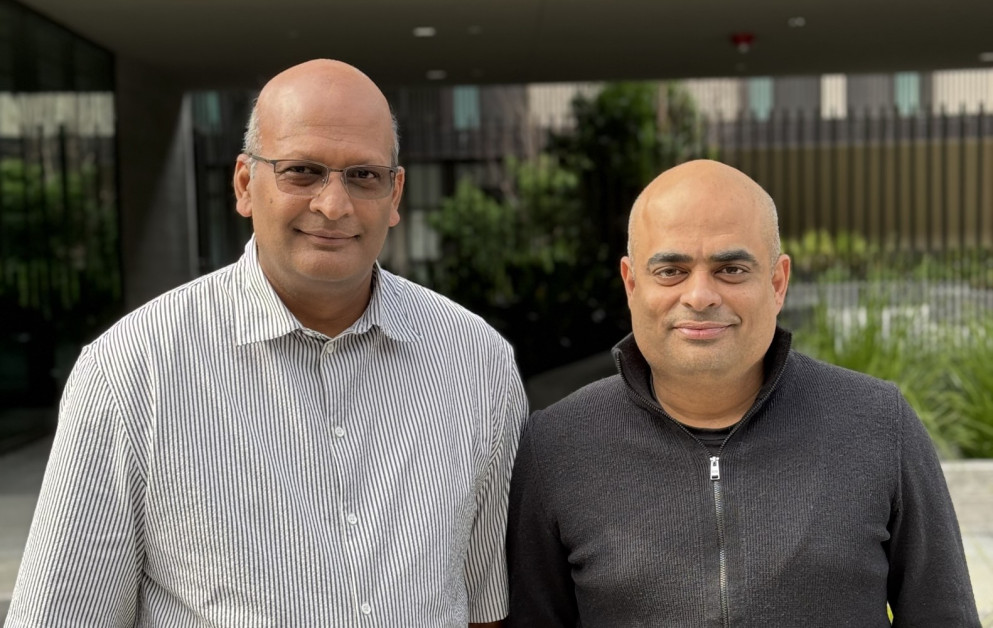
In 2022, Menon announced a new venture alongside Asim Krishna Prasad, Cole Stuart, Luv Misra and Ravi Desu. His announcement dwelt on the people he would be working with and the goals they wanted to pursue. Auxia began with experience drawn from businesses including Google, Meta and Lyft, where personalization had already become an engineering discipline.
Menon's explanation for leaving Google centers on an imbalance. Large technology companies had the people and infrastructure to use customer signals in real time. Elsewhere, companies had assembled considerable stores of data, often in cloud warehouses, but struggled to turn that information into a timely decision. The raw material was available. The ability to work with it was unevenly distributed.
That is a more specific founding problem than the fashionable desire to put AI into something. Auxia set out to connect what a company knows about a customer with what it should do next. Its service launched in early 2024. The interval matters: Menon has described spending more than a year developing the infrastructure before the company could deliver personalization at the scale it intended.
The banker could remember a family and adjust the conversation. A system serving millions of people has to perform the corresponding work while messages, purchases and product activity keep changing. Remembering yesterday is insufficient when the useful moment is happening now.
People set the objective and the boundaries. Each response informs the next choice.
The case for leaving the inbox alone
Auxia's decision system considers possibilities across web pages, apps, email and SMS. A customer might need help completing a sign-up, a prompt to try a feature or an offer connected to an earlier purchase. Selecting a message is one part of the job. Timing it, choosing a channel and understanding its place among other interactions complicate the assignment.
Menon makes an unusually welcome qualification for someone selling marketing software: sometimes the system concludes that sending a message will add no value. In that case, he says, it does not send one. He describes that restraint as part of being authentic. It is a modest proposition with considerable appeal to anyone whose inbox has become a crowded room of brands clearing their throats.
His account also leaves responsibility with the marketer. People set the strategy and decide the limits within which the system operates. An agent's ability to act does not settle whether an action is appropriate. The customer experiences the result of those choices, whatever machinery sits behind them.
This makes Auxia's human problem as interesting as its technical one. Menon has talked about the difficulty of changing how teams work: aligning stakeholders, explaining automated decisions and helping people feel able to use the system. A successful demonstration cannot do all of that. Someone still has to trust the recommendation enough to put it into practice.
The money came with a decision of its own
In March 2025, Auxia announced $23.5 million in combined seed and Series A funding. VMG Technology Partners led the financing, with investors including MUFG Innovation Partners, Incubate Fund, Vela Partners and Stage 2 Capital. Individual backers included Google chief marketing officer Lorraine Twohill, Booking.com chief marketing officer Arjan Dijk and former Facebook chief business officer David Fischer.
The funding story contains a revealing detail. Menon later said Auxia had originally intended to raise a smaller amount. Investor demand led the company to accept extra capital. For a founder selling software that weighs possible actions, fundraising supplied a particularly consequential choice of his own.
“Our plan was to raise less than that.”
Sandeep Menon, on Auxia's funding
His accompanying point was about the value of early equity. A larger round changes what a company can spend, but it also belongs to a longer calculation about ownership and the business a founder wants to build. Menon spoke about valuing that equity carefully. The size of the announcement was only one part of his account.
MUFG offered a different kind of connection. The group was a client and partner as well as a source of investment. Menon has described working with multiple MUFG business units and building Auxia's presence in Japan. In May 2026, when asked for a favorite company memory, he recalled opening the Japan office and launching a new version of the Analyst Agent in the same week.
It is an apt choice of memory for his current job: a new market and a new product, both arriving together. Auxia also joined the Comcast NBCUniversal LIFT Labs Accelerator in 2025, giving the team another setting in which to work directly with a large enterprise.
A hundred billion small tests
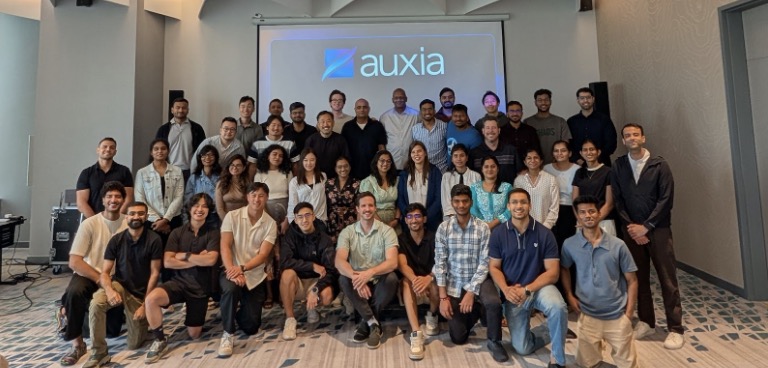
By March 2026, Menon was announcing that Auxia had crossed 100 billion decisions. The company reported operations in Palo Alto, Tokyo and Bangalore, and customers including Atlassian, Comcast, The Guardian, Mercari, MUFG and NTT Docomo. His update paired the scale figure with business results and an explanation of how customers were expanding their use.
March 2026
The count describes activity, while the outcomes supply the business argument. Among the results Auxia reported were an 84 percent improvement in cross-sell customer lifetime value and $12 million in incremental revenue impact from a single enterprise deployment in its first year. These are company-reported examples from particular deployments, rather than a promise of identical results for every customer.
Menon's broader ambition is to preserve what a team learns. A decision leaves behind context, a choice and a response. Collect enough of those records and the system may retain useful experience that otherwise remains in people's memories or disappears when colleagues leave. The comparison with the family banker becomes more interesting here: continuity mattered as much as recognition.
The next customer is the marketer
During July 2026, Menon extended his argument from customer decisions to the work of the marketing team itself. His essays examined the time consumed by briefs, approvals, reporting and coordination across tools. Even a good recommendation can arrive at a team with little capacity to execute it.
On July 23, he introduced Auxia Agent Studio. Its proposed role is to connect a team's tools and context, then help carry out campaign work, from preparing reports to coordinating feedback. Marketers can specify approvers and determine which actions require permission. Menon's product argument has widened from choosing an interaction to helping the people responsible get their work done.
He calls the intended beneficiary a supermarketer. The name has a cape; the job description has rather more reporting and fewer rooftops. His stated ambition is that agents take on execution so people can spend more time deciding what is worth doing.
The thread through his career is easier to see at this smaller scale. Help a business get online. Make a product usable for someone arriving at it for the first time. Give a marketer access to analysis without a queue of technical requests. Help a company remember enough to be useful to the person in front of it. The father's banker had a manageable number of families. Menon has spent his working life dealing with what happens when the number grows.