Matt Wheeler remembered the awkwardness. In a classroom, beside another trainee, he had to pretend to be on a customer call. The exercise was supposed to make the real thing easier. Yet, as Sallie Mae’s instructional design manager later recalled, comfort with the call flow could take months. The practice helped. Getting enough of it was the problem.
That gap is where Zenarate built its business: between knowing the answer and being able to deliver it when somebody needs help.
- Rehearse: employees practice conversations and software tasks with AI.
- Measure: interaction analysis connects coaching to customer outcomes.
- Automate: AI agents take on defined workflows, with human handoffs.
01 / The expensive first attempt
A classroom can explain a policy. A customer can interrupt it. The employee has to listen, find the right screen, remember the rule and sound like someone worth trusting. A slide deck separates those activities. A live call piles them together.
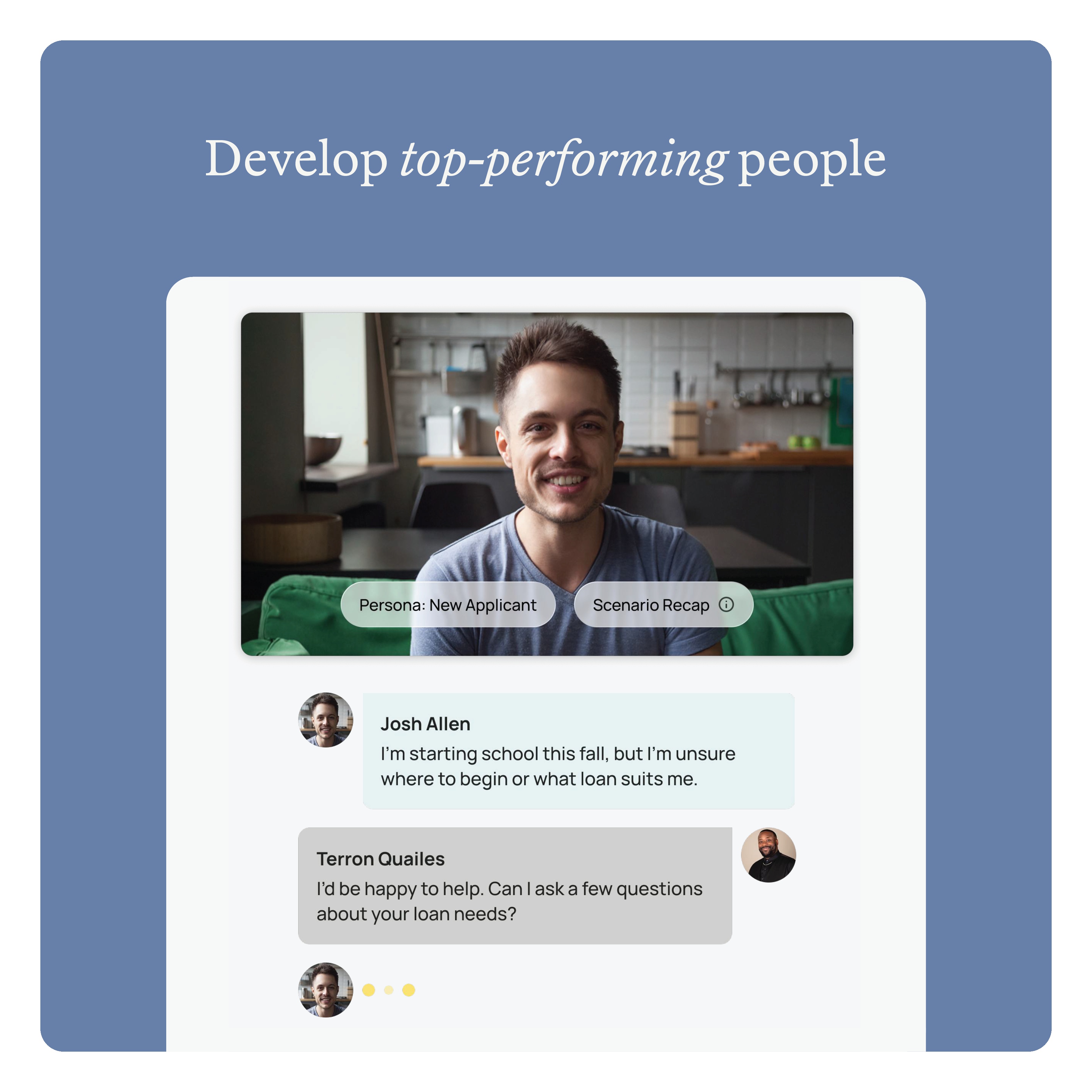
Zenarate’s simulations let employees speak in their own words and practice the associated software work. They receive feedback on specific behaviors, including tone and required practices. A manager can assign another attempt without finding a colleague to play an irritated caller.
There is useful experience behind that choice. Co-founder and CEO Brian Tuite previously ran contact centers at a top-five financial institution, according to investor Volition Capital. Co-founder Rab Govil brought enterprise software experience. The company dates its founding to 2017, well before the current enthusiasm for conversational AI.
02 / Practice gets a production budget
At Sallie Mae, the bottleneck was classroom-heavy instruction and peer role-play that resisted scaling. Zenarate supplied repeatable conversation practice, scorecards and certification tools. The published case study reports 56% faster proficiency and 32% lower employee attrition. Those are customer-specific results reported by the vendor; they should inform a pilot, rather than become its forecast.
TruGreen offers another example. The lawn-care company trains nearly 4,000 contact center agents annually. Working with Bright, now part of Zenarate, it rebuilt onboarding around simulated conversations and hands-on system practice. Training moved from roughly three weeks plus shadowing to 1.5 weeks without live shadowing.
50% shorter core training. Previous shadowing excluded from bars. Vendor-published customer case.
The case attributes $3 million in annual savings to the redesign. First-month sales closure rose 7.5 points and NPS rose eight points. The interesting detail is the combination: learners practiced both what to say and what to do on screen. Shortening the course was accompanied by better early performance.
03 / What the buyer actually buys
Today, Perform packages simulations, learning programs, certification, coaching plans and AI tutoring. Analyze examines customer interactions, identifies recurring friction and generates coaching plans. Evolve builds and operates conversational AI agents. Products can be bought separately, giving an enterprise a starting point smaller than replacing its entire customer service stack.
This is enterprise SaaS, sold through custom quotes. For a buyer, the meaningful cost calculation includes scenario design, policy maintenance, staff practice time and whatever integrations the chosen workflow requires. Savings estimates belong beside those costs. A shorter course is valuable only if employees arrive better prepared.
The market includes classroom training, LMS platforms and AI role-play specialists such as Second Nature. Zenarate’s pitch combines conversation rehearsal, software simulation and a connection to operational performance. Its expertise sits where learning design meets contact center work: the disclosure, the difficult explanation, the screen navigation and the measurable consequence.

The company reports more than 200 enterprise customer experience teams globally, across banking, insurance, healthcare, telecom and hospitality. Its users include trainers, quality teams, supervisors and technology leaders. Those groups often see different pieces of the same problem. A trainer sees the assessment; a supervisor sees the struggling employee; the customer experiences the accumulated result.
04 / The coach crosses the line
In June 2023, Zenarate announced a $15 million investment led by Volition Capital. In September 2024, it acquired Bright, adding learning and simulation capabilities. Bright founder Rob Wright joined the leadership team. An expanded HeyGen partnership followed in May 2025, bringing avatar technology into the mix.
Then came a more consequential move. Zenarate had emphasized helping employees through AI. Evolve, launched in June 2026, handles live customer interactions itself. Wright’s October rebrand essay acknowledges the tension: leadership judged AI agents unavoidable and decided its experience setting standards for people should extend to machines.
“Information is not improvement until something changes.”
Brian Tuite / October 2026
Grand Pacific Resorts makes that decision concrete. Its reservation-confirmation process involved repeated outbound calls, Salesforce updates and case closure. Evolve took over the routine workflow, and employees moved to inbound service. The case describes capacity equivalent to roughly 2.5 to three employees being redeployed. The useful unit of automation was the whole task, including the administrative aftermath.
05 / The score is only the beginning
Zenarate’s October 2026 repositioning asks whether the customer’s problem was solved across multiple contacts. A completed call can conceal an unresolved issue. A successful escalation can be the right result. That changes what an analytics system should reward and what the next practice session should teach.
The copyable lesson is practical: choose one recurring customer problem, define the behaviors that resolve it, rehearse the conversation and the clicks, then inspect live outcomes. Repeat when policies change. My reading of these cases is that practice needs this connection to operations; otherwise, a better simulation score may simply mean someone has learned the simulation.
The same logic sets the limits. Stale scenarios teach stale policies. Poorly chosen scoring criteria reward the wrong behavior. An employee cannot rehearse away a broken product or an unhelpful rule. For AI agents, reliable system access and sensible handoffs matter as much as fluent speech. Zenarate’s proposition earns its keep when the next real customer has less work to do.
That also makes adoption a management choice. Someone must protect time for practice, decide when an agent is ready and review whether the measurement matches the customer’s experience. A convincing avatar can make rehearsal feel more natural. It cannot settle those questions. The work becomes useful when a company is prepared to change its training or its process after seeing what happens.