A building can be very clever about opening a door and remarkably unhelpful about explaining why the cooling bill went up. Its equipment may be sophisticated; the conversation between its systems can still require a human, a spreadsheet and several follow-up messages. Prabhu Ramachandran saw a business in that awkward silence. He had spent years helping telecom operators make sense of complicated networks. Real estate, he thought, could use some of the same manners.
That observation became Facilio in 2017. Ramachandran and three co-founders set out to connect building data with the daily work of maintaining properties. The appeal was practical: let operators see across a portfolio, understand what needs attention and get the work moving. His career since then has followed a persistent question. Why should the people running an expensive building spend so much effort persuading its technology to cooperate?
Seventeen years before the starting line
Ramachandran’s early surroundings were a long way from the property portfolios his company would eventually serve. He came from an agricultural background. His father was a farmer, and his home village was Siruseri, near Chennai, a place that became part of Tamil Nadu’s technology expansion. The geography gives his story a particular texture: the software industry was arriving near the place where he was imagining his future.
After engineering college, he joined Zoho in 2000. He went on to head WebNMS, working on software for telecom infrastructure. In 2010, he helped extend the platform into the Internet of Things, bringing machines and their operational data into the picture. Networks were changing quickly, and the product had to change with them. A professional apprenticeship in that environment offered repeated lessons in keeping useful software useful.
He stayed for about 17 years. That length of service matters to the founding story. Facilio emerged from a substantial stretch of building products, dealing with enterprise customers and learning how software made in India could sell internationally. Before he had a startup of his own, he had a long working education in the less photogenic business of making technology dependable.
Four colleagues, one conversation
His fellow founders were Rajavel Subramanian, Krishnamoorthi Rangasamy and Yogendra Babu. They had worked together at Zoho. Ramachandran’s account of starting the company is striking for its emphasis on people who already knew one another’s work. The shared experience gave the new venture a foundation of relationships as well as technical knowledge.
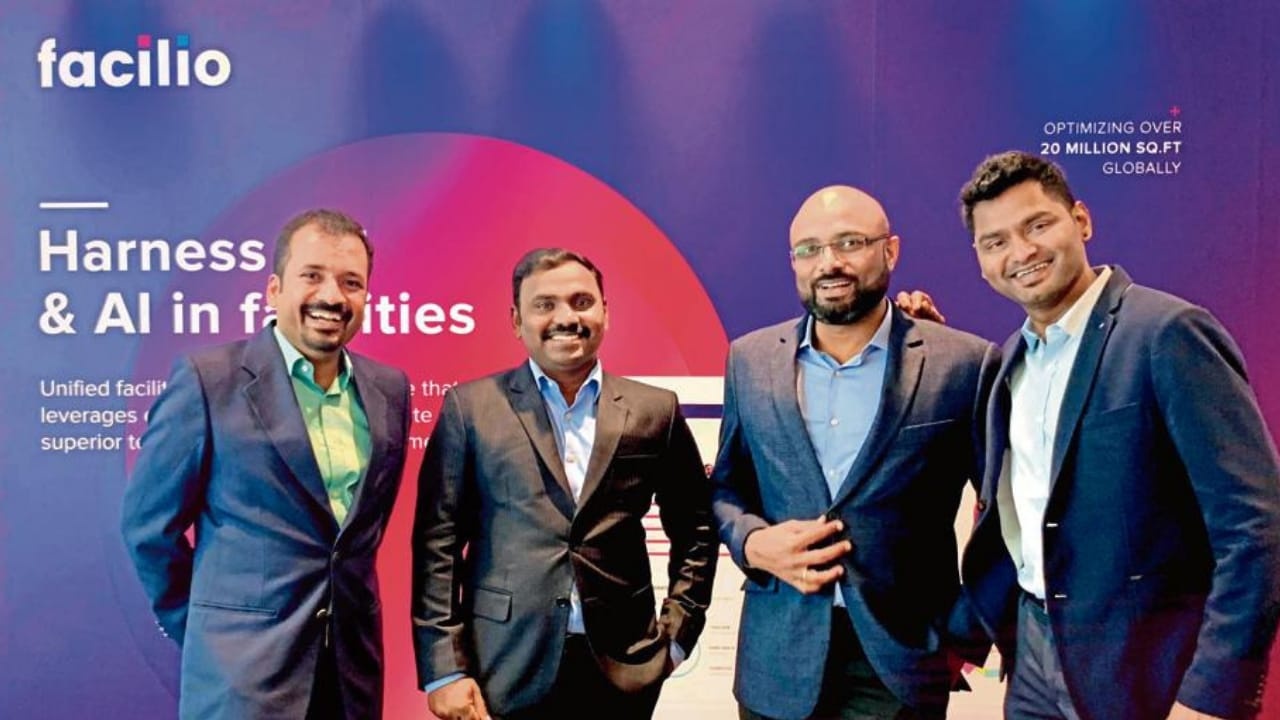
The problem they chose was fragmented operation. Commercial property teams could have automation equipment, maintenance applications and business tools from several vendors. Each might do its own job while leaving the team to assemble the whole picture. Ramachandran’s early description dwelt on scattered communication and data kept in separate places. The cost accumulated in routine work, repeated across buildings.
Facilio’s approach was to connect existing infrastructure through software. Property owners had already invested in equipment; replacing everything was a formidable proposition. Connecting those investments offered another route. Data could feed maintenance workflows, technicians could receive useful information, and managers could look across locations. The building would retain its machinery while acquiring a more coherent way of running it.
His leadership language fits that ambition. He has argued for giving colleagues ownership and room to make decisions. In an operation built around reducing unnecessary handoffs, keeping every decision at the founder’s desk would be a curious design choice.
“take ownership of their work and empower people to make decisions.”
Prabhu Ramachandran · 2019
A skyline close enough to visit
The company’s early reach was already international. By November 2018, Facilio was working across more than 150 commercial buildings and 20 million square feet in the United States, Gulf countries and India. Those are historical figures, from the young company’s first phase. They show the scale of the ambition without requiring a retrospective fairy tale about overnight success.
Dubai supplied an especially useful starting point. It offered a concentration of large properties, buyers open to new technology and straightforward access from Chennai. The founders spent time in the market. For a company trying to enter a traditional industry, being able to return to the same customers and conversations had obvious practical value. A skyline makes a handsome backdrop; a reachable customer makes a business.
Ramachandran planned around enterprise buyers and their long purchasing processes. He also favoured charging for pilots, even modestly. Money creates a reason for a buyer to expect an outcome and makes the trial pass through actual approvals. A free experiment can remain pleasantly detached from a purchasing decision. He wanted to discover whether the organization would make a commitment.
His later advice about growth kept returning to focus. Customers with many buildings had the complexity the product was designed to address. Finding the right early adopters, developing relationships and working with channel partners were parts of the job. Writing software was one discipline. Getting an established property business to trust a young supplier required several others.
The customer who bought into the company
A consequential relationship took shape around ICD Brookfield Place in Dubai. The 990,000-square-foot development opened to the public in 2020 with Facilio as its connected operations platform. Ramachandran later described it as an important early marquee customer. It gave the company a concrete example of its ideas at work inside a substantial property.
On February 22, 2022, Facilio announced a $35 million Series B. Dragoneer Investment Group led the round; Brookfield Growth joined Accel and Tiger Global as participants. Brookfield’s presence carried a particular significance. A customer relationship had become an investment relationship. The people backing the company included an organization with direct experience of the world it was trying to improve.
Led by Dragoneer, with Brookfield Growth, Accel and Tiger Global.
The money was intended to support expansion and the teams needed to serve more customers. In his own reflection, Ramachandran gave attention to experimentation, customer listening and the difficulty of finding a ready-made playbook for this kind of enterprise software business. He also thanked Accel’s Shekhar Kirani for mentorship and help sharpening execution. The public milestone had a quieter supporting cast.
By his November 2022 interview, he described a distributed workforce of more than 200 people and customers across four continents. The geographic spread brought a further management problem: maintaining an intelligible product and a useful customer relationship across markets. Growth had enlarged the operation that the founder himself needed to coordinate.
An empty room does not need applause. Or cooling.
One useful way into Ramachandran’s environmental thinking is an unoccupied room. If a building can connect information about occupancy with information about energy use, operators have a better basis for deciding when heating or cooling is needed. A routine operational decision becomes part of a larger effort to use fewer resources.
Facilio’s work with British Land and Equiem illustrates the point. Equiem contributed operational information, including data from booking and visitor systems; Facilio helped bring it together for analysis. In January 2024, Ramachandran described a reported 33% year-on-year reduction in heating and cooling energy consumption associated with the collaboration. That is a project result, rather than a promise about every building.
His recommended sequence is deliberately manageable: monitor, then predict, then optimize. Establish what is happening, learn where intervention would help and act on that knowledge. In his writing on decarbonization, he has argued that software can offer a practical starting point alongside physical upgrades. The appeal lies in improving the way existing assets operate, with decisions repeated and refined over time.
The next job is chasing less
By 2026, Ramachandran’s attention had moved further into the work between an alert and its resolution. Facilities teams could see more, yet still spend large parts of the day assigning tasks, checking documents, pursuing vendors and moving approvals along. Connecting data had exposed another layer of friction: the effort required to coordinate a response.
“Changing perceptions was harder than building technology.”
Prabhu Ramachandran · 2026
His recent discussions of AI agents focus on that layer. The proposed role is to help workflows advance, from service requests and technician routing to invoice validation. These are his company’s product priorities and ambitions. Their usefulness will be judged in the ordinary details of implementation: whether a request reaches the right person, whether an approval moves and whether an operator has less chasing to do.
That practical emphasis also appears in his approach to international expansion. In a July 2026 discussion, he stressed local credibility, customer evidence and an understanding of how buying works in each market. The software can cross borders more easily than trust. A recognizable customer, a relevant example and a sustained relationship still have work to do.
There is a consistent scale to Ramachandran’s ambition, from his early wish to build globally from India to a company serving operators across continents. There is also a consistent unit of attention: the daily job. Networks, buildings and portfolios grow complicated quickly. Someone still has to make them run. His career has become a prolonged attempt to give that person fewer systems to consult, fewer messages to chase and a better chance of finishing the task.