Imagine asking a trading desk how much risk it holds. The question sounds simple. Then come the qualifications: which positions, which prices, which moment? A trade may appear in one system before it reaches another. A familiar word can conceal an unfamiliar calculation. The trouble begins before anybody makes a bad decision. It begins when two people believe they are discussing the same number.
- TS Imagine connects trading, portfolios, risk, wealth and prime brokerage.
- Its AI platform follows a reported five-year, $100 million investment.
- The useful lesson: settle the data definitions before automating decisions.
TS Imagine has built its business around those awkward handoffs. It sells software to banks, hedge funds, asset managers and other financial institutions. Its newest argument is that financial AI becomes useful only after the underlying information has been made coherent. That turns a fashionable technology story into something closer to a story about plumbing. The bill, according to the company, reached $100 million over five years.
Two businesses. One stubborn problem.
The company took its present form in May 2021, when Francisco Partners combined TradingScreen and Imagine Software. The attraction was practical: bring electronic trading together with portfolio and risk management. An execution tells you what happened in the market. A risk calculation tells you what that event means for the rest of the book. Connecting the two gives the investment team a more useful picture.
Rob Flatley became chief executive; TS Imagine identifies him as its founder. His background crossed the same boundary as the merger: financial institutions and financial technology vendors. He had held senior roles at Bank of America and Deutsche Bank, and founded CoreOne Technologies. This matters because the buyer of trading software is buying someone else’s understanding of what can go wrong between a decision and its implementation.

The software follows the money
Consider the journey of an institutional investment. Somebody decides what to buy. Somebody finds liquidity and executes the order. Somebody measures the resulting exposure. Financing, collateral and reporting follow. TS Imagine sells modules along that journey, with TS One providing the common platform. Its commercial model is enterprise SaaS and licensing, with implementation and support surrounding the software.
TradeSmart handles order and execution management across asset classes, connecting desks to more than 250 brokers and venues. It is broker-neutral: the software connects the institution to trading counterparties. Built-in compliance checks and FIX and REST interfaces help it fit into the surrounding machinery. The company describes a typical deployment as four to six months, a useful reminder that institutional software still requires institutional work.
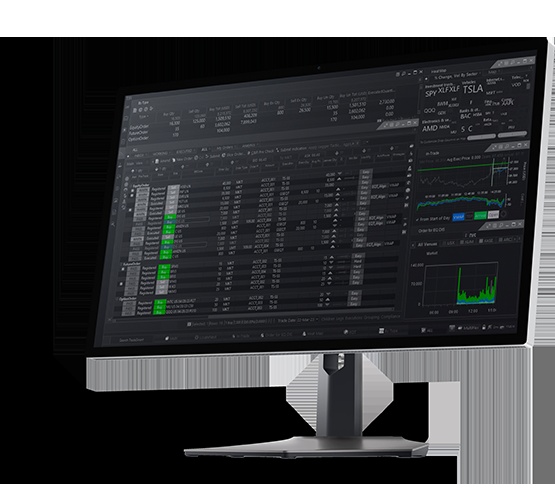
RiskSmart+ gives buy-side teams portfolio visibility, real-time exposures, profit and loss, value at risk and stress testing. RiskSmart X addresses sell-side risk and margin. WealthSmart brings portfolio, trading and reporting tools to private banks and wealth managers. PrimeOne supplies prime brokerage infrastructure through CashSmart, SwapSmart and LoanSmart. That last trio covers physical prime, synthetic prime and securities lending, respectively.
There is a pleasing loop in PrimeOne’s history. TS Imagine acquired it from S&P Global in 2024. Flatley had helped build the technology during his CoreOne years. Here was expansion through acquisition with unusually direct institutional memory: the chief executive already knew something about the engine coming aboard.
The customer who kept SimCorp
A platform story can sound like an invitation to replace everything. MEAG offers a more interesting example. In April 2025, Munich Re’s asset management business announced that it had gone live with TS Imagine’s fixed-income execution capabilities through an expanded SimCorp partnership. SimCorp One supplied the investment platform; TradeSmart supplied execution. The integration extended an existing collaboration dating to 2017.
MEAG’s stated requirement was a unified execution platform for fixed income and exchange-traded instruments. Its head of trading, Elke Wenzler, reported improved workflows, liquidity access and trader productivity. The lesson is specific: a useful connection can preserve a customer’s existing system while improving one demanding part of the job. Integration itself can be the product.
First, agree on Tuesday
In September 2026, TS Imagine launched TSIQ. The company said the AI platform followed five years of investment in data, infrastructure and financial context. Its proprietary ontology supplies consistent definitions and relationships between financial concepts. An AI answering a question about exposure needs that vocabulary as well as access to the positions. Otherwise, a confident answer may simply accelerate a misunderstanding.
“three systems that each think Tuesday was a different day”Rob Flatley, on fragmented financial data
Five years of investment behind TSIQ.
2021 → 2026
TSIQ’s operating sequence is explain, recommend, act. An answer can investigate execution slippage or portfolio stress. A recommendation can suggest a routing change. An approved action still passes through the existing controls. According to TS Imagine’s framework, outputs retain evidence and lineage, permissions filter access, and recommendations require approval. Those constraints are central to the product’s usefulness.
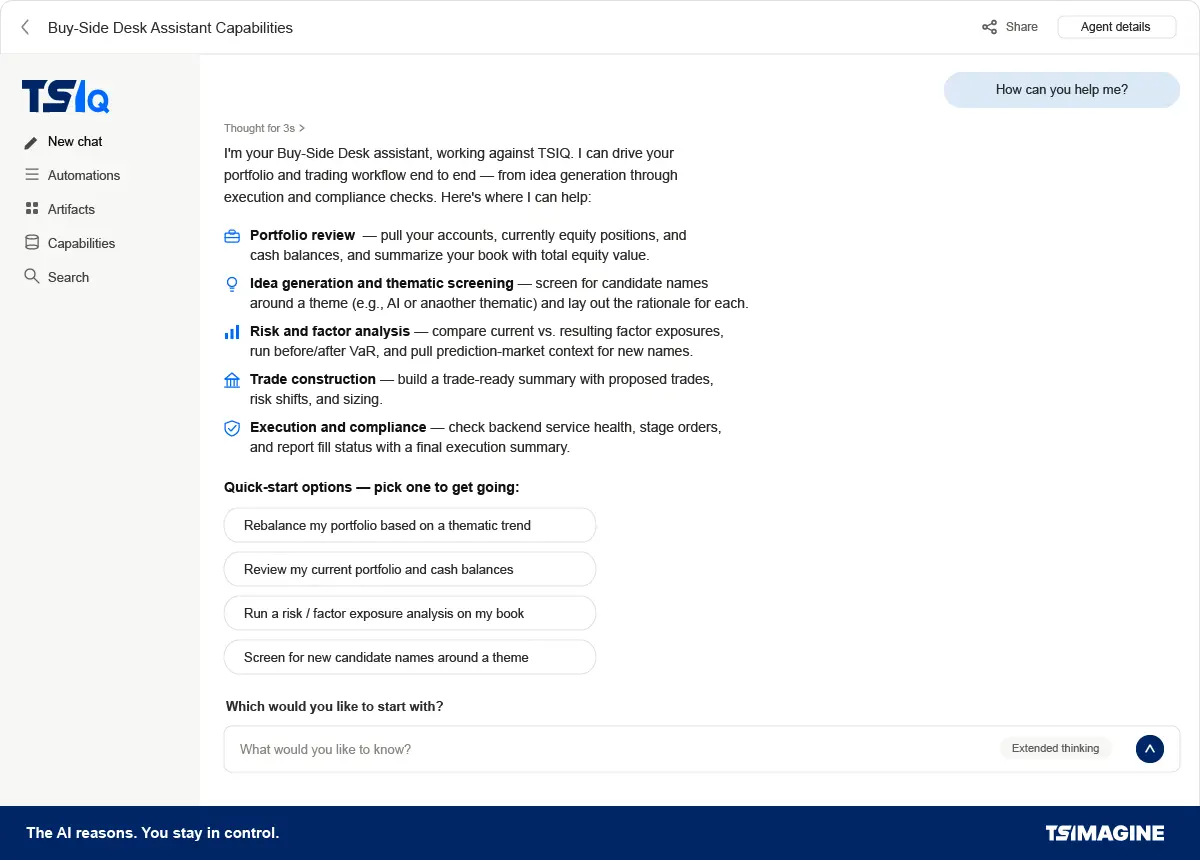
The platform kept widening. In July 2026, an expanded Trumid integration added access to more bond-trading automation. In October, TSIQ added Gentek.ai’s regulatory intelligence through its Model Context Protocol, helping compliance teams examine reporting requirements and identify missing information before submission. Both developments extend the same idea: connect a specialist capability to the institution’s working data.
What deserves copying
The market offers plenty of alternatives, including Bloomberg, FlexTrade, SS&C Eze, LSEG and FactSet. TS Imagine’s case rests on how much work can share one data foundation. For a buyer, the sensible test is concrete: follow one order into positions, risk and reporting. Check whether the definitions survive the journey. Ask who approves an action and who can reconstruct it afterward.
A small desk with straightforward needs may gain less from this breadth. Any implementation also depends on reliable inputs, suitable integrations and people willing to change established routines. The transferable idea is refreshingly ordinary: fix the handoffs, settle the vocabulary, then automate. A machine can answer very quickly. The hard work is making sure everyone asked the same question.