The investor-relations website is one of capitalism's stranger rooms. Every important object is technically there - annual reports, exchange notices, governance policies, a webcast nobody has time to replay - but the lights are off and the filing cabinet is locked by a search box from 2009. Reap's proposition is wonderfully literal: let investors ask the room a question.
The small company builds AI software for the people who explain companies to the market. Its IR Assistant sits on a corporate website, in WhatsApp, inside the Reap mobile app or behind an API. It answers questions using the issuer's own material. Around that assistant, Reap has assembled three adjacent products: Insights turns questions into themes and sentiment; Events collects and drafts answers for investor-day Q&A; Targeting ranks institutional funds that may actually fit the company.
That sounds like a chatbot suite until you notice the unusually sharp constraint. Reap says its assistant should answer from official content, expose the supporting material and say so when the evidence is insufficient. In ordinary consumer AI, refusal is friction. In a regulated disclosure environment, refusal is product design.
The product began in the investor's pocket
Reap's earliest recognizable product was mobile: follow selected companies, receive announcements and event reminders, inspect financial results and share prices. The current App Store description names companies across the NZX, Mexico's BMV, Brazil's B3, USX, NYSE and Shanghai's SSE. That international list is not trivia. The app's job is to make a New Zealand shareholder update or Brazilian earnings release feel as accessible as a push notification.
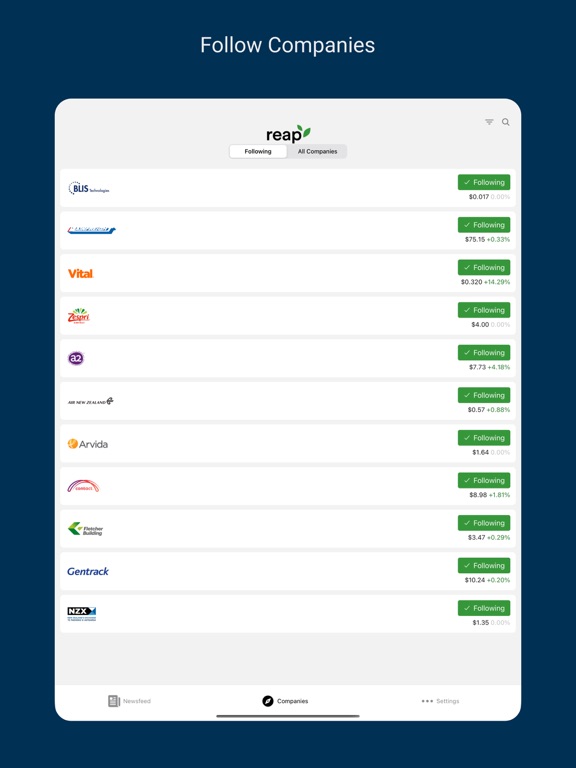
There is no public evidence that this first bet failed. But the center of gravity clearly moved. A consumer-facing information app is useful; software embedded in an issuer's workflow has a budget owner. By late 2024, Reap was promoting a multilingual AI assistant on corporate IR sites. Thomas Samuelson - an emerging-markets investor and corporate-access veteran - joined that current phase as CEO and co-founder. The product began serving both sides of the table: free access for investors, paid workflow for issuers.
The Reap loop
The company uploads filings, releases, presentations and approved IR material.
An investor questions the assistant on web, mobile, WhatsApp or at an event.
The IR team sees themes, sentiment and the gaps its next communication should fill.
One document pile, four products
The expansion is coherent because each product eats the same raw material. The assistant retrieves an answer. Insights watches what people ask. Events adds an approval step around time-sensitive Q&A. Targeting leaves the document archive and studies fund fit, but still ends at the IR team's next conversation. Reap is not trying to automate finance broadly. It is trying to own the distance between an official fact and the investor who needs it.
IR Assistant
Always-on, multilingual answers grounded in company-approved information.
Insights
Question themes, sentiment, behavior patterns and suggested communication fixes.
Events
Pre-submitted questions, AI drafts, human approval and support during live sessions.
Targeting
Funds ranked by financial fit, market presence, style, timing and accessibility.
“Not a list of names. A list of real targets.”Reap's pleasantly impatient pitch for investor targeting
That line takes aim at a familiar IR ritual: ask a bank or consultant which funds own peer companies, receive a handsome PDF, then discover that ownership data describes last quarter. Reap says it evaluates what funds own and how they invest, then ranks those more likely to have appetite for the issuer. The promise is predictive rather than archaeological. Whether the rankings outperform a skilled IR officer's network will depend on data freshness, explainability and access to the right contact - the unglamorous ingredients that make a model actionable.
The customer is the company. The user is everyone.
Reap displays an unusually geographic customer roster: meat producer JBS, Colombian-American glass maker Tecnoglass, Mexican conglomerate Orbia, New Zealand logistics group Mainfreight, kiwifruit marketer Zespri, Mexican hotel operator Norte 19, Brazilian food company Fictor Alimentos and telecom equipment maker Padtec. These are not one tidy vertical. They share a disclosure problem: many documents, investors in different languages and an IR team that cannot stay awake in every time zone.
Norte 19 told shareholders in 2024 that the app would provide access to reports, filings, presentations and tailored AI insights. Fictor deployed a branded assistant called DN.IA, promising immediate answers from official information in multiple languages. Zespri promoted Reap for publications, dividend history and share-price information. Those examples reveal the sales pitch better than a feature list: extend the IR desk without hiring an around-the-clock, multilingual IR desk.
What it costs - and what it must save
Reap does not publish current pricing; prospects schedule a demo. A publicly indexed 2026 fundraising deck modeled roughly $10,000 in average annual subscription revenue per issuer and sought a $1 million pre-seed round. Those are planning assumptions, not a verified price card or completed financing. Still, they provide the economic shape: a five-figure annual tool must replace repetitive labor, improve investor reach or uncover targets valuable enough to justify itself.
The inherited stack
- PDF archive and brittle site search
- Email answers repeated by hand
- Separate webcast and event tools
- Static ownership reports
- Broker access and consultant retainers
Reap's bundle
- Conversational document retrieval
- Answers across existing channels
- Questions turned into analytics
- Approval built into event Q&A
- Ranked, refreshed fund targets
The practical competitors are therefore larger IR platforms such as Q4 and Notified, intelligence products from Nasdaq and S&P Global, targeting specialists, generic chatbot vendors and the surprisingly durable combination of inbox, consultant and spreadsheet. Reap's advantage is focus. Its risk is that focus can be copied, bundled by an incumbent or rebuilt by a sufficiently technical issuer.
The counterweight is workflow memory. Every answered question teaches the IR team what investors misunderstand. Every unanswered one identifies a missing document or message. Every event supplies another set of approved language. If Reap makes that feedback loop useful, switching means losing more than a chat bubble. If it merely retrieves paragraphs faster, a website vendor can add the feature and call the bundle complete.
The first thing that breaks is trust
Investor relations punishes the standard AI failure mode. A fabricated restaurant recommendation is annoying. A fabricated margin, dividend date or forward-looking statement can move money and create regulatory trouble. Reap's disclosures acknowledge that public source material may be incomplete and that generated analysis is not a reliable forecast. Its security paper says the widget uses public, non-sensitive data, runs on AWS and collects an email address to deter spam. Its governance procedure assigns model and retrieval testing to a technical lead, product validation to a product lead and oversight to the CEO.
Failure order
Trust fails before convenience. One unsupported answer can make an IR team abandon hundreds of useful ones. Provenance, refusal behavior, approval and escalation are not compliance garnish; they are the product.
This is also where the business will not work. Reap is a poor fit when a company has thin or disorganized disclosure, expects the assistant to invent guidance, cannot maintain current source documents, or serves investors who will not use digital channels. It is less compelling for an issuer receiving only a handful of predictable questions, and fragile where local rules require human review of every response. The tool amplifies an IR program; it cannot manufacture one.
The part worth stealing
Founders building vertical AI can copy five choices without copying Reap. Start with an expensive recurring question, not a general-purpose chat window. Ground answers in material the customer already trusts. Deliver inside channels people already use. Keep a person in the loop where stakes spike. Then expand into adjacent jobs produced by the same interaction data. Reap's assistant generates questions; those questions naturally become Insights, Events and, eventually, better targeting.
The company itself has several birthdays. New Zealand records show Reap (New Zealand) Limited registered in 2019 by engineering co-founder Gustavo Chiechelski and product-and-design co-founder Matheus “Matt” Costa. LinkedIn lists 2021. The current AI-led chapter coheres around 2024. That untidy chronology is revealing: products rarely pivot on a ceremonial date. They accumulate a user, a workflow and then a buyer.
The New Zealand legal entity is registered in Auckland.
The market-facing company timeline begins on LinkedIn.
The AI IR Assistant launches publicly; Samuelson joins the current phase.
Mobile updates and written AI governance make the guardrails visible.
Assistant, Insights, Events and Targeting form a broader IR suite.
Reap is still small, its revenue and completed funding are not public, and its target market contains vendors with deep distribution. But it has found a crisp place for AI: between the fact a company has already approved and the person asking for it now. If it can preserve that boundary while the suite expands, the little green leaf may grow into something less decorative - the front door to the investor-relations department.