On July 5, 2018, Brandon Elliott became chief executive of Northern Oil and Gas through a particularly literal exercise in management: he and the incumbent exchanged titles. Michael Reger became president and concentrated on acquisitions. Elliott, previously president, took responsibility for day-to-day operations and investor relations alongside chief financial officer Nick O’Grady. The announcement had little patience for ceremony. Here were two jobs, two people, and a decision about where each could be useful.
For Elliott, it was another move across the table. He had already worked as an institutional investor, then as the executive explaining a company to investors. Now he was running the company they were assessing. That progression gives his present work in CEO advisory at Consello its particular interest. He has occupied several of the seats involved in the same conversation, each with a different view of the arithmetic.
The title exchange also offers a welcome complication to the familiar executive ascent story. Corporate careers are usually presented as a staircase, with each new title one step nearer the chandelier. At Northern, the rearrangement was more practical. Reger would pursue opportunities in the Williston Basin; Elliott would manage the business and its relationship with capital. The assignment followed the work.
First, learn to ask the questions
Elliott graduated from Dartmouth College with a bachelor’s degree in psychology. His professional route then led into institutional investing, including Cardinal Capital Management and Friess Associates. Taken together, those investment roles accounted for 12 years as a portfolio manager and analyst. His education and early employment put human behavior and company analysis next to one another on the résumé, an interesting pairing for someone whose later work would involve shareholders, boards, and executive teams.
From 2000 to 2010, he worked at Friess Associates, manager of the Brandywine Funds, eventually serving as a portfolio manager. A decade in that setting preceded his move inside a public company. The direction matters. Before he had to present a corporate strategy, he had spent years in investment roles evaluating businesses. Later, investor relations would require him to explain the choices being made by management.
His next stop was CONSOL Energy, where he served as vice president of investor relations from 2010 to 2012. Coal and natural gas brought their own vocabulary and their own exposure to commodity markets. The job placed him at the junction between operating decisions and outside expectations. A shareholder could ask a straightforward question about a complicated business; an executive still had to supply an answer that survived a second question.
By January 2013, Northern Oil and Gas had hired him as executive vice president of corporate development and strategy. Its announcement emphasized the combination of corporate and investment experience he brought. The appointment put the two parts of his working life in the same job description. Researching investments and explaining an energy company were now preparations for helping shape one.
A business built on other people’s wells
Northern’s business was based on non-operating interests in oil and gas properties, with a core focus in the Williston Basin’s Bakken and Three Forks formations in North Dakota and Montana. That distinction is essential to understanding Elliott’s executive years. The company participated economically in wells operated by others. Choosing where to commit capital, and understanding what those interests could produce, were central to the model.
In April 2018, while Elliott was interim president, Northern announced an agreement to acquire properties from Salt Creek Oil and Gas. The package included producing wells, wells being drilled or awaiting completion, and future drilling inventory. Elliott emphasized the ability to add production and future locations without adding general and administrative costs. His argument connected the acquisition to the scalability of the business, giving investors a reason to examine what would happen after the purchase.
The following month, the company named him president and chief operating officer. Chairman Bahram Akradi outlined three priorities: restructuring the balance sheet, developing a consolidation strategy for the Williston Basin, and assembling the executive team to carry it out. Elliott had been at Northern since 2013. His promotion took place inside a broader reorganization, with financial structure and management responsibilities being addressed together.
July brought the exchange of titles with Reger. Elliott’s new assignment retained investor relations as an explicit responsibility. The company did not treat communication with shareholders as a task that disappeared once he reached the chief executive’s office. It remained part of the work. O’Grady, newly appointed CFO that June, would share that responsibility while Elliott handled daily management.
The arithmetic beneath the acquisition
As CEO, Elliott repeatedly described Northern’s goals in terms of free cash flow, debt, and cash flow per share. These are less picturesque subjects than acreage or drilling rigs, but they explain the discipline behind the expansion. A company can become larger while making an investor’s position less attractive. His public explanations kept returning to what the enlarged business could produce relative to its obligations and share count.
In August 2018, Northern announced an agreement to purchase assets from an affiliate of W Energy Partners, a Crestview Partners portfolio company. The package comprised 10,600 acres and an estimated 6,750 barrels of oil equivalent a day at closing. Management forecast approximately $95 million in cash flow for 2019 against a base capital plan of approximately $42 million. Those were expectations when announced, rather than a completed scorecard. They show the calculations management wanted investors to consider.
The same release discussed the contribution of the recently closed Salt Creek acquisition and the pending Pivotal transaction. Elliott described a business moving toward significant free cash flow and lower leverage relative to peers. Several transactions were being assembled into one financial argument. The challenge was to explain how the pieces worked together, rather than ask investors to admire the pile.
In April 2019, another agreement brought the logic into sharper focus. The proposed VEN Bakken purchase involved approximately 18,000 net acres and 86.9 net producing wells. Its consideration combined $165 million in cash, a $130 million three-year unsecured note, and approximately 5.6 million common shares. Each component had a different consequence for the company. Cash, borrowing, and equity all paid for assets, but none was free of tradeoffs.
Northern announced the closing that July. Elliott said the assets were performing above the initial forecast and described their expected contribution to debt-adjusted cash flow per share and lower administrative expenses per barrel. He also pointed to hedges put in place at the announcement to protect additional cash flows. The explanation joined the purchase price to operating performance and risk management. A transaction had to keep making sense after the announcement was filed away.
Announced consideration, before closing adjustments. Different forms of payment carry different tradeoffs.
A handover, with some work still attached
December 2019 brought a different kind of announcement. Elliott would step down as CEO on December 31, with O’Grady succeeding him on January 1, 2020. Chad Allen would become CFO. Elliott would leave the executive team in January and remain a consultant through 2020, helping with the transition and advising on strategic matters. Responsibility was being transferred, with continuity built into the arrangement.
In his own farewell, Elliott recalled equity financing, acquisitions, exchanges, consent processes, lending facilities, and the recurring work of quarterly and annual announcements. He reached for the image of a roller coaster and wrote about watching the energy business from the sidelines for a while. The list made the metaphor understandable. Much of a corporate transformation consists of transactions and processes whose names would clear a dinner party remarkably quickly.
The January 2020 filing confirmed that his employment had ended and that the planned separation and consulting agreements had been executed. The departure had an administrative reality beyond the farewell. His connection to the company continued in an advisory capacity, while a new executive team took over. For a career that had already crossed between investing and management, consulting offered another way to apply the experience.
By 2021, Elliott appeared on the NIRI Twin Cities board as founder of e2 Advisors. He later served as a chapter co-president. Those roles kept investor relations in the foreground after his CEO tenure. The profession had been a thread through his investment background, his corporate appointments, and his leadership responsibilities; it continued through his participation in its professional community.
“Even the most exhilarating and amazing roller coaster needs to be appreciated from the sidelines on occasion.”Brandon Elliott · December 31, 2019
Washington, and the questions that keep coming
Elliott joined FTI Consulting’s financial communications practice in 2023. His work there addressed corporate strategy and investor relations, including the demands surrounding transactions, leadership changes, and shareholder activism. By February 2025, he was also teaching in NIRI’s Fundamentals of Investor Relations program. His sessions covered shareholder engagement and becoming a trusted strategic adviser to management and the board. The course brought practical corporate experience into a setting for people learning the profession.
In June 2025, the Twin Cities chapter named him its advocacy ambassador for the 2025-2026 program year. His Washington work also included participation in an IPAA discussion about pressure on boards, capital allocation, and proposed mergers and acquisitions. These were familiar subjects viewed from an advisory position. His career had given him opportunities to encounter them as an investor, a company representative, and an executive with responsibility for decisions.
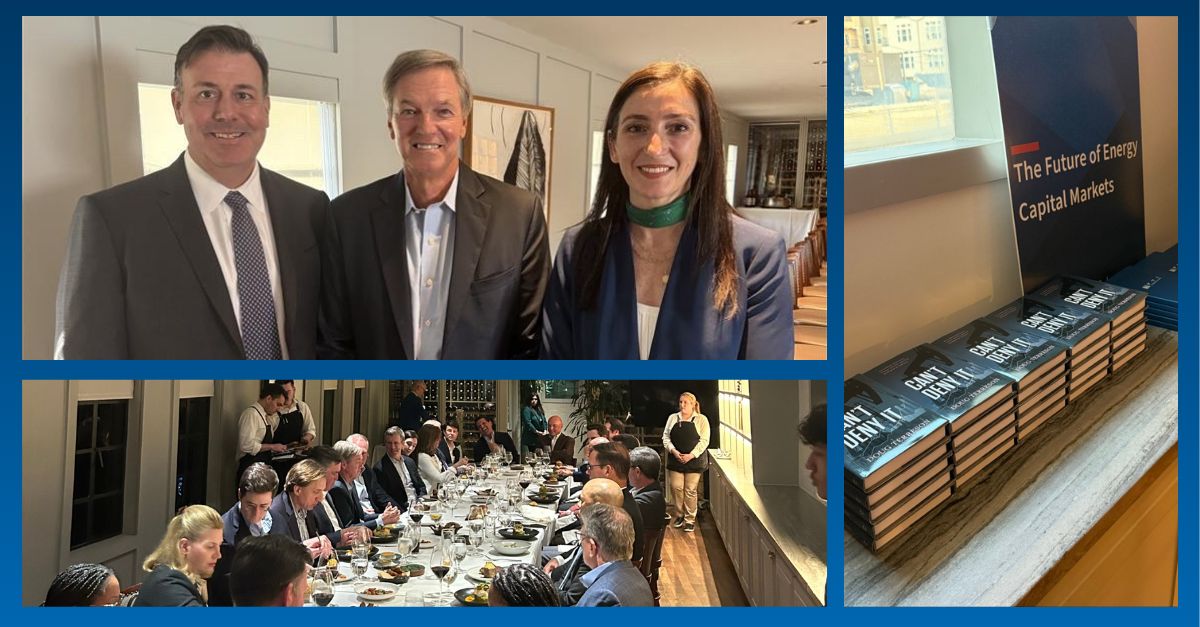
A September 2025 FTI gathering with Doug Terreson, author of the energy memoir Can’t Deny It, put some of those conversations around a dinner table. Elliott helped moderate the discussion and later thanked Terreson for the chance to reconnect. The photographs show books, guests, and the comparatively civilized surroundings of an industry conversation conducted over a meal. Energy finance occasionally allows its participants to sit somewhere other than behind a spreadsheet.
His current role at Consello places CEO advisory at the center of his work. The route to it is the more revealing detail: ten years at Friess, investor relations at CONSOL, corporate development at Northern, the chief executive assignment, and subsequent advisory work. The continuity lies in the relationship between a company’s decisions and the people providing its capital. Elliott has approached that relationship from several directions. The next conversation begins with experience on both sides of the table.