There is a peculiar moment in the life of a growing company when its own explanation stops working. The product may be selling. The revenue chart may be behaving. The founders can describe the opportunity with the fluency of people who have lived inside it for eight years. Then an investor asks a plain question, the kind that fits in half a line on a legal pad, and the room acquires weather.
Why should this company be worth more than the other one?
Market Street Partners lives in that weather. Founded in San Francisco in 2000 by Carolyn Bass and JoAnn Horne, the firm advises public and pre-IPO growth companies on investor relations: the work of deciding what a company means to the people who price it. MSP can become the whole IR function, reinforce an internal team or handle one sharp assignment. The nouns are familiar - earnings releases, analyst meetings, investor targeting, road shows, perception surveys. The unusual part is the feedback loop behind them.
The interpreter has to stand outside the room
Most executives do not lack information. They lack information that can travel upward without being sanded smooth. An employee knows which answers are rewarded. A shareholder has no such incentive. MSP's premise is that an external adviser can hear the second version - what investors say after the presentation, what they think management is avoiding, which metric they trust and which promise sounds ornamental - then return it to the people running the company.
The real deliverable is not a prettier story. It is the discovery of where belief stops.
That makes investor relations less like publicity and more like translation. One side speaks in product road maps, operating decisions and market possibility. The other speaks in comparables, risk, credibility and expected cash flows. A useful adviser must understand both languages without becoming loyal to either one's euphemisms.
Bass arrived with mathematical economics, management consulting and investment-banking experience. Horne brought English and business training, institutional sales at Goldman Sachs and years managing West Coast investor-relations work. The pairing is almost too tidy: numbers and sentences, issuer and buyer, argument and audience. Their firm's point of difference is explicitly financial. MSP says it approaches investor relations from banking and capital markets, not merely corporate communications.
A client page that looks like a software index
The firm is small enough for public directories to count it in the low teens. Its published roster is wonderfully disproportionate. Google. Workday. Rivian. OneStream. nCino. JFrog. Bill.com. Upwork. Equinix. Tableau. Cloudera. NetSuite. Some are current-era names, others are companies acquired or transformed long ago. The page says these are companies MSP has advised, not that every logo represents a present engagement. That distinction matters. So does the cumulative shape of the list.
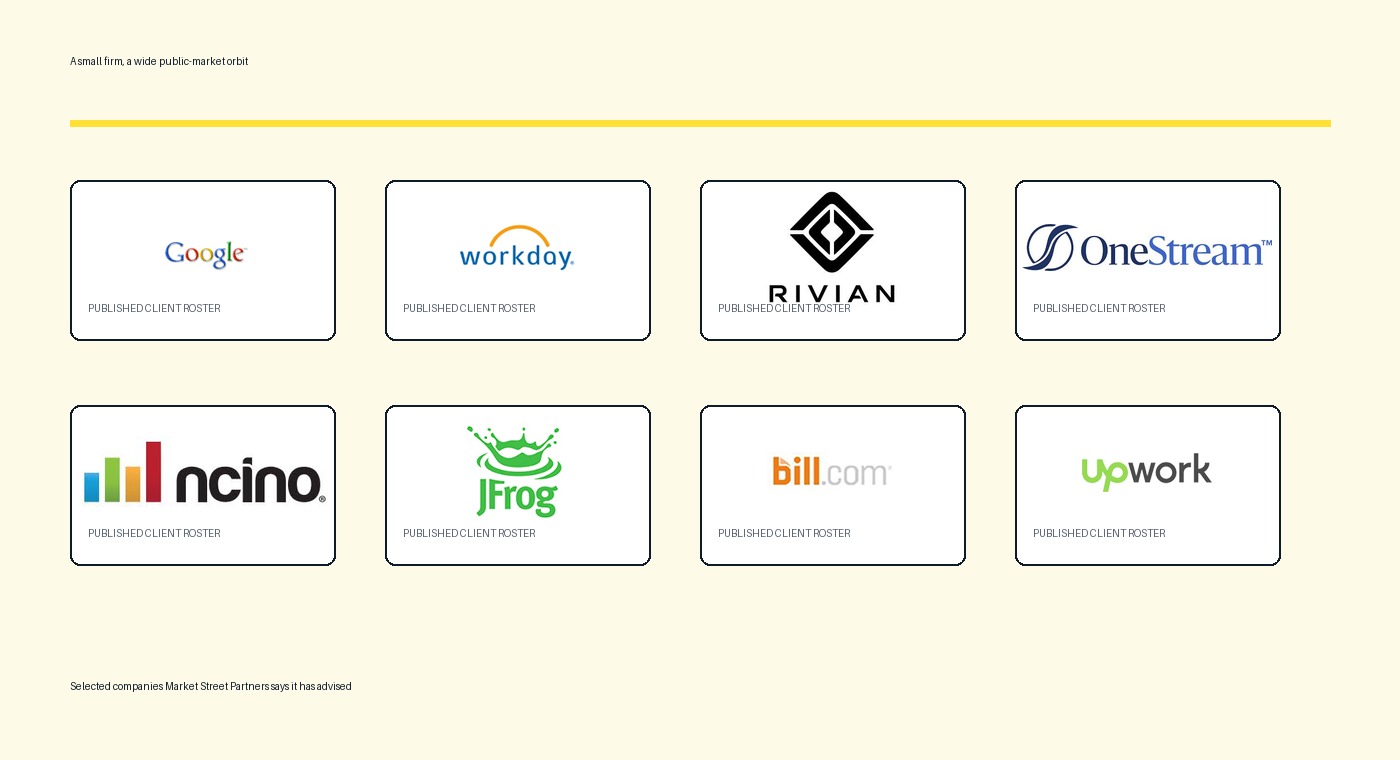
The logo grid also explains where MSP fits in the market. It is not an advertising agency buying attention, an investment bank underwriting securities or a management consultancy redesigning the org chart. It sits beside the CEO and CFO at the seam between corporate strategy and market interpretation. The customer is often a growth company whose economics are complicated, whose category is young or whose public identity has not caught up with the business.
For private companies, the work begins before the ceremonial bell. MSP lists bank and analyst introductions, public-company peer analysis, valuation review, disclosure training, investor-presentation development, employee IPO education, website protocols, road-show feedback and preparation for the first earnings call. That last item is revealing. Going public is not finished when shares begin trading. It is finished, if it ever is, when a company can explain a disappointing quarter without borrowing credibility from the bankers who introduced it.
What the invoice actually buys
MSP does not publish a fee card. The commercial logic is easier to see than the price: companies buy senior judgment without adding a comparable full-time executive, plus an execution team that already knows the calendar and customs of Wall Street. The firm says this costs less than bringing a senior IR resource in-house. The model is likely some mix of ongoing retainers and defined advisory projects, depending on whether MSP is the IR department, an adjunct or a specialist for an IPO or transaction.
The first thing this model refuses is scale for its own sake. MSP says it strictly limits how many clients each senior professional serves. For an agency, that is an economic constraint disguised as a principle - and also a principle enforced by an economic constraint. A client is paying partly for the absence of too many other clients.
Scarcity is not the marketing garnish here. Senior attention is the inventory.
The alternative choices are clear. Hire an internal head of IR and gain complete immersion, but risk a narrower outside view. Hire a large financial-communications agency and gain bench depth, but inspect who will attend after the pitch team leaves. Use a boutique such as MSP and gain proximity to experienced counsel, but accept less visible scale and key-person dependence. There is no universal winner. The company stage, cadence of market events and management's appetite for unfiltered feedback decide the fit.
The part another company can steal
You do not need to be nearing an IPO to copy the useful machinery. Begin with ten conversations outside the company. Ask investors or sophisticated outsiders to explain the business back to you. Do not correct them. Mark every point where the retelling diverges from management's intended story. Sort those gaps into three boxes: misunderstanding, disbelief and genuine weakness. A communications fix can address the first. Evidence must address the second. Only operating work repairs the third.
Then make the story survive contact with numbers. Identify the few metrics that demonstrate progress, show why they connect to economic value and rehearse the skeptical follow-up. Repeat quarterly because both the business and its comparison set change. This is cheaper than a campaign and more uncomfortable than one.
The bargain requires an adult in the room
Candid feedback is valuable only under specific conditions. Management must be willing to hear that the market's confusion may be rational. The company must possess evidence strong enough to support the revised argument. Leaders must disclose consistently and stay inside regulatory boundaries. And the adviser must earn enough trust on both sides to report what was actually said, not what makes the next meeting pleasant.
It will not rescue weak economics, manufacture demand for an unwanted stock or make a volatile market polite. A narrative can focus attention; it cannot permanently outrun results. Nor is an outside boutique the right answer when a large global company needs round-the-clock, multilingual coverage across many constituencies, or when the internal team already has deep investor access and management's confidence.
Market Street Partners has endured because the information problem endures. Inside a company, everyone knows too much in the same direction. Outside it, investors know less and decide faster. Between them stands a small San Francisco firm asking a question with a large consequence: when you have finished explaining the company, what did the market actually hear?