There is a particular compliment that only a consultant can receive: the client decides it would rather own the advice. By 1997, WPP had been paying Buchanan Communications for more than a decade. Then the advertising group offered £4 million in cash and as much as £11 million more if the firm hit its earnings targets. Tim Anderson, one of Buchanan's founders, said earning the full amount would require the business to roughly double. It was both a purchase price and an assignment.
The anecdote is useful because it explains Burson Buchanan better than the usual fog of communications language. This is a firm hired when a company must make its case to people with the power to change the outcome - investors, analysts, journalists, regulators, employees, judges or politicians. The work may end as an earnings narrative, an IPO campaign, a sustainability report, an annual report, a crisis plan or a redesigned website. The product underneath each one is confidence supported by evidence.
Today the company sits inside Burson and, above it, WPP. It says it serves more than 90 retained clients with 45 specialist consultants, from FTSE 100 companies to private businesses. Its headquarters remain in London, but the map now stretches through Washington, New York, San Francisco and the wider Burson network. That makes it an unusual animal: a financial communications boutique with access to the plumbing of a global agency.
The machine behind the discreet phone call
Financial public relations once looked like a compact triangle: company, broker, newspaper. Burson Buchanan works in a messier geometry. A merger announcement can trigger an employee revolt, a regulatory question, a social-media pile-on and a fall in the share price before the chief executive has finished the first television interview. A useful adviser has to see the whole chain.
So the menu has widened. Financial PR covers investor relations, listings, fundraising, M&A and the financial calendar. Corporate PR handles media, executives and internal audiences. Sustainability consultants conduct materiality studies, shape disclosure and help define the KPIs that turn an environmental promise into something an investor can inspect. Crisis specialists prepare for the ugly day. Public-affairs teams work on policy, antitrust, CFIUS reviews and cross-border deals. A creative studio turns the argument into reports, presentations, websites, film and social content.

That breadth is not the same as being a generalist. The firm's edge is the financial market at the center of the picture. Its advisers include former bankers, equity researchers, investigative journalists, government figures and corporate communicators. They know that a phrase loved by marketing may alarm an analyst, and that a sentence written for a filing will escape into the press release whether anyone plans for it or not.
“The key to evolving the Buchanan brand was distilling the essence of our business. Sounds simple. Tough to get right.”Neil Stockwell · Creative Lead
What failed first was the pipeline
Specialists are valuable because they concentrate risk. They are also vulnerable for the same reason. After the 2016 Brexit vote, Buchanan's UK-focused IPO pipeline weakened. WPP's annual report recorded the damage plainly. Yet a recovering natural-resources sector helped push the firm's year-end retainer run rate nearly 20 percent higher. The episode offered a compact lesson: expertise can be narrow, but the revenue base cannot be brittle.
The more revealing change came later. In 2023 the firm stopped describing its three disciplines as PR, ESG and Design. It chose Communications, Sustainability and Creative. This sounds like the sort of exercise that keeps branding workshops supplied with biscuits. But the research had found something practical: audiences wanted dependable, trusted information, and the old labels constrained the work. “PR” sounded like press coverage; “communications” could include the whole stakeholder system. “ESG” had become a contested acronym; “sustainability” forced discussion of the actual business. “Design” made things pretty; “creative” could shape how the argument was understood.
A mining report is never just a mining report
Consider Predictive Discovery, an Australia- and London-listed gold developer. Burson Buchanan's creative work placed employees from the Bankan project in Guinea on the cover of the 2024 annual report. The object looks like publishing, but it performs several jobs at once. Investors see operational progress. Employees see themselves in the corporate story. Regulators and communities see an argument about local presence. A dry statutory requirement becomes a stage on which the company explains why it deserves capital.
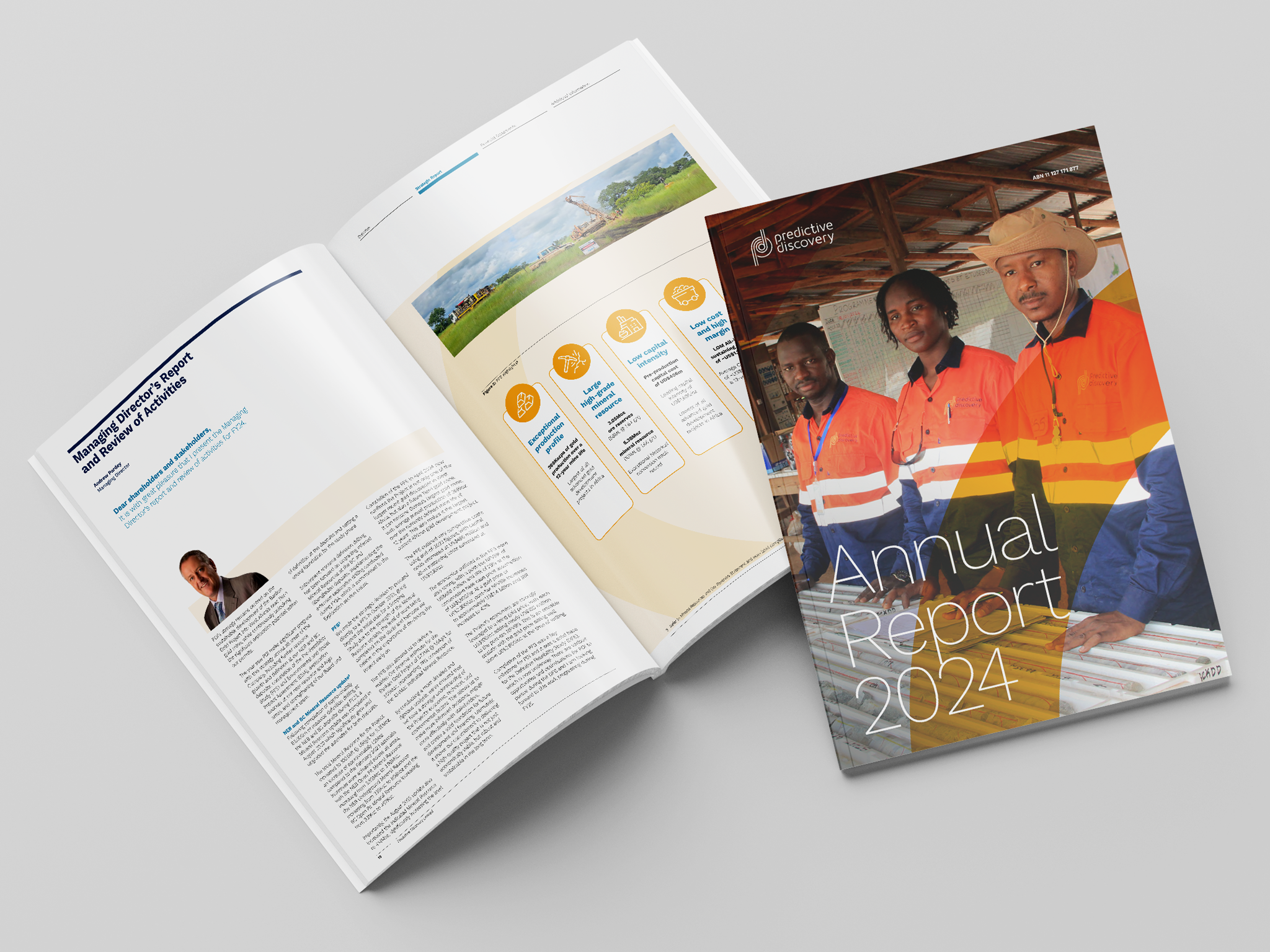
The longer mandate carried higher stakes. Burson Buchanan says its four-year work with Adriatic Metals ended with a US$1.3 billion takeover by Dundee Precious Metals in 2025 and a fourfold increase in shareholder value over the engagement. It also advised Predictive Discovery through its combination with Robex Resources, a deal described at roughly US$3 billion. Communications did not discover the ore or negotiate the price. It helped make the assets, strategy and risks legible across borders and investor bases.
The same pattern appears in OEG Energy Group. Before Apollo-managed funds agreed to acquire the offshore-energy services company in a transaction valued above $1 billion, Burson Buchanan worked on perception research, the investment narrative, sustainability evidence and external presentation. The sequence matters: listen first, define the story second, then express it everywhere. A new logo without the first two steps would have been expensive stationery.
Can reputation acquire a price tag?
Joining Burson in 2024 changed the scale of the toolkit. The parent network was announced with more than 6,000 people in 43 markets. In 2025 it launched Reputation Capital, an AI-enabled platform available through WPP Open. The system monitors signals from company information, digital media and social conversation, scores eight levers of reputation, and models their relationship to business outcomes such as stock returns, sales or purchase intent.
The useful idea is not that a machine has solved reputation. It is that a board might see which belief is moving before the quarterly survey arrives. Burson reported that, in its technology-company modelling, a one percent rise in one profiled company's reputation score corresponded to $2.4 billion in shareholder value. The number is a model output, not cash in a drawer. Its value depends on the quality of the data, the assumptions and the willingness of executives to act on an uncomfortable signal.
Senior attention, market fluency, institutional memory and the nerve to challenge a board.
Geographic reach, public affairs, specialist practices, creative scale and predictive tools.
This is the experiment inside Burson Buchanan: can those two halves coexist without one flattening the other? A boutique earns trust because clients know who will answer at 2 a.m. A network earns its keep when the crisis begins in London, crosses a regulator in Washington and reaches investors in Sydney before breakfast. The combination works only if access remains simple and accountability stays visible.
The part no communications plan can fix
The method is copyable. Conduct a genuine perception study. Identify the claim that matters to the audience, not merely the one management enjoys repeating. Attach evidence. Map the second-order reactions. Put one team in charge of carrying the same argument through results, media, policy, reports and digital channels. Rehearse the hostile questions before the microphones arrive.
But the method has a boundary. It will not rescue a company whose economics, governance or conduct contradict the story. It will struggle when management wants visibility without scrutiny, sustainability language without measurable progress, or crisis preparation without giving the adviser access to decisions. Reputation is not a coating applied at the end. The communication becomes credible when the behavior beneath it is credible.
That may be the lasting point of the WPP story. The advertising giant did not buy Buchanan because it produced a clever description of itself. It bought a capability it had watched at close range for years. The most persuasive case study was the work.