The most important product at Kekst CNC is often a sentence. It might explain why two public companies should become one, why a chief executive is leaving, what is known about a cyberattack, or why a creditor should support a restructuring. The sentence is written while lawyers are revising it, employees are refreshing their phones, investors are repricing the company and reporters are calling. A normal agency can polish it. Kekst CNC is paid to decide whether it should be said at all.
That distinction explains the firm better than the usual label, public relations. Kekst CNC is a strategic communications consultancy owned by Publicis Groupe. Its clients include listed and private companies, boards, executives, investment firms, institutions and nonprofits. They hire it for M&A, shareholder activism, IPOs, litigation, restructuring, public affairs, cybersecurity incidents and reputation work. These appear to be different services. In practice, they are variations on one unnerving problem: the facts are moving faster than the organization can agree on its story.
The accident that became a specialty
Gershon Kekst founded Kekst & Company in New York in 1970 after leaving Ruder & Finn. He had wanted, earlier in life, to be a radio journalist. Instead he wandered into a young specialty that barely had a name: explaining mergers, takeovers and financial upheaval to the outside world. His account of the strategy was disarmingly plain. The first assignments that came in were financial. Had they been fashion assignments, he later joked, he might have built a fashion agency.
The more revealing origin story is about what failed first. An early pharmaceutical client gave a journalist optimistic projections. When the eventual earnings looked nothing like the promise, the journalist called Kekst to complain and learned that the adviser had already resigned the account. Years later, asked why he discouraged another struggling CEO from taking an interview, Kekst gave the rule in one line: the CEO should speak only if he was comfortable telling the truth.
“I said he shouldn’t speak to you unless he was comfortable telling the truth.”Gershon Kekst, recalled by Norman Pearlstine
There is no halo to award here. Strategic communications firms are advocates, and their work is usually private. But that early failure clarifies the commercial logic. A story unsupported by operations is not an asset; it is a second crisis waiting for a timestamp. Kekst's reputation grew in the deal rooms of the 1980s and 1990s, advising on contests involving RJR Nabisco, Time Warner, Citigroup and Chrysler. The firm's edge was proximity to the lawyers, bankers and chief executives who controlled the consequential facts.
Two firms, one long rehearsal
Across the Atlantic, Christoph Walther, Roland Klein and Sigmar Mosdorf founded CNC in Munich in 2002. CNC brought German financial communications, public affairs and a cross-border network. Publicis bought Kekst in 2008 and CNC in 2012. The CNC price was kept confidential. The Kekst price was also undisclosed, although contemporaneous reporting put it as high as $150 million.
What the ownership path cost
Publicis buys Kekst. Undisclosed; reported estimates ran as high as $150 million.
Publicis buys CNC. Price confidential.
The sister firms combine as Kekst CNC. No separate purchase price announced.
The consequential change did not arrive with an acquisition pitch. Kekst and CNC had collaborated on cross-border client work for nearly two decades. By 2018, global mandates were no longer occasional exceptions: a transaction announced in New York could trigger political concern in Berlin, workforce anxiety in London and investor questions in Tokyo before breakfast. The firms formalized what the assignments had already taught them. They combined, opened Hong Kong and launched Kekst CNC with more than 250 professionals, 13 offices and over 600 clients.
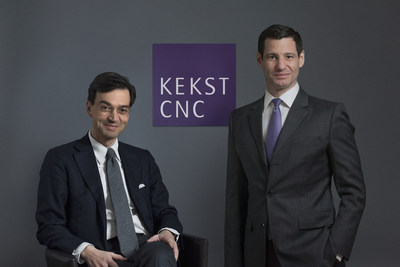
The photograph looks like a merger announcement because it is one: dark suits, controlled smiles, a purple sign doing the work of a handshake. The less photogenic detail is the one worth copying. Collaboration preceded consolidation. The companies tested each other on live assignments long before they shared a name. That is a useful antidote to integrations built from slides and introductions.
A market for simultaneous trouble
Kekst CNC sits at the high-stakes end of a market that includes Brunswick, FGS Global, Teneo, Joele Frank, FTI Consulting, Prosek and H/Advisors. It is smaller than a mass-market agency network and more integrated than a solo adviser. Publicis ownership supplies access to broader data, technology, marketing and transformation capabilities. The boutique structure keeps senior communications counsel close to the center.
A deal, breach, activist, lawsuit, restructuring or leadership change with several audiences and one shrinking clock.
Senior judgment, audience research, scenario planning, narrative, media and stakeholder execution.
Attention is not the only goal. Legal exposure, valuation, employee behavior and regulatory trust can move together.
A legally safe answer may still fail with customers, journalists, investors or the people running the business.
The firm's services have widened without abandoning that center. Its IPO team says it has supported offerings in more than 40 countries that raised over $200 billion. Its cyber practice covers preparation, active response and recovery. Research teams analyze stakeholders, media and public opinion. A creative studio turns strategy into campaigns, identities, digital experiences and data visualization. Retainers and project fees are not published; the work is bespoke, combining senior time, specialist analysis, simulation and execution.
Technology now enters the product as evidence rather than spectacle. The Executive Impact Score, developed with Oxford University Innovation linguistics expertise, analyzes audio from speeches, earnings calls, interviews and town halls across seven variables. The firm has also studied how generative AI reads proxy-fight arguments and how disinformation moves through networks. The promise is not that a model replaces counsel. It is that counsel gets a sharper instrument.
The method hiding inside the mystique
Much of this work cannot be copied from the outside because confidentiality is the point. The operating logic can. A company preparing for a consequential event can borrow the sequence even if it never hires Kekst CNC.
A five-move pressure test
- Give one person ownership of the verified facts, including the uncomfortable gaps.
- Map audiences by consequence, not visibility: regulator, employee, investor, customer, reporter.
- Decide the order of communication before drafting the language.
- Rehearse the hostile question and the operational failure, not merely the prepared statement.
- Publish only claims the business can continue proving after attention moves on.
The ordering matters. Teams often begin with words because words are tangible. Yet the sentence becomes easy only after someone has resolved who knows what, which audience can cause what damage, and what action the company is actually prepared to take. Communications then becomes an operating system for decisions, not cosmetics applied after them.
This approach has limits. It cannot rescue a false premise, replace technical containment during a cyberattack or manufacture trust after leaders refuse corrective action. It is also expensive in management attention: lawyers, operators, executives and advisers must share incomplete information quickly. In a routine promotion where speed and reach matter more than consequence, a specialist crisis-and-financial firm may be unnecessary. The model works when truth can be established, action can support the message, and decision-makers accept unwelcome counsel.
The sentence after the crisis
In 2026, Lyndsey Estin became co-chief executive for the United States, working with London-based co-CEO Richard Campbell, who leads non-U.S. operations. Estin spent two decades at the firm and built its U.S. cybersecurity practice; Campbell founded a consultancy, sold it to Publicis and folded it into the wider business. Their résumés describe the two directions in which Kekst CNC keeps stretching: deeper into technical risk and farther across borders.
The firm now has more than 300 professionals in 15 offices. Its scale is meaningful but not the real trick. The trick is maintaining a culture in which an adviser can still say the thing a client least wants to hear. Kekst CNC calls its values Integrity First, Critical Judgement, Uncompromising Excellence and Globally Connected Thinking. The capitalization is corporate. The underlying idea is less ornate: reputation survives when the next sentence remains true after everyone has checked it.