The dangerous sentence in finance is rarely delivered with villainous music. It is the missing disclosure on a rushed call, the optimistic claim in a partner's Instagram reel, or the chatbot answer that sounded sensible until counsel read it on Tuesday. For years, institutions managed this problem by sampling. A quality team might inspect a small percentage of conversations, log the exceptions and hope the rest of the ocean behaved like the cup they scooped from it. Sedric was built around a blunt objection: the cup is no longer a useful map.
Founded in 2020 by CEO Nir Laznik and CTO Eyal Peleg, Sedric makes compliance software for regulated financial services. It takes a firm's policies, brand rules and regulatory obligations and turns them into controls that can evaluate calls, chats, emails, marketing assets, partner content and AI-generated responses. The system flags risk, links findings to rules, records what reviewers change and, in live conversations, can prompt an agent before the next sentence leaves the building.
The problemSampling failed before the software did
The first thing to break was not a model. It was the old operating assumption that compliance teams could review enough material by hand to understand the whole business. Customer communication escaped the call center and spread into text, chat, email, social media, affiliates, influencers and embedded-finance partners. Generative AI then made content production cheaper still. The number of reviewers did not multiply at the same rate.
Sedric's earliest wedge was call monitoring, especially in collections and other tightly regulated conversations. That made sense: calls were high-volume, emotionally loaded and rich with measurable failures such as omitted disclosures or prohibited language. But the company followed the work outward. In an interview, Laznik described the move from phone calls to written and spoken channels as a natural expansion, not a reinvention. The buyer remained the person who must explain what happened to a regulator.
What it doesA traffic system for regulated words
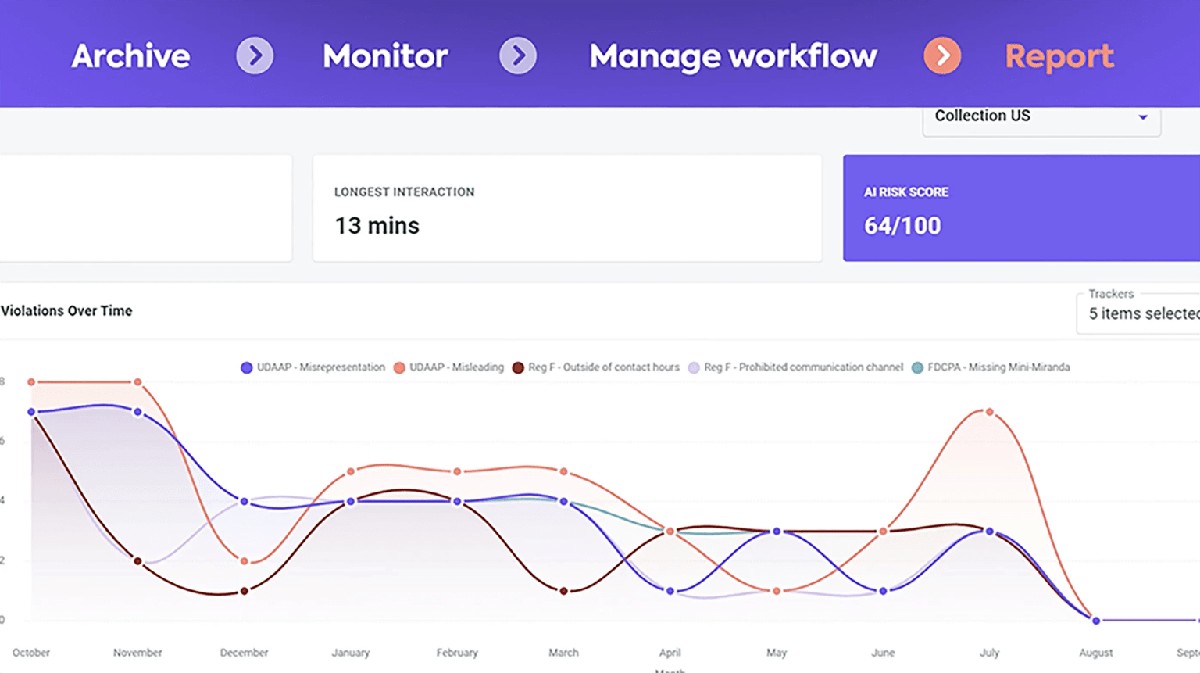
Sedric's current product can be understood as four connected jobs. First, Policy Manager structures the rulebook. Second, marketing and partner tools review ads, webpages, videos and affiliate content before publication, then keep watching after they go live. Third, communications monitoring analyzes calls, messages and email after the interaction. Fourth, Real-Time Agent Assist intervenes during a live exchange with alerts, dynamic guidance and a post-call summary.
That last job is the hinge. Plenty of tools can label a sentence risky. A bank needs to know which policy fired, why the system reached its conclusion, who overrode it and what version eventually reached a customer. Sedric says it uses a multi-vendor model architecture, validation pipelines, customer annotations and controlled releases. The point is not model theater. It is to make an automated decision inspectable enough for a skeptical professional.
“The AI solution cannot just evaluate itself.”Nir Laznik, CEO and co-founder
That principle explains a revealing product boundary. Sedric has been asked to fix or create marketing content, not merely review it. The company could technically move in that direction. It has chosen to stay the separate line of defense. In other words, the bot writing the ad should not also be the only bot declaring the ad clean. It is an unusually modest claim in a market full of software volunteering to run the department.
The customersWho buys an independent referee?
Sedric sells to compliance, risk, marketing, QA, contact-center and partner-oversight teams at banks, lenders, trading platforms, fintechs, insurers and collection agencies. Public names include Trading 212, Libertex, WebBank and UK wealth app Chip. In 2024, Laznik told TechCrunch the company had hundreds of paying compliance officers and enterprise customers across the United States and Europe.
The WebBank deployment shows why the market is widening. Sponsor banks distribute credit products through fintech brands and other partners, but accountability does not travel neatly downstream. WebBank selected Sedric to accelerate marketing approval across that ecosystem while retaining independent oversight. Chip's case is a different version of the same pressure: a lean team wanted to reduce FCA financial-promotion queues that could take weeks without lowering the review standard.
Change the denominator
The customer results are concrete but should be read as cases, not universal promises. Sedric reports that a sponsor-bank deployment moved to full interaction coverage and cut compliance time by 85 percent. A collections case reports twice as many calls per agent per month and more than $1 million in incremental monthly collections. Another reports post-call wrap-up near nine seconds and a 23 percent improvement in QA scores. The useful detail is the mechanism: more coverage produces better coaching data, while summaries and routing reduce clerical work.
The economicsWhat the bet cost
Sedric raised a $3.5 million seed round in 2021 and an $18.5 million Series A led by Foundation Capital in September 2024, with Amex Ventures and existing backers participating. The Series A brought disclosed equity funding to $22 million. HSBC Innovation Banking added an undisclosed strategic venture loan in June 2025. The capital has gone toward the Tel Aviv AI lab, product development and go-to-market teams in New York and other key markets.
The company sells B2B software through a demo-led enterprise motion. It has described an off-the-shelf offer for smaller firms and a hybrid model with customizations for banks and large enterprises. That maps to the work: a regulation library may be reusable, but each institution has its own products, policies, jurisdictions, risk appetite, data-retention rules and integration stack. Sedric reported fivefold revenue growth in the year before its Series A. Its more recent proof points are named institutions, expanded product surfaces and repeat industry recognition rather than consumer-scale user counts.
The edge and the catchVertical knowledge is only useful when it survives contact
Sedric's differentiation is less “we use AI” than “we use it across one narrow, unforgiving domain.” Its models and workflows are built around financial regulations such as UDAAP, TILA, FINRA rules, FCA financial promotions and MiFID. Flags are meant to point back to the relevant requirement. A compliance officer can alter the model with firm-specific policies and feedback instead of accepting a generic moderation score.
That advantage comes with conditions. An unclear policy encoded at machine speed remains unclear. A faulty transcript can produce a confident but faulty flag. Language, accent and context can expose bias in speech systems. An integration that misses a channel cannot monitor what it never receives. Sedric's own architecture acknowledges these risks with testing, versioning, canary releases, PII redaction, configurable retention and human overrides. The system works best when the customer brings clean data, explicit ownership and reviewers willing to measure false positives as carefully as missed violations.
It is also a better fit where volume and regulatory exposure justify implementation. A small firm with a few easily reviewed communications may not need an orchestration layer. A large firm with vague procedures may need policy work before software. And no institution should treat an AI score as a legal conclusion. The product can widen visibility and shorten reaction time; responsibility remains stubbornly human.
The stealable playbookStart with one ugly queue
Laznik's most useful implementation advice is almost aggressively unglamorous: begin with the data already available. Pick the channel where violations are common or expensive, prove that automated review surfaces useful findings, and let users develop an appetite for broader coverage. Then expand into adjacent channels and workflows. The sequence matters because compliance software is partly a trust product. Teams must see not only that the system catches mistakes, but that they can understand and correct its mistakes too.
Copy this, even without Sedric
- Choose one high-volume, high-risk communication queue.
- Rewrite the relevant policy as specific, testable criteria.
- Benchmark humans and software against the same labeled sample.
- Route uncertain cases to a named professional and log the reason.
- Expand only after the audit trail earns the team's trust.
By 2026, Sedric had added WebBank and Chip, won a Banking Tech Award for communications compliance, appeared on the AIFinTech100 and RegTech100, and joined the American Fintech Council. Those markers do not settle the larger question. They do show that banks and fintechs are shopping for something beyond an archive and a monthly scorecard.
Sedric's wager is that compliance becomes infrastructure: policies at the center, specialized agents doing the repetitive inspection, and professionals orchestrating the exceptions. If it works, the payoff is not a compliance department that says yes to everything. It is one that can explain its answer before the campaign ships, while the call is happening and long after the examiner opens the file.