Imagine running a restaurant where you taste two dishes out of every hundred and declare the kitchen consistent. This is more or less how customer support quality assurance used to work. A supervisor sampled a few calls, marked a scorecard, and hoped the rest of the queue behaved similarly. Mark Hughes and Patrick Finlay, who had worked together at Intercom, saw an opening in that hope. Their company, Solidroad, asks a simple question: what if a team could inspect every customer conversation, then use the awkward ones as material for practice?
- Solidroad scores support conversations handled by people and AI agents, then identifies specific quality gaps.
- Its training simulations let agents rehearse those gaps with AI customers before the next live encounter.
- Customers including Crypto.com, Ryanair and ActiveCampaign report gains in handling time, hiring efficiency and QA coverage.
- The enterprise product is sold through custom quotes; no public rate card is available.
Six tries, then a narrower question
Solidroad began in 2023. Hughes had been an early sales hire at Intercom; Finlay had been a product engineer there. Both had already founded companies. The first version aimed AI roleplay at sales teams in startups. Hughes told The Product Market Fit Show that they won some early customers, but the problem was not urgent enough at that scale. The early path was untidy: investor rejections, repeated pivots, and six applications before Solidroad entered Y Combinator's Winter 2025 batch. The team even pasted rejection emails on a wall. Venture capital's stationery became office decor.
A contact center prospect supplied the correction. Most of its conversation volume was support, not sales. Larger support organizations began using the simulations more heavily than sales teams. In March 2024, outsourcing company PartnerHero put the tool into agent onboarding. After months of nearly flat usage, Hughes recalled waking to thousands of simulations and hundreds of users. The product was throwing errors; people kept using it. There is a peculiar kind of compliment in customers refusing to wait for the bugs to be fixed.
Training customers then asked whether the same scoring system could inspect their real conversations. That became Solidroad's quality assurance product. Hughes said the founders narrowed in on a blind spot: roughly 98% of customer conversations went unreviewed. That figure is his characterization of the problem, rather than a measurement of every contact center. Yet the mechanism is obvious. A human reviewer has limited hours, and a busy team produces a very large pile of chats, calls and emails. When only a sample is read, a repeated mistake can look like a one-off and a one-off can look like a trend.

The score is only the beginning
Solidroad connects to support systems and applies custom scorecards to conversations. A company can score for empathy, accurate answers, policy adherence or any other behavior its quality team can describe. The software reviews interactions across channels and can evaluate both a human representative and an AI support agent. It then looks for patterns: the refund explanation that goes wrong, the escalation that comes too late, the bot answer that sounds certain but drifts from policy.
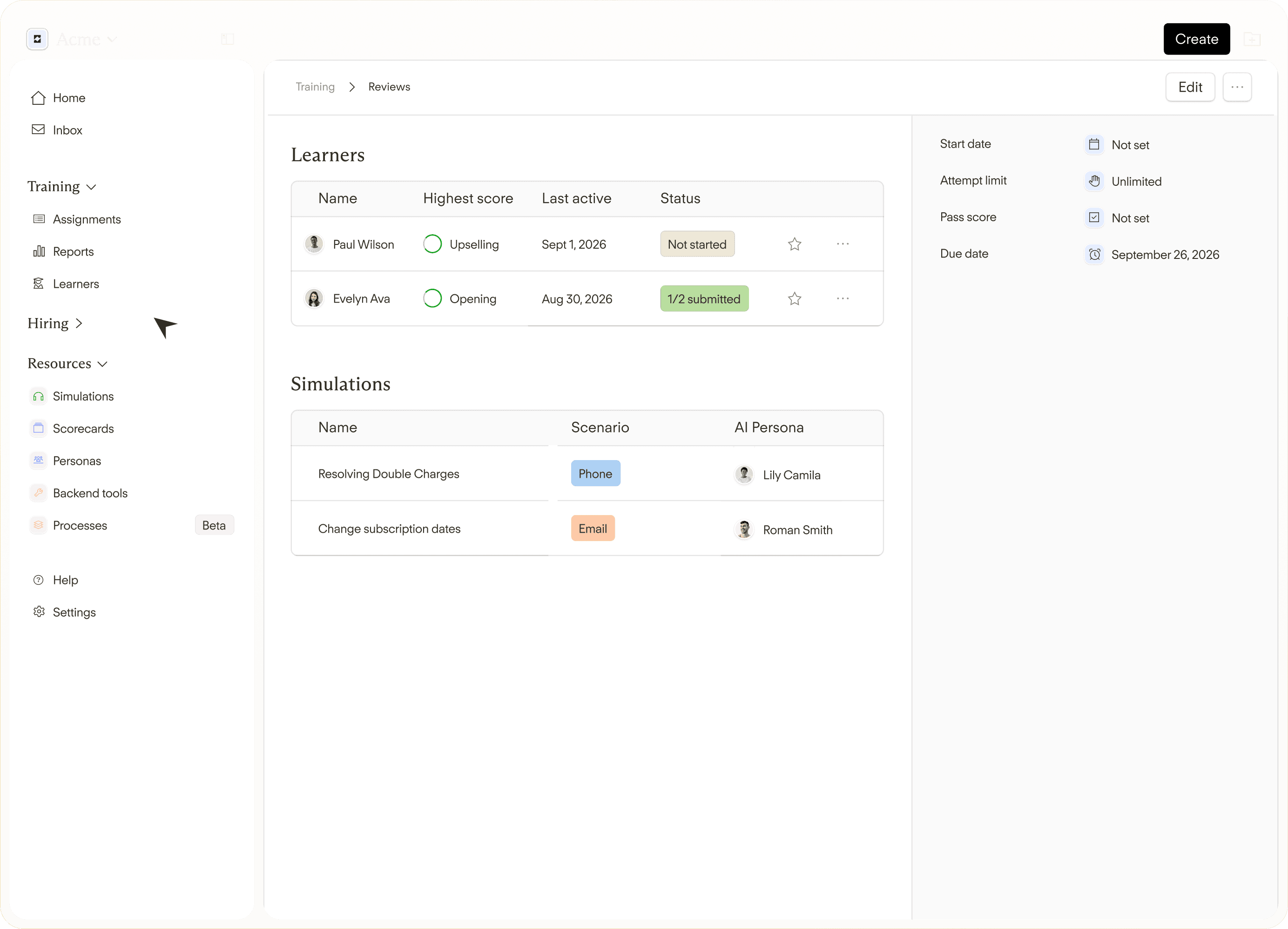
Here is the distinctive step. A low score can become a training scenario, populated with an AI customer who has a particular problem and temperament. The agent practices a response, receives feedback against the same rubric, and can try again. The next live conversation gives the manager a more meaningful test than course completion. A quiz proves that someone clicked through a lesson. The live call shows whether they can use it.
That pairing separates Solidroad from a standalone conversation dashboard or a library of generic training videos. The market already includes Zendesk QA, Playvox by NICE, Scorebuddy, Observe.AI, Level AI and others. Some offer automated scoring and coaching workflows. Solidroad's particular claim is that the same evidence and criteria should drive both the diagnosis and the rehearsal. It is a useful distinction for a buyer to test, not a reason to assume every score will be fair or every simulation realistic.
The numbers have names attached
Solidroad reported more than 50 customers and hundreds of thousands of conversations analyzed each month in June 2025. Its public customer roster now stretches from airlines and financial services to software companies and outsourcing firms. That variety matters because the failure modes differ. An airline may need to test new hires quickly; a fintech company may care about a policy mistake; a software company with global support may need one quality standard across regions.
At Ryanair, Solidroad's case material describes simulated candidate assessments that cut interview time in half and saved 38 recruiter hours during a 100-candidate day. Podium uses validation simulations as a gate before agents handle real customers and reports that they reached its quality threshold 50% faster. ActiveCampaign says automated coverage replaced more than 2,000 hours of manual QA effort across its global teams. Crypto.com reports an 18% reduction in average handling time and a 3% rise in customer satisfaction. These are customer case study outcomes, not promises a new buyer can simply paste into a forecast.
“We finally have consistent visibility into quality across every region. And we can verify readiness before agents go live, not after.”Destiny Young / ActiveCampaign
Finom offers a smaller, perhaps more instructive example. Its training and quality team had relied on manual evaluation and had previously used Klaus through Zendesk. The team chose Solidroad for a more flexible scorecard and feedback features. Its case study reports 12% more conversations reviewed and one hire avoided, while saying the scorecard was still being tuned. That last detail is worth keeping. Better coverage is useful only if the scoring rules reflect what the company actually wants its agents to do.
What it costs, and what the buyer should count
Solidroad does not publish a standard subscription price. It sells through demos and custom enterprise quotes. The public capital figure is clearer: a $6.5 million seed round led by First Round Capital in 2025, followed by a $25 million Series A led by Hedosophia in April 2026. The latter was intended to expand teams in San Francisco and Dublin. Funding buys the company time to build; it says nothing by itself about a buyer's return.
Building the business had its own price. Hughes told The Product Market Fit Show that reaching $1 million in annual recurring revenue took about 500,000 outbound emails, yielding roughly 5,000 replies, 250 meetings and 40 customers at an average annual contract value of $25,000. He also described taking 56 flights in a year to sit with customers and solve adoption problems. Those are founder reported figures from an early phase, not a current price list. The useful part to copy is the order: first learn who has the problem through direct conversations, then scale outreach, then watch what people actually use.
A buyer's evaluation starts with a few mundane measurements: the share of conversations currently reviewed, the hours reviewers spend on each one, the time trainers spend inventing roleplays, and the lag between an error and useful feedback. Then compare those numbers with the cost of a scoped quote, including integrations and calibration. A team with a tiny queue and a good human reviewer may see little benefit from covering every interaction. A large, distributed operation has more reason to care about the conversations its sample never caught.
The harder cost is trust. If agents believe an automated grade is arbitrary, more coverage can simply produce more arguments. Solidroad's newer Assisted QA feature leaves a reviewer able to verify or override AI suggested scores. It reflects a practical point: the scorecard is a policy decision, not a law of nature. Teams still have to agree what a good answer sounds like, check the machine against real examples, and correct it when it misses context.
Now the agent might be a machine
Support teams are adding AI agents from products such as Fin, Decagon and Sierra. Solidroad's integrations page says it can evaluate those agents too. The categories of error change: a human may forget a step; a bot may produce a polished falsehood. Both require someone to notice, define the failure and improve the next response. Solidroad's July 2026 announcement of OpenAI Select Partner status places it closer to the infrastructure supporting that shift. In September, it announced a partnership with Unwrap, whose customer intelligence software surfaces recurring issues and resolution paths; Solidroad turns those findings into training.
There is a portable idea here even for teams that never buy the product. Take a real, recurring customer problem. Write down what a good response must contain. Let an agent rehearse it before the next shift. Then measure the next live interactions on that exact behavior. It is less glamorous than declaring every ticket an “insight.” It also has the virtue of giving the insight somewhere to go.