At Brex, the quality team had a familiar problem: plenty of work, plenty of scores, and an uneasy relationship between the two. Managers graded a handful of support conversations. Reports followed. But the exercise, according to the company’s account published by MaestroQA, was consuming hours without revealing enough about what customers actually experienced.
- MaestroQA began by helping managers review and coach support agents.
- AI widened the lens from sampled tickets to patterns across conversations.
- Renamed Rippit in 2026, it now sells reusable agents for quality, insights and business risk.
A score looks authoritative because it arrives as a number. Yet a customer can receive a courteous, technically correct answer and still be furious about the policy behind it. Grading the answer tells you something about the agent. Understanding the complaint might tell you something more expensive about the company.
The three per cent problem
Brex’s published case study says its conversation coverage rose from 3% to 100%. The change followed a demonstration of MaestroQA’s AI to its COO, which prompted the team to rebuild around insights. The financial platform wanted visibility into customer health and risks, rather than another procession of grades.
“We were spending hours on QA every week, but it wasn’t driving customer outcomes-it was just generating scores.”
Brian Klaja · Brex · customer case study
Those results are customer claims in a vendor-published story. They illustrate a question worth asking even without buying software: are your quality reports helping someone make a decision? A scorecard can become an exquisite filing cabinet for information nobody uses.
The first idea needed a second act
Vasu Prathipati and Harrison Hunter started the company in 2013. Their original customer-retention software struggled to take off. They noticed a more concrete opportunity: companies still employing human support representatives needed better ways to coach them. The support-QA iteration arrived in 2017.
By September 2021, Forbes reported that MaestroQA was profitable and served more than 250 large-scale clients. A $25 million Series A, led by Base10 Partners, financed expansion. The founders believed the product was ready to scale after years of customer feedback. They were raising money to enlarge a working business.
Its expertise grew around the mechanics of service: custom scorecards, reviewer calibration, reporting, screen capture and coaching. These are unglamorous ingredients. They matter because a useful observation must survive the journey from an interaction to a manager’s feedback session.

A request for the manager defeats the keywords
The technical turning point is pleasingly ordinary. In a March 2025 AWS article co-written by Hunter, MaestroQA explained a limitation of its rules engine. Customers asking for a manager and customers asking for someone higher up wanted the same thing. Their words did not match.
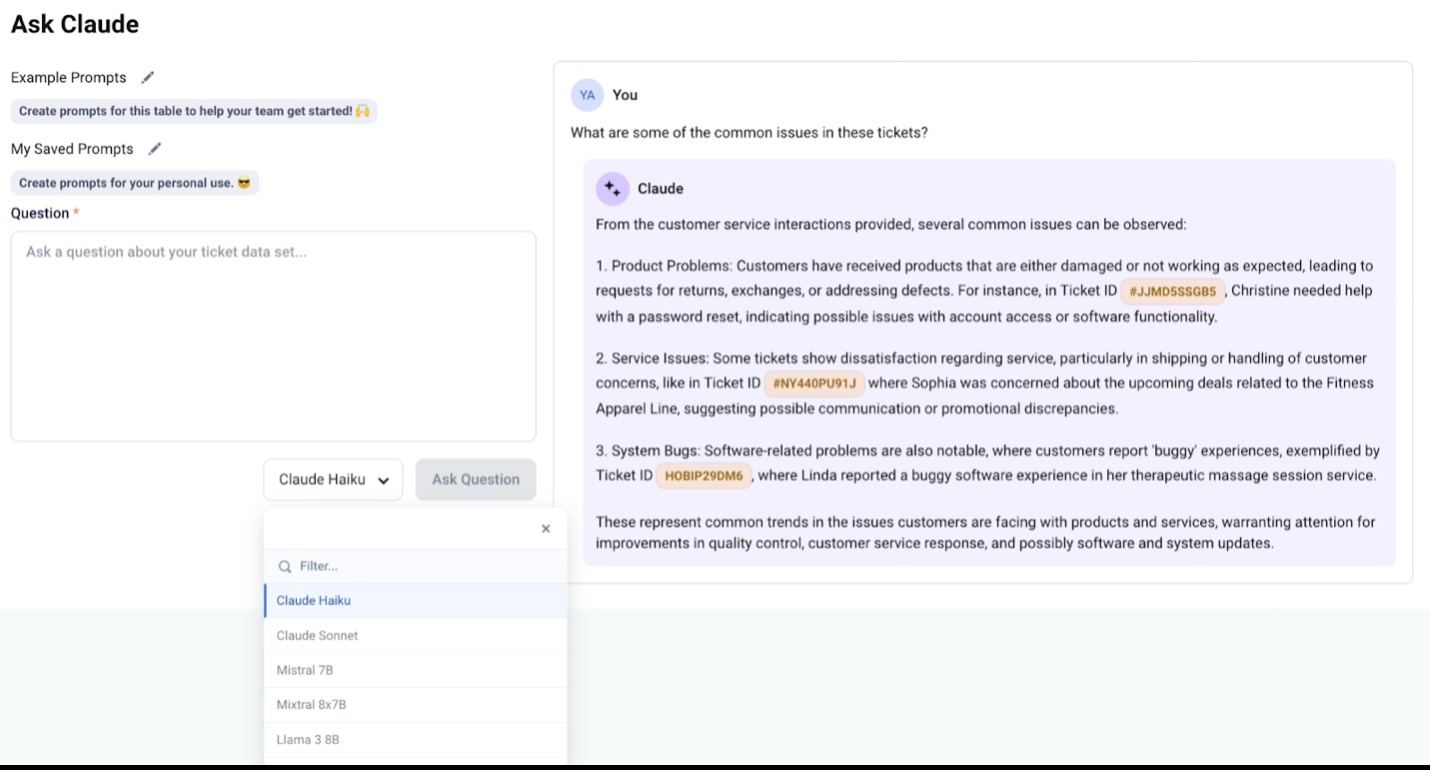
AskAI let users ask open-ended questions about sets of up to 1,000 conversations. Customers then wanted that analysis across their entire transcript collections. The company used Amazon Bedrock to provide foundation-model choices and support analysis at larger scale. The demand came from actual questions, including marketing, service and product issues.
The product’s ambition widened accordingly. MaestroQA became Rippit in 2026. The new platform lets teams describe conversation-analysis agents in plain language and schedule their work. Existing customers retain their rubrics and history. Quality remains a use case, alongside customer insights, churn signals, chatbot monitoring and compliance checks.
Give the finding somewhere to go
SpotOn supplies the practical example. Its old process manually reviewed 3-5% of tickets, while inconsistent reporting and unreliable CRM labels obscured patterns. It combined merchant and ticket metadata from Snowflake with MaestroQA’s conversation analysis, adding business context to what customers said.
The resulting workflow detects themes such as billing confusion and hardware frustration. Findings go to Product, Engineering and Enablement; flagged opportunities can generate Salesforce cases. SpotOn’s case study reports insights reaching more than 13 departments, and executive updates taking under 90 minutes instead of one or two days.
The useful detail is the routing. A complaint about hardware becomes more valuable when someone can see which merchants it affects and who should investigate. An insight without an owner is another item awaiting attention.
+ merchant context
of recurring issues
for the right teams
The bot gets a performance review, too
Upwork brought a different employee to the review: its chatbot. Hallucinations, inaccurate answers and limited analytics made evaluation difficult. Its team spent more than 16 hours weekly reviewing about 1% of conversations in spreadsheets. It introduced custom rubrics for accuracy, escalation and human-likeness, alongside AutoQA and AskAI. The published account says review time fell to seconds; it provides no measured error-rate reduction.
Human coaching has a similar problem of finding useful evidence. DraftKings used the LLM metric builder and AskAI to surface specific behaviors across conversations. Its performance manager Eric Haywood described the old coaching approach as “soul-sucking.” The alternative gives a manager examples to discuss, rather than a vague instruction to improve a number.
Buy the workflow; budget for the reading
Rippit currently lists Starter at $185 a month for 300 agent runs and Growth at $495 for 1,000, plus free and custom Enterprise tiers. AI credits cost extra, at cost. One agent run executes a workflow: weekly coaching for 20 agents means 20 runs each week. Unlimited Q&A still consumes AI credits.
Zendesk QA also advertises automated review of every ticket, and evaluagent offers AI-assisted quality management. Full coverage alone is a weak distinction. MaestroQA’s broader proposition connects service analysis to product questions, risk and follow-up work.
A sensible starting point is one recurring problem, a connected conversation source and a named owner. Check the machine’s findings against actual interactions before widening the program. Low volume offers less reason to automate; inaccessible data and nobody assigned to act weaken the case further. The method readers can copy is simple: ask what went wrong, inspect the evidence, and give the answer a job.