The first version of Playvox began with a conversation in a contact center in Chile. Oscar Giraldo, then a software developer, asked a manager what made running the place difficult. The answer was motivation. Agents left; the center hired and trained replacements; the cycle began again. Giraldo's idea was to notice good behavior automatically, give it a score, and make recognition part of the workday. It is an almost quaint premise for an enterprise software company: perhaps a person might do better work if someone noticed.
That premise traveled a long way. Giraldo founded Playvox in 2012 in Manizales, Colombia. It grew into software for reviewing customer interactions, coaching agents, teaching skills and recognizing results. By January 2021 the company said it served more than 200 customers in 34 countries. Today it carries the name Playvox by NiCE and is sold in a much larger customer-experience portfolio. Its current pitch has a different center of gravity: plan the people who handle chat, email, tickets and back-office cases, as well as calls.
- Playvox started with agent quality, coaching and recognition.
- It added digital workforce planning by buying Agyle Time in 2021, then conversation analytics through Prodsight in 2022.
- NiCE now markets Playvox for forecasting, scheduling and tracking work that passes between channels and teams.
A telephone call is a tidy unit
A call rings, someone answers, and eventually it ends. That shape made the old staffing problem comparatively legible. Count calls, estimate their length, allow for breaks, and put enough people on the phones. Customer support now arrives in shapes that refuse to behave. A chat may overlap another chat. An email may wait until tomorrow. A case can move from an agent to a specialist to a back-office team and return with a new question. One customer problem produces several pieces of work, none with the elegance of a ringing telephone.
Playvox's workforce management software takes those workstreams seriously. Its NiCE data sheet describes forecasts and schedules for synchronous and asynchronous workloads, using service targets, business rules and actual activity data. Managers can compare incoming volume with forecasts, see adherence and occupancy, and adjust during the day. The advertised difference is its proximity to the systems where digital work already lives, particularly Salesforce and Zendesk. A ticket is not forced to masquerade as a call to appear in a staffing plan.
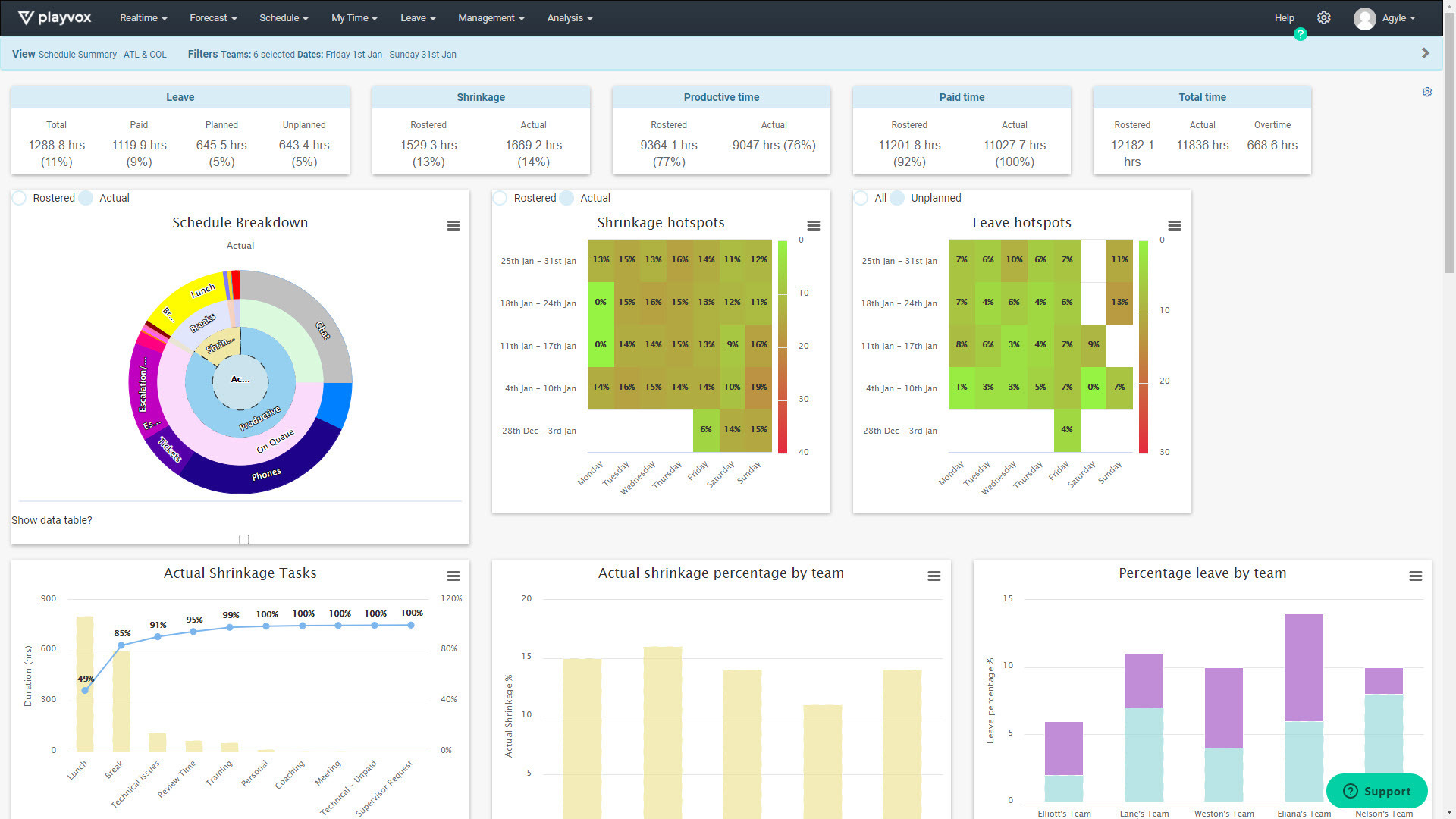
This is where the two halves of the company meet. Quality Management lets a team build scorecards, evaluate conversations and calibrate reviewers. Coaching turns an evaluation into a plan, rather than a record filed away. Learning and recognition add a way to act on the result. Workforce Management asks when that agent is available, which work they can handle, and what demand is coming. The buyer is usually a contact-center or support leader; the people feeling the software every day include agents, quality analysts, coaches, schedulers and BPO managers.
“My message would be to apply the same level of effort that you are putting into your customer experience into creating agent experiences.”Oscar Giraldo, in Call Centre Helper
The acquisitions tell the story
The company did not build this whole suite in a single heroic sprint. In January 2021, Playvox announced a $25 million investment from Five Elms Capital and the purchase of Agyle Time, an Australian workforce-management company. A business known for agent quality and engagement had bought the machinery for forecasting and scheduling. Playvox said active users had grown by more than 400 percent during 2020; the bigger product scope made sense for an enterprise customer that wanted fewer seams between review, coaching and staffing.
A year later it acquired Prodsight, which analyzed customer conversations for topics and sentiment. Renamed Playvox Customer AI, it added a way to learn what customers were talking about, not merely how agents answered. The sequence is more revealing than a feature list. First, measure the interaction. Then help the person handling it. Then plan enough people for the next wave. Finally, read the wave for patterns. For a support operation, those are neighboring problems; for software vendors, they have often been separate products.
That loop has a cost, though its present price is negotiated. NiCE directs prospective Playvox WFM buyers to request a quote. A Salesforce AppExchange listing for Playvox Quality Management advertises a starting price of $15 per user per month. That is a listing price for one product, not a reliable estimate for a full deployment. The more consequential cost is operational: integrations, clean data, sensible definitions of productive work and supervisors with time to coach. A dashboard cannot decide which behaviors deserve a badge.
What a clearer picture bought Angi
Angi makes the case concrete. Its customer operation had more than 800 agents in different locations and relied on business-process outsourcing partners. According to a NiCE case study, it lacked a clear view of productivity across that network. After implementing Playvox WFM, Angi reported that agent occupancy rose from 43 to 80 percent, touches per hour from 2.5 to 5.5, and service-level performance from 70 to 90 percent. It estimated more than $1 million in annual BPO productivity gains and cost efficiencies. These are Angi's reported results, not a promise that another team will reproduce them.
More visible work, higher reported service levels
Reported by Angi in a NiCE customer case study. The chart shows association with its deployment, not an isolated causal effect.SeatGeek offers another angle. Its client-services team supports buyers and sellers by voice, chat and email. A NiCE case study says the team considered eight products before choosing Playvox WFM, integrated with Talkdesk and Zendesk, and later described forecasting and scheduling as ten times less complex. The lesson is not that every organization needs the same software. It is that a plan built from one channel's data will miss work hiding in the others.

The view from inside a larger company
The Playvox by NiCE name appeared publicly in 2024. Giraldo had already stepped away that March; in a later interview he described a disagreement about vision and strategic direction. That complication belongs in the story. A founder's first idea and a larger owner's roadmap do not always travel together. NiCE now presents Playvox as part of its workforce-management lineup, with particular emphasis on digital channels, CRM-connected teams and back-office operations. Its 2026 material still describes Playvox by name, suggesting the product retains a distinct job within the portfolio.
It sits between focused digital-first scheduling tools, such as Assembled, and broader contact-center suites from established vendors. Its appeal is most obvious where customer work moves through tickets, multiple channels and several teams, and where managers want quality feedback and staffing data near the same workflow. A small operation with simple calls and a stable rota may find the machinery excessive. A team that has not agreed what “done” means for a case will find its forecast impressively precise about the wrong thing.
The useful idea to copy is older than the software. Start by asking what managers and agents cannot see. Map one customer problem from arrival to resolution; count every handoff and every pause. Forecast from that work, then check the plan against the day that actually occurred. Finally, make quality feedback timely enough to change the next interaction. The call center left the phone years ago. Its arithmetic is still catching up.