At a poker table, certainty is usually an expensive costume. The cards arrive in pieces. The other players disclose themselves by degrees. A strategy that worked fifteen minutes ago can become a donation after the blinds rise or a new opponent sits down. Diego Lomanto learned this while playing professionally to help pay his way through graduate school. He still enters the World Series of Poker, and he has carried the habit of recalculation into a career spent marketing technologies whose categories are still being invented.
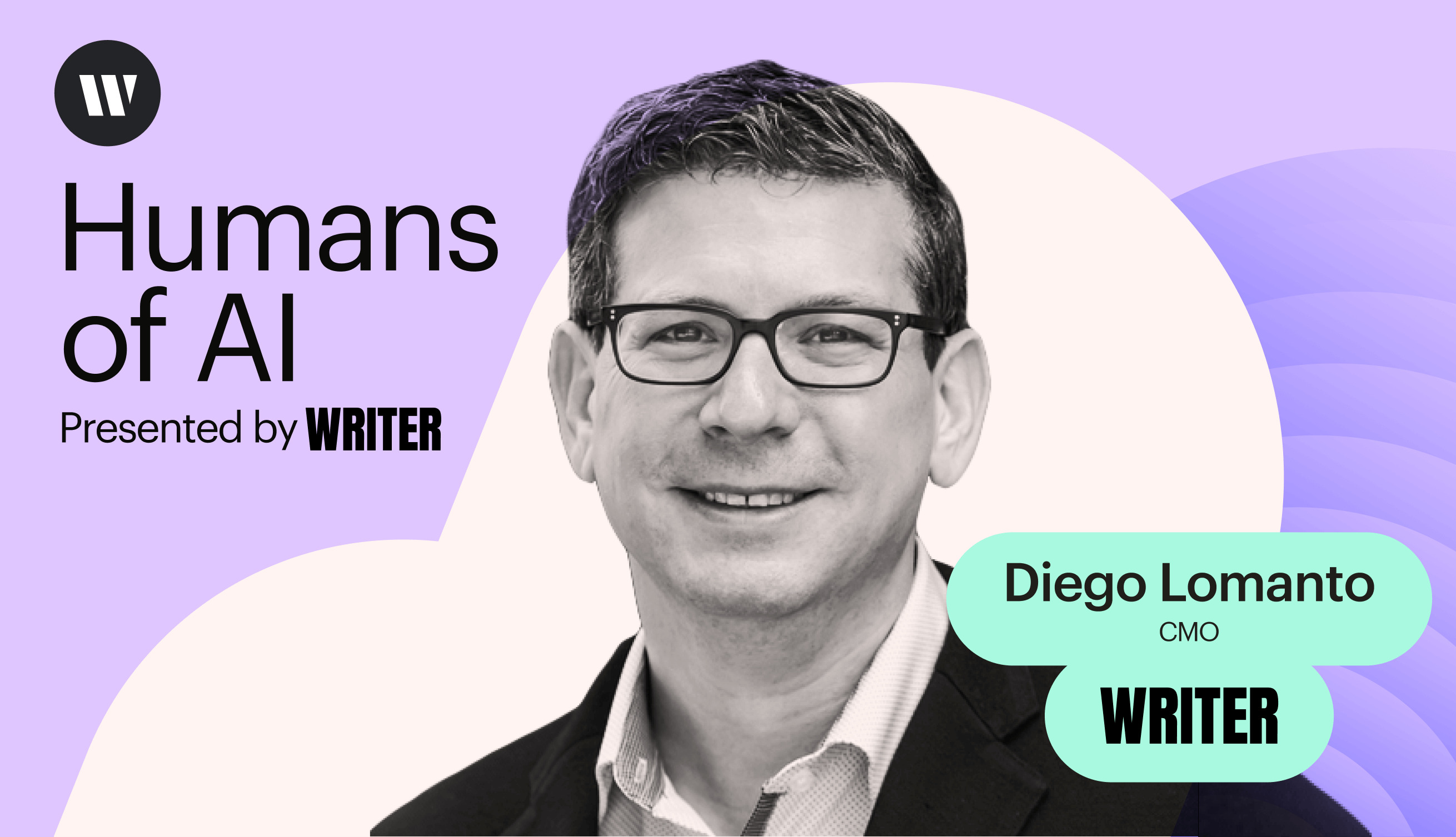
Now the chief marketing officer of WRITER, Lomanto works in an industry where the table seems to change between breakfast and lunch. Models improve. Agent frameworks multiply. Buyers oscillate between curiosity and fatigue. His job is to make an enterprise AI company intelligible while the meaning of enterprise AI keeps moving. The title sounds like a seat at the head of a polished conference table. His preferred metaphor comes with chips, imperfect information, and the possibility that a perfectly sensible plan has just expired.
“I actually think AI is forcing marketers to spend more time thinking about brand differentiation and personal relationships than ever before.”Diego Lomanto, Humans of AIFirst hand
Before the story, he learned the machinery
Lomanto did not begin his working life at a safe distance from the product. His early career included web development, digital production, and consulting. Years later, while co-founding Tournament Poker Edge in 2010, he used PHP and MySQL to help build the subscription training site himself. He also developed its product and marketing strategy and created a poker podcast that became an acquisition channel. The distinction between making the thing and explaining the thing was pleasantly untidy.
That background helps explain his affection for product marketing. He speaks warmly about product managers and engineers and describes his own route to the C-suite as coming up through the product side of the house. Features are raw material. The marketer's work is to discover which difference matters to a customer, then make that difference simple enough to remember.
His formal training added another lens. Lomanto earned a marketing degree with honors from St. John's University, then completed an MBA at NYU Stern with a specialization in strategy and marketing, also with honors. Poker helped with the bill. More valuably, it gave strategy homework immediate consequences. Probabilities had to coexist with an account of what the person across the table believed.
Public tournament records list 15 cashes through June 2024, including events at Mohegan Sun, Borgata, Foxwoods, the Venetian, and the World Series of Poker. Lomanto jokes that nobody should ask about the winnings. The useful return was a mental model. Marketing, like poker, combines the measurable with the stubbornly human. Data describes the visible board. Judgment begins with the story people are telling themselves about it.
A career spent naming the next kind of work
The corporate chronology has a recurring theme. At WorkMarket, which he joined around its Series A stage, Lomanto helped position software for managing an enterprise's contingent workforce. ADP acquired the company in 2018. Between those points he became the first CMO of Talent Inc., building its marketing organization, and then moved to Verint, where he guided strategy and development for products representing more than $200 million in revenue.
In 2018 he joined UiPath as the company was crossing roughly $50 million in annual revenue. Robotic process automation was not a phrase that slipped easily into ordinary conversation. The work demanded more than campaigns. It required a platform narrative and the architecture of a category. Lomanto began with a product marketing group of two, himself and Joe Edwards. By the time he left four years later, he said the wider function had grown beyond 35 people across product and industry marketing, analyst relations, competitive intelligence, customer evangelism, and content.
UiPath during Lomanto's tenure
Annual revenue figures Lomanto used when describing the company's Series B-to-IPO journey. Scale shown relative to $1 billion.
UiPath went public in 2021. Lomanto's departure note the following year carried pride in the journey and an admission about his temperament. He wanted to build again. He called the startup growth phase “insane, chaotic and beautiful,” the sort of description that works equally well for romance and a broken quarterly plan. The established prize was less attractive than another unsettled table.
He joined conversational AI company Ada as CMO in late 2022. In 2024 he became WRITER's first chief marketing officer. The move returned him to the work he had enjoyed at UiPath: taking a technically ambitious enterprise product, finding the clean market narrative, and building the go-to-market muscles around it. He compared the energy he saw inside WRITER's customer base with UiPath's early days. By then the poker metaphor had gained a new wrinkle. The dealer was software capable of generating some of the marketing itself.
The operating ideaUse the machine, keep the judgment
Lomanto is an enthusiastic daily user of AI and an unusually clear critic of lazy automation. His team has a rule: before buying another tool or starting a project in the customary way, stop and ask whether AI can do the work. The first attempt may take longer. A reusable workflow can then return the investment many times. In one workshop, his marketing group turned more than 100 use-case ideas into three working agents by the end of the day. The revealing act was the reduction from 100 to three.
His argument begins with a distinction between capacity and value. AI can create drafts, variants, summaries, and repetitive production at remarkable speed. That capacity reaches a business result only when it is reinvested. WRITER's marketing operation, he said in 2026, was producing 2.2 times the volume with 1.25 times the headcount, with AI-driven execution accounting for roughly 60 to 70 percent of the gain. More output is the receipt. The strategic question is what the freed attention buys.
Turn recurring execution into systems. Accept a slower first build when the workflow will be used again.
Score ideas by frequency and impact. Narrow the field. Capacity without priorities is merely a faster queue.
Spend the dividend on creative judgment, customer trust, and a brand with a recognizable point of view.
This is where Lomanto's position becomes more interesting than a generic sermon about efficiency. If every competitor gains access to similar production power, volume loses its distinction. Brand, taste, relationships, and the nerve to make a particular choice become scarcer. He believes an AI-equipped CMO remains a person. Storytelling still requires finding an angle amid a chorus. Positioning still requires listening to many customers. Prioritization still requires turning down good ideas. Trust remains stubbornly social.
“What we crave is just that one-liner, simple way of understanding what you do.”Diego Lomanto, Next Gen Builders
Simplicity is his preferred test. Asked to describe WRITER, Lomanto offered three verbs: build, activate, supervise. Builders create agents, people across the business use them, and IT retains governance. Much of the platform disappears inside those words. That disappearance is the labor. He says teams can spend weeks or months reaching the line that sounds obvious afterward. A complicated sentence may prove that the speaker studied the product. A simple one proves the company decided what it means.
How he leadsDrivers, dates, and the art of orchestration
In hiring, Lomanto watches how candidates approach a presentation. Do they ask questions? Seek context? Advance the conversation before someone tells them what to do? He calls the desired person a driver rather than a passenger, someone whose instinct is to move the ball forward. This is a practical filter for a company where next quarter's market map may already be obsolete.
His language for leadership is “orchestrating.” At WRITER, he says, shifts do not emerge from executives disappearing for a weekend and returning with a proclamation. Customer results circulate. Teams participate in the conversation. Leadership aligns many small groups around the few things that matter. Marketing can feel like twelve departments borrowing one calendar, so the discipline is to choose one, two, or three shared priorities and stop there.
Then he puts a launch date on the calendar. Dates make things happen, he says with earthy emphasis. A release moment gives product, engineering, sales, and marketing a common beat. The observation lacks the glamour of a grand theory, which is why it rings true. Even an industry intoxicated by limitless intelligence must still ship on Tuesday.
In May 2026, Lomanto became a co-chair of WRITER's AI CMO Council, a group created for senior marketers working through agentic transformation. His writing that year focused on the gap between enterprise AI spending and meaningful returns, shared organizational context for agents, and the functions emerging inside AI-native marketing teams. The topics sound technical. His concern stays human: fear, incentives, judgment, and whether the organization changes its habits after the demo ends.
The long gameRead the table, then make the bet
Lomanto's public optimism about AI is tempered by technological memory. He studies earlier waves and argues that society reshapes itself around foundational inventions. The transition hurts and surprises; the eventual form cannot be seen cleanly from the beginning. His advice is to accept the discomfort and adapt. It is the tournament player's answer, seasoned by dot-com cycles, the financial crisis, automation, an IPO, and the end of cheap capital.
Poker never promised him perfect information. Neither does the current market. What it offered was a way to act responsibly without waiting for certainty: calculate what can be calculated, observe the people, update when conditions change, and keep enough humility to fold. The same pattern runs through his career from developer to product marketer to CMO. He remains close to the machinery, but he studies the story around the machinery just as carefully.
AI marketing, in Lomanto's telling, is less a contest to manufacture the most material than a test of what a company chooses to preserve. The machines can supply speed. The organization must supply memory, standards, and intent. The marketer must still decide which sentence deserves to leave the building.
That makes the long game surprisingly old-fashioned. Know your customer. Explain the product simply. Give good people room to act. Reconsider the plan when the blinds go up. And when everybody at the table receives more chips, remember that chips were never the same thing as judgment.