Michael Ciancio has spent a career selling things that resist a slogan. Nutritional ingredients. Software distribution. Cloud communications. Employee-performance systems. Legal intelligence. Each arrives with a private dialect, a crowded diagram and an impatient buyer. His useful trick has been to translate without sanding away the substance. Now, as Chief Marketing Officer at Expert Institute, that habit meets an audience trained to object.
The company helps law firms find and evaluate expert witnesses, review records and analyze litigation intelligence. It is a proof business. A claim cannot merely sound plausible; it must survive another professional's scrutiny. For a marketer who has argued that brands need to become citation-worthy, the fit is almost too neat. The old assignment was to earn a click. The present one is to earn belief before, during and after the click.
Ciancio's public philosophy can be reduced to three verbs: translate, diversify, accelerate. Translation makes a complex product useful. Diversification keeps a pipeline from depending on one lucky tap. Acceleration removes friction without handing judgment to a machine. None is especially theatrical. Together they form an operator's answer to a noisy moment in B2B marketing.
“AI isn't the headline - it's the velocity shift underneath it.”Michael Ciancio, on the changing go-to-market playbook
The economics student learns to explain
The groundwork was laid in Gettysburg, Pennsylvania. Ciancio studied economics at Gettysburg College from 2004 to 2008, joined Phi Kappa Psi and captained the baseball team. Economics offered systems and incentives; captaincy offered the less tidy matter of getting people to move together. His later vocabulary - team results, orchestration, velocity - carries traces of both.
His early public record puts him at Pharmachem Laboratories, where a 2012 trade directory listed him as marketing manager. The products were ingredients with names such as Lactium and Pomanox, sold through specifications and applications rather than glamour. Around the same period, he returned to school. He completed an MBA in marketing at Montclair State University in 2014, adding formal work in finance, market analysis, operations, project management and crisis communication.
He would go on to work across Wayside Technology Group, Vonage, Infor and IntelePeer. The categories changed, but the central task grew sharper: make an intricate product understandable to the person who might buy it, use it or approve it. IntelePeer eventually described his focus as turning complex concepts into engaging solutions that provide customer value. It is a modest sentence with a demanding standard. Anyone can simplify. The harder act is preserving what matters.
A marketer with a catcher's eye
Baseball comparisons are cheap, but Ciancio has earned one. A good catcher sees the whole field while everyone else is busy inside a single play. His version of marketing works similarly. He rejects the idea that the department's responsibility stops at the top of the funnel. Awareness matters, but so do the handoffs, the gaps between stages and the customers who can become a growth engine.
In a 2025 reflection after a Growth Wizards Podcast conversation, he called marketing an orchestrator across the buyer journey, from first notice through expansion. He urged teams to inspect the friction from sales-accepted lead to sales-qualified lead to closed business. The implication is plain: a swollen lead count can coexist with a weak growth system. Volume photographs activity. Velocity reveals whether the parts cooperate.
His portfolio rule is particularly memorable: avoid letting any single source drive more than 30 to 40 percent of pipeline. It sounds like financial advice because it is the same species of caution. Concentration flatters a dashboard until the channel changes, the auction gets expensive or the audience moves. Partnerships, which he regards as underinvested, can add another leg to the stool.
The career turns toward AI
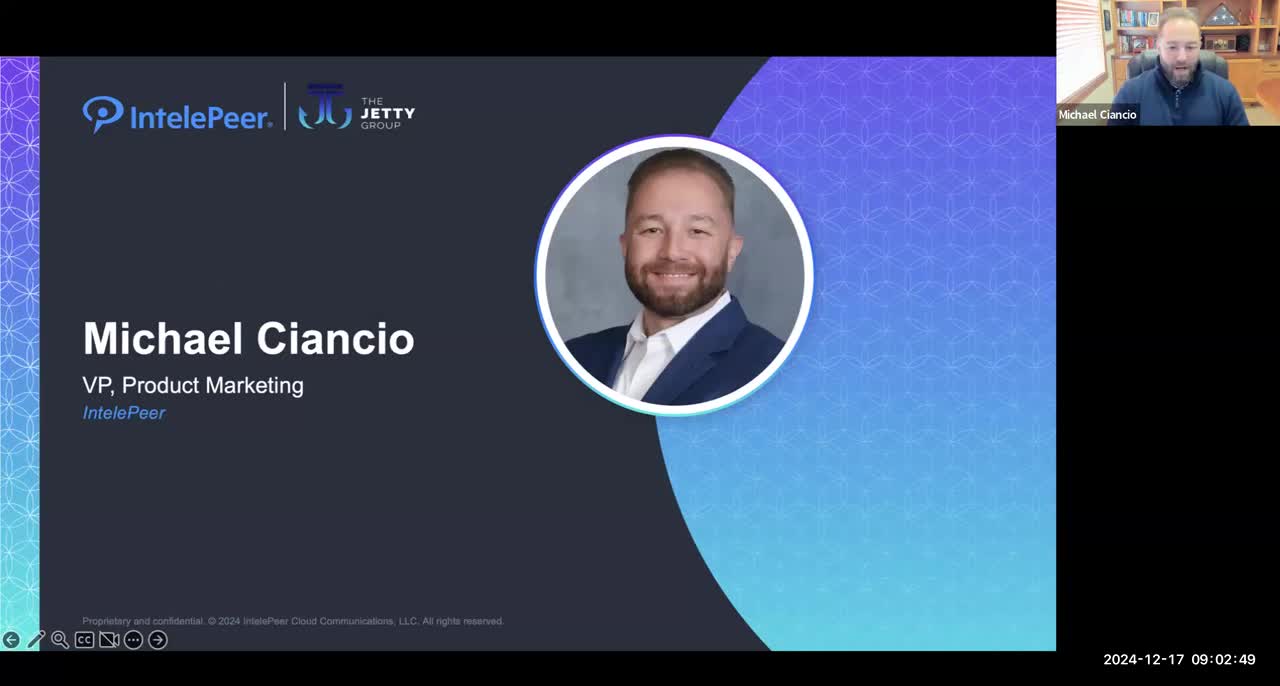
At IntelePeer, Ciancio served as Vice President of Product Marketing and appeared in webinars on communications automation and AI. The format suited his method. A broad technological promise had to become a sequence of recognizable jobs, choices and outcomes. The spectacle was secondary to the workflow.
In March 2025, Centrical appointed him Chief Marketing Officer. The brief covered global marketing, brand growth and market expansion for an AI performance platform. Ciancio said marketing would help drive the next growth phase by deepening the company's presence in the United States and abroad and expanding its partner ecosystem. Founder and CEO Gal Rimon pointed to his experience in data-driven marketing, product innovation and brand building.
The role also gave him a front-row seat to AI's effect on marketing itself. His position is neither devotional nor defensive. Use the tools to clear routine desk work, he argued, so people can spend more time on strategy and storytelling. Keep humans in the loop. Add guardrails. The machine supplies speed; the team remains accountable for direction.
“Teams who learn to orchestrate, not just execute, will win.”Ciancio's mental model for the next marketing organization
Authority after the blue link
Ciancio also sees discovery changing. Buyers increasingly ask large language models before visiting a vendor's site. He uses the shorthand GEO or AEO - optimization for generative and answer engines - but his prescription predates either acronym: become worth quoting. Authority and citation-worthiness begin to matter more than stuffing a page with familiar phrases.
That idea lands differently at Expert Institute. Its platform sits in litigation, where the provenance of a fact, the history of an expert and the shape of an opposing argument are not content-marketing abstractions. They can affect a case. The current company team page lists Ciancio as Chief Marketing Officer, alongside executives responsible for research, medical affairs, commercial operations and product technology. Marketing is one part of a system designed to help legal teams make better-supported decisions.
Expert Institute's own account of the business begins with an old legal habit: attorneys often find specialists through static directories, colleague referrals or a familiar roster. The company's wager is that a broader pool of data can make that choice more deliberate. It aggregates information across specialties, evaluates qualifications and helps firms compare suitability at a wider scale. Its product set now includes case management, expert research, transcript tools and litigation analysis. The promise is not a cleverer search box. It is a more informed decision before a deposition or trial makes the cost of a weak choice obvious.
For Ciancio, this creates a satisfying inversion. In many software categories, marketing must labor to make an invisible system feel concrete. Here, the system's raw material is already a collection of concrete things: credentials, testimony, publications, records, transcripts and prior litigation. His team must show how those fragments become confidence without pretending that software replaces professional judgment. The product and the pitch therefore share an obligation. Both must organize a complicated body of evidence and help a person decide what deserves attention.
His path there was not a single-industry ascent. It was a long apprenticeship in changing vocabularies. He learned products, audiences and channels, then learned to connect them. A colleague from Wayside Technology Group remembered his ability to manage difficult client and vendor relationships and lead cross-functional teams. OneNine AI lists him as a board member. He joined the advisory council for Seton Hall University's Customer Experience Program in 2025. Since 2023, he has also served on the Gettysburg College Baseball Alumni Council.
Those affiliations sketch a social style around the operating doctrine. Translation requires listening. Diversification requires relationships. Orchestration requires accepting that no department completes the music alone. Ciancio's own early biography used competitive, passionate, persuasive and articulate. The résumé adds a quieter adjective: connective.
The useful thing to steal
The temptation with any executive profile is to search for one secret. Ciancio's is closer to a checklist. Can a smart outsider understand the product? Can every important claim point to support? Is demand spread across enough sources to withstand a surprise? Where does momentum die between interest and revenue? Which repetitive work can a tool accelerate, and which judgment still belongs to a person?
These questions travel. They worked when the subject was communications software. They work when the subject is AI. They become especially sharp when the customer is an attorney and the product promises better intelligence. The language of evidence is less forgiving than the language of advertising, which may be precisely why it suits him.
Ciancio's public aspiration is not to produce more marketing for its own sake. It is to build larger pipeline impact by making teams orchestrators: across stages, across channels, across people and machines. There is discipline in the modesty of that ambition. The marketer does not need to be the loudest instrument. He needs to make sure the song reaches the right ending.