Before an enterprise buyer writes a request for proposal, a quiet contest has usually begun. Names are remembered or ignored. Categories harden. Colleagues compare notes. A vendor may believe the race starts when sales receives the document, but Michelle White sees a much earlier starting gun. In February, the new TigerConnect chief marketing officer described switching on a program called “Surround Sound,” designed to put the company in front of selected accounts before the RFP, the outbound call, or the meeting request. Her summary had the snap of a good operating rule: “Not random. Not loud. Intentional.”
The line says plenty about White. She is a marketer who talks about presence as architecture, not confetti. Her public biography is concise, even by executive-page standards, but its verbs are revealing: drive, turn, scale, unify. They describe someone less interested in decorating a company than in wiring its parts together. At TigerConnect, her formal territory is go-to-market strategy, brand, and market voice. The practical territory is larger. She must make marketing, sales, and product sound like three sections of the same orchestra.
That assignment is especially sharp in healthcare technology, where the product can become a thicket of integrations, workflows, acronyms, alerts, devices, and buying committees. A marketer can respond by adding more language. White's instinct is to add more structure. “AI is not a feature. It’s infrastructure,” she wrote. The sentence referred to the role of AI in her marketing system, but it also works as a description of her habits: build the underlying thing that allows many actions to behave as one.
“Enterprise deals aren’t won with one touch - they’re won with coordinated presence.”Michelle J. White, February 2026
A career built at both speeds
White arrived at TigerConnect with an unusually useful range. Her company biography places her inside Silicon Valley startups, private-equity-backed scale-ups, and Fortune 15 enterprises. It names Wolters Kluwer, Cardinal Health, Qventus, and Iodine Software. Each environment teaches a different version of patience. Large organizations have reach, process, and many stakeholders. Startups have a shorter runway between a claim and its commercial consequences. A scale-up gets the entertaining burden of both: it must move quickly while proving that the motion can repeat.
enterprise
scale-up
startup
The available record does not invite a grand origin myth. It offers something more credible: accumulated practice. White earned an MBA in marketing from Kent State University. Her LinkedIn profile also records Honors College participation and summa cum laude graduation. She then built a career inside companies where the object being marketed was rarely simple and the buyer rarely acted alone.
At Cardinal Health, she combined her day job with internal volunteer roles in career development, mentor circles, diversity and inclusion work, and charitable activity. It is a small but telling detail. Cross-functional alignment can sound like a rectangle on a strategy slide. Mentoring and committee work reveal the human version: repeated conversations across boundaries, often without the neat authority of an org chart.
- Marketing leadership at Wolters Kluwer and Cardinal Health.
- Joined Qventus and publicly tied the move to its mission of simplifying hospital operations.
- Represented Qventus as Head of Marketing during its announcement of strong early KLAS feedback.
- Led marketing at Iodine Software as Waystar announced its agreement to acquire the company.
- Listed as TigerConnect CMO, responsible for go-to-market strategy, brand, and market voice.
The mission enters the sentence
In March 2022, White announced that she was joining Qventus. The wording is worth noticing because it begins with the mission, not the title. She wrote that she was drawn to simplifying the way healthcare operates so hospitals and caregivers could focus on care. Then she named the machinery: artificial intelligence, machine learning, behavioral science, and data science applied to operations. Finally, she thanked three colleagues for the onboarding experience.
Mission, mechanism, people. It is a compact three-part construction, and it reappears in her later work. The idea must matter. The operating method must be explicit. The humans doing the work must be visible. When Qventus announced a 96.9 score in the first KLAS capacity-optimization report the following year, White was its Head of Marketing and media contact. The score belonged to the company and the customers surveyed, not to one executive, but its form suits her stated taste: a broad promise converted into a number someone can examine.
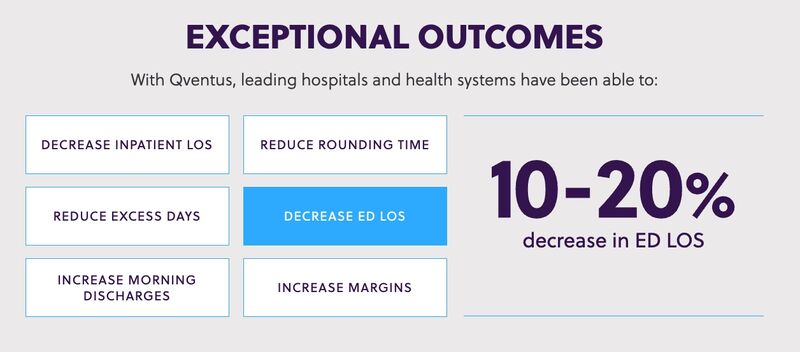
Qventus also shows the advantage of joining a company while its category is still being translated for the market. AI in hospital operations was not a blank concept in 2022, but it had not yet become the decorative label attached to half the software aisle. White had to connect the technology to the actual work it changed. In that context, “AI-powered” is only the opening clause. The sentence must end with what becomes faster, easier, or more measurable.
The acquisition and the next operating table
White later moved to Iodine Software, another AI-focused healthcare software business, where she led marketing. When Waystar announced an agreement to acquire Iodine in July 2025, White appeared as Iodine's media contact. That placement sounds administrative. It is also where a market narrative meets its most compressed test. An acquisition announcement must explain what a company does, why its assets matter to the buyer, and what the combined story becomes, all under the attention of customers, staff, investors, and competitors.
By early 2026, White was on TigerConnect's leadership page. The platform she inherited as a marketing subject is broad: secure messaging, physician scheduling, alarm management, operator tools, patient engagement, and an AI orchestration layer intended to route requests and alerts to the right role. Breadth is useful in a sales catalog. In a market position, it can become soup. White's remit is to turn the ingredients into a meal.
The scale makes her infrastructure metaphor more than a nice LinkedIn phrase. TigerConnect said in August 2026 that more than one million care-team members at nearly 6,000 organizations use its products. Its winter product release introduced 21 capabilities, including an AI-powered operator console. A company with that many users and that much product surface cannot rely on one clever launch. It needs a market system sturdy enough to preserve a coherent identity while the product keeps moving.
Marketing without the costume jewelry
White's stated belief is that marketing's highest purpose is to turn bold ideas into measurable business outcomes. The formulation keeps imagination and accounting in the same sentence. Boldness alone can produce an admired campaign that the rest of the company cannot use. Measurement alone can produce a beautifully instrumented shrug. The interesting work is the conversion between them.
That conversion requires choices. A platform can list every capability or own one useful idea. A team can chase every account or coordinate around the right ones. A brand can be loud or be remembered. White's “Surround Sound” post made the selection clear. The target accounts should encounter TigerConnect consistently before the buying event, not through random repetition but through planned presence. The goal is not to surprise a buyer at the RFP. It is to make the company's relevance feel familiar by then.
There is a pleasant bit of irony here. Marketing departments are routinely asked to make noise, yet White's sharpest line warns against loudness. She is not arguing for invisibility. She is arguing for signal. In a category where communication itself is the product, the distinction is unusually apt. A useful message reaches the right person, carries context, and arrives in time to change an action. TigerConnect says its software does this for operational work. White is building a marketing analogue.
“Not random. Not loud. Intentional.”A three-line brief for enterprise attention
Her new role also places her among leaders responsible for growth, product, customer experience, technology, finance, and people. Alignment with sales and product appears explicitly in her biography, but the job inevitably touches all of them. A promise that sales cannot defend is decoration. A promise that product cannot deliver is debt. A promise customers do not recognize is fiction. The CMO's craft is not simply to tell the story. It is to keep the story honest enough that the company can inhabit it.
White's record remains more operator's notebook than memoir. There are no published childhood revelations here, no cinematic garage, no convenient lightning strike. What emerges instead is a pattern of decisions: take on complex products, move between company stages, attach technical claims to operating results, and give alignment the status of actual work. This is less dramatic than an origin legend and more useful to anyone running a team on Monday morning.
Before the meeting request
The phrase in White's headline is temporal: before. Before the RFP. Before outreach. Before the meeting. It recasts marketing from the department that promotes finished work into the system that prepares a market relationship. Preparation is not glamorous because, done well, it disappears into readiness. The buyer knows the name. The product story fits the problem. Sales does not need to perform a cold introduction and a category lesson in the same breath.
TigerConnect's challenge will keep changing. AI language is becoming cheaper by the week. Enterprise buyers have reason to distrust vague automation claims. A portfolio that grows through releases and acquisitions must continually decide what belongs in the foreground. White's answer so far is a disciplined one: treat AI and marketing as infrastructure, coordinate the touches, and make the outcome carry the argument.
It is the sort of strategy that can look obvious after it works. Most infrastructure does. The pipes vanish behind the wall; the room simply functions. White's ambition is similar. When the RFP finally arrives, the marketing should already have done its quiet labor. The company is present. The idea is legible. The evidence is close at hand. Nothing random, nothing merely loud. Just a machine built early enough to matter.