A medical claim has a peculiar journey. The appointment is over, but the work of getting paid continues: a code, a check, a transmission, a response. Now imagine that its usual route stalls. The biller needs another way through. In an August 2026 announcement, TechMatter described a deceptively modest answer: give its CureAR billing platform a second clearinghouse connection, while keeping the work inside the same dashboard.
- Build the tool: CureAR handles billing workflows; Credentialli manages provider credentials.
- Bring in the operators: DoctorPapers adds billing, coding, and virtual staffing expertise.
- Connect the foundations: State Drives brings enterprise hardware into the managed IT business.
That small routing change is a useful way into this company. TechMatter sells software, but it also supplies people and manages infrastructure. Its portfolio follows the administrative journey around healthcare. The interesting question is whether putting those pieces together makes the journey easier for the practice doing the work.
The claim needs another way through
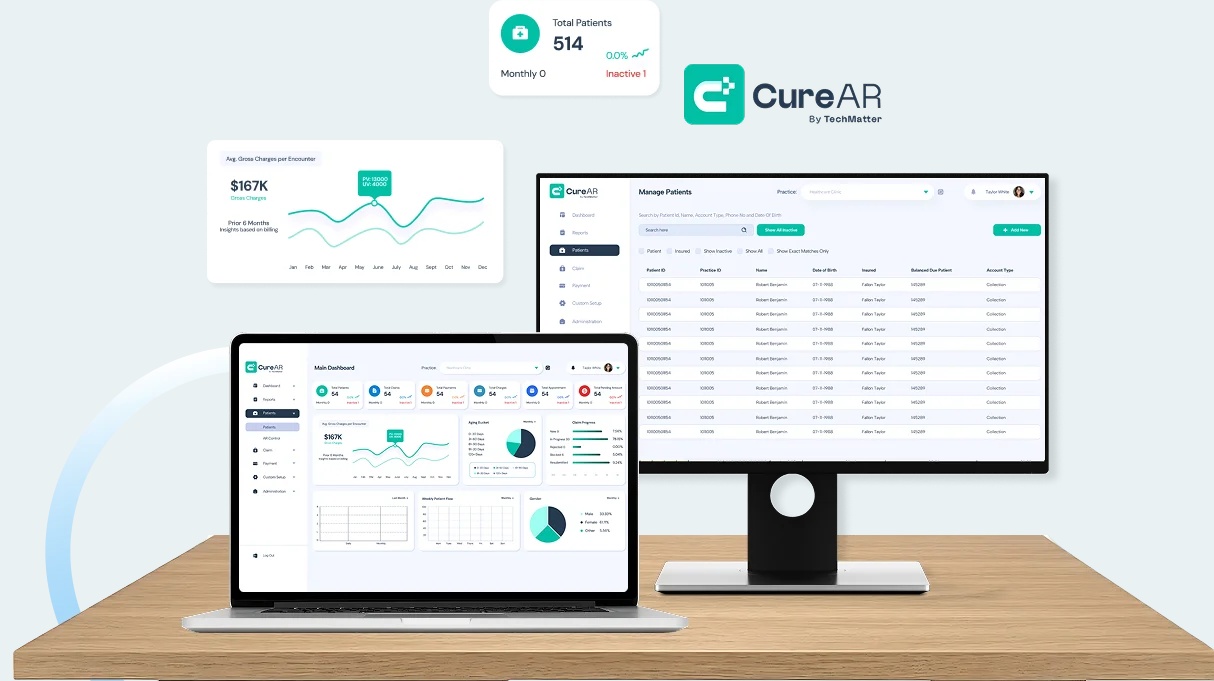
CureAR sits above clearinghouse infrastructure. It helps billing teams check claims, track submissions, manage denials, and examine collections. It does not become a clearinghouse simply because everything appears in one window. That distinction matters: a friendly screen still depends on the connections underneath it.
TechMatter says billing teams wanted more flexibility when payer requirements, maintenance, or connectivity complicated a single route. It added Harris Secure Connect alongside Office Ally. Existing users would receive the integration in phases; new clients could have the two-connection setup at signup. The practical change was another routing option without another interface to learn.
“Billing teams do not want a second login to manage, they want a second option when the first path is not working.”Mubashir Hanif, founder and CEO
Buy the missing piece
Founder Mubashir Hanif’s background helps explain the emphasis on operations. TechMatter’s leadership page describes him as a Chartered Certified Accountant who founded the company in 2017. Follow the money through a medical practice and technology stops looking like a collection of separate purchases. Enrollment, documentation, billing, and the computers supporting them become related decisions.
In July 2025, TechMatter announced its acquisition of DoctorPapers, a California medical billing and revenue cycle management business founded in 2020. The announcement said DoctorPapers had supported more than 500 providers across specialties. It brought coding, collections, and virtual staffing capability, along with existing client relationships. Its leadership would continue under the new owner.
Then came a different purchase. In November 2025, TechMatter announced the acquisition of State Drives from Spacexsystem LLC for an undisclosed amount. State Drives sells enterprise hardware, including storage, servers, and networking equipment. TechMatter’s stated rationale connects that supply capability to managed IT delivery and healthcare workloads. A company selling billing software had acquired a business that could help supply the machines beneath it.
The paperwork before the paperwork
Credentialli addresses an earlier part of the process. Before a provider’s billing can run smoothly, somebody must keep enrollment information, licenses, and renewal dates in order. TechMatter describes a platform that centralizes those records, monitors deadlines, and maintains audit trails. Its intended users include medical groups, staffing firms, and networks managing multiple providers.
The connection to billing is the point. A credentialing change has consequences elsewhere. TechMatter presents Credentialli as working alongside billing, human resources, and operations so departments share consistent provider information. That is a more specific proposition than simply promising less paperwork: keep one administrative change from becoming several inconsistent records.
The people remain part of the offer. RCM Matter provides revenue cycle services; DoctorPapers supplies billing operations and support. In November 2025, RCM Matter announced a partnership with Rinova AI. Rinova describes automation for repeatable work with human review for exceptions. The question for a buyer becomes who takes responsibility when a claim needs judgment.
The wider company also offers custom software development, cloud infrastructure, cybersecurity, and EHR implementation. That gives it work beyond medical billing and a place in the broader enterprise IT market. Its offices span the United States, the United Kingdom, Pakistan, and Dubai. The delivery model therefore depends on coordination inside TechMatter as well as connections between its products. Its careers materials emphasize cross-regional collaboration, documented feedback, and professional development. Those are useful commitments for a services business: the quality of the handoff depends on the person receiving it.
What the monthly number buys
The business model spans subscriptions, operational services, custom technology work, and hardware sales. CureAR’s G2 pricing listing, last updated October 27, 2025, provides a useful illustration. Starter lists at $129 a month; Growth at $199. RCM Pro lists at $799 a month or 4.99% of collected revenue, whichever is higher. Enterprise pricing is quoted. Those dated figures need confirmation before a purchase.
$129Starter / month
$199Growth / month
Published October 2025 listing. Implementation and current contract terms require confirmation.A subscription buys access to a tool. A collections-linked service changes the scope of the relationship. The useful comparison includes staff time, integration work, clearinghouse access, and responsibility for follow-up. A low monthly number says little if a practice still carries every exception itself.
A useful test before the demo

TechMatter occupies the intersection of healthcare software, outsourced administration, and managed IT. A practice might instead choose billing software such as Tebra, hire a specialist billing provider, retain its internal team, and contract separately for IT. TechMatter’s proposition is to connect more of that work through one organization.
There is a practical lesson here for anyone buying operational technology: trace one piece of work across departments. Ask who owns it after an error, what happens when its usual connection is unavailable, and whether the next person receives usable information. Ask to see the exception handled during the demonstration.
The combined offer makes sense when those handoffs are causing measurable trouble. It is harder to justify when existing systems already cooperate, a required payer connection is absent, or the service contract leaves responsibilities unclear. TechMatter’s most revealing feature may be that second route: a small acknowledgment that useful systems need somewhere to go when the ordinary path gets stuck.