Consider two phrases: a patient reports chest pain; a patient denies chest pain. The same alarming words appear in both. Their meanings pull in opposite directions. For a hospital, that distinction travels from the examination room into documentation, coding and eventually a bill. A system that notices the words but misses the denial has understood the least useful part of the sentence.
Nym’s business lives in that gap. It makes software that reads clinical documentation, assigns medical codes and sends successfully coded encounters onward to billing. Its customers are health systems and physician groups, rather than the patients in the waiting room. The sale is administrative: reduce a queue, lower coding costs, make the account ready to bill. The underlying problem is linguistic.
- Nym automates medical coding across six specialties and service lines.
- Successfully coded encounters can go to billing without human approval.
- Every generated code comes with traceable reasoning.
- Automation coverage varies; people still handle exceptions.
The sentence that changes the bill
Medical coding is translation with financial consequences. A clinician records what happened. Codes turn that account into a standardized description of diagnoses and services. The difficulty lies in the relationships: who said something, whether it happened now or previously, whether a condition was present or explicitly absent. A clinical note is a small narrative with a surprisingly demanding readership.
Nym calls its approach Clinical Language Understanding, or CLU. Its current technical description combines proprietary machine-learning models with rules-based clinical ontologies. It constructs an account of the encounter, then applies medical coding knowledge. The company’s wager is that interpreting the story and documenting the coding decision belong in the same system.
The origin has an appealingly domestic scale. In a founder-written account, Amihai Neiderman described his wife’s medical research: finding suitable patients required a laborious search through electronic records. Computerized records had not made the information conveniently usable. Neiderman and computational linguist Adam Rimon founded Nym in 2018. Medical coding became their chosen commercial problem.
The little irony is that putting a record on a computer does not necessarily make the computer understand it. Digitization supplies the text. Interpretation supplies the use. Between those two steps sits a considerable amount of hospital work.
A queue that would not shrink
The first thing to strain in the customer stories was capacity. Inova’s emergency departments faced heavy encounter volumes, coding backlogs and staffing shortages. Contract coders and mandatory overtime helped carry the load, but brought their own expense. The patient could leave while the financial account remained stuck in a queue.
Inova selected Nym for emergency-department facility coding across five hospitals and several outpatient emergency-care centers. Nym’s published case study reports a $1.3 million reduction in annual ED coding costs, the removal of mandatory overtime and four coders promoted into more complex areas. These are customer-specific reported results, rather than a savings schedule available to every buyer.
What changed a skeptic’s mind? Inova’s Dr. Melissa Koehler points to the experience after deployment: accuracy held while efficiency and staff opportunities improved. Her remark is unusually useful because it locates confidence after observation.
“Initially a skeptic of autonomous medical coding, my experience with Nym has completely changed my perspective.”Dr. Melissa Koehler · Inova, quoted by Nym
That is a more interesting test of healthcare automation than a theatrical demonstration. Does the queue shrink? Can staff take time off? Does a system keep producing defensible work when the novelty has worn away? Those are questions an operating department can recognize.
Teach the hospital before trusting the engine
Geisinger’s rollout offers a compact lesson in adoption. It supplied historical records, configured Nym to its procedures and payer guidelines, and ran a shadowing period. Both sides coded accounts; comparisons prompted adjustments. The agreed go-live requirements included 96% accuracy and turnaround below 12 hours.
The deployment also kept an explicit route back to human coding for incomplete and unprocessed records. That detail matters. A system’s ability to finish some work independently does not imply that every record becomes suitable for independent processing.
A reader evaluating automation can copy the sequence: establish the baseline, compare outputs on real work, agree acceptance criteria, then activate the production route. The practical question is whether the organization can supply representative records, settle its coding rules and maintain an exception workflow. Buying the engine does not settle those questions by itself.
- 01Historical records
- 02Parallel comparison
- 03Agreed thresholds
- 04Billing + exceptions
Two numbers, two different promises
Accuracy and coverage answer different questions. Accuracy concerns the quality of the coding being evaluated. Coverage concerns how much work the engine completes autonomously. Confusing them makes an attractive percentage do a job it cannot do.
Genesis HealthCare System provides a concrete illustration. Its Nym case study describes ED automation beginning at roughly 50% of encounters and increasing to roughly 70%, with coding accuracy of 96% or higher. The same deployment therefore carries two percentages, describing two different properties.
At Genesis, cross-training and moving coders between specialties had created friction. Automation allowed experienced coders to spend more time in higher-complexity departments and opened training opportunities for others. The interesting unit of change was the working week: where someone spent it, and which skills they could develop.
Nym’s implementation guidance expects 50%-70% automation of complete records, depending on specialty. A buyer should therefore model the remaining workload as carefully as the automated share. Incomplete documentation and out-of-scope encounters still need a destination. The engine’s boundary is an operating requirement, not a footnote.
A receipt for the machine’s reasoning
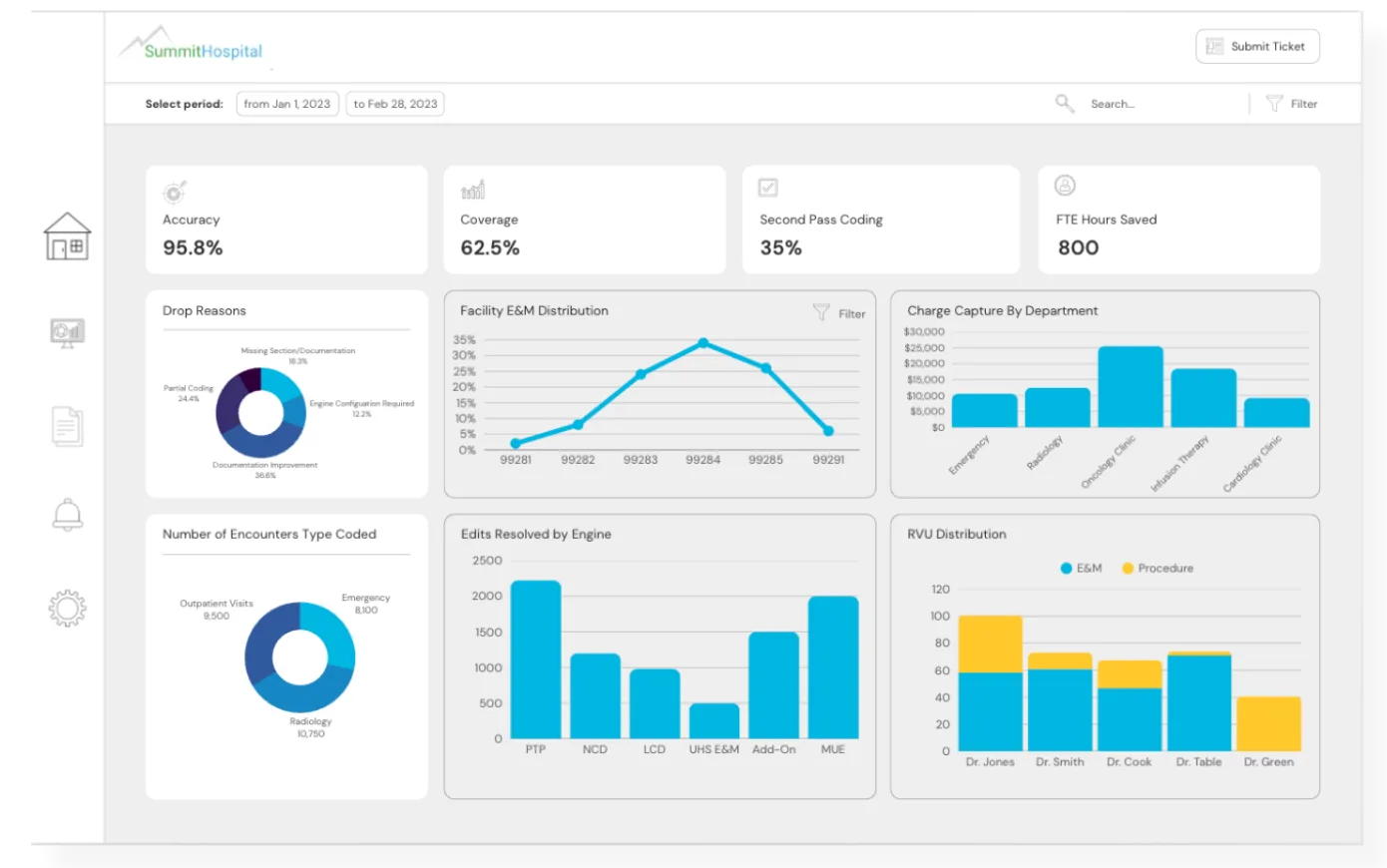
Nym’s product includes audit trails and coding-performance dashboards. A generated code is accompanied by documentation explaining its assignment. When an account is questioned, a hospital needs a route back to the clinical record and the applicable logic. Speed is convenient; a defensible explanation has a longer working life.
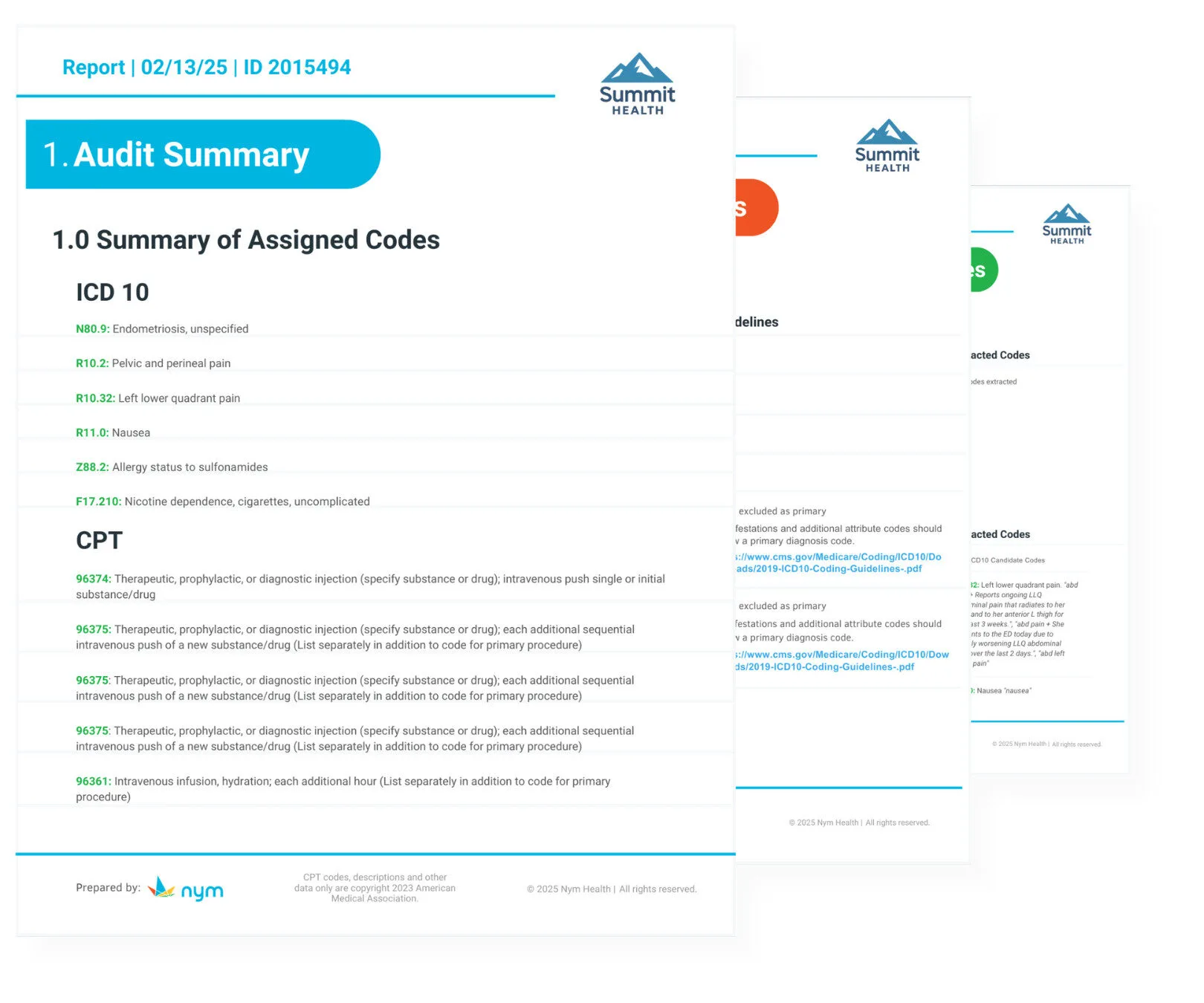
The distinction from computer-assisted coding is the handoff. Assisted tools put suggested codes in front of a person. Nym’s autonomous route can finish the encounter without that approval step. Fathom and CodaMetrix also sell autonomous coding, so autonomy alone does not distinguish Nym from every competitor. Its pitch puts clinical interpretation, customer-specific configuration and traceability together.
That positions it within revenue-cycle software, downstream of care delivery and upstream of reimbursement. It supports emergency medicine, radiology, outpatient surgery, outpatient visits, inpatient professional services and urgent care. The phrase “inpatient professional” deserves its full wording: buyers should check the specific service line they intend to automate.
Capital follows the paperwork
Nym announced a $16.5 million Series A led by GV in October 2020 and $25 million led by Addition in July 2021. In October 2024 it announced a $47 million growth investment led by PSG. That funding was intended to support expansion of its multispecialty solution into additional care areas.
The company sells enterprise software through a sales and implementation process. The economic case must be built for the customer’s workload: software and integration spending on one side, coding expense and operational benefits on the other. Customer savings are evidence for that discussion; they do not reveal the purchase price.
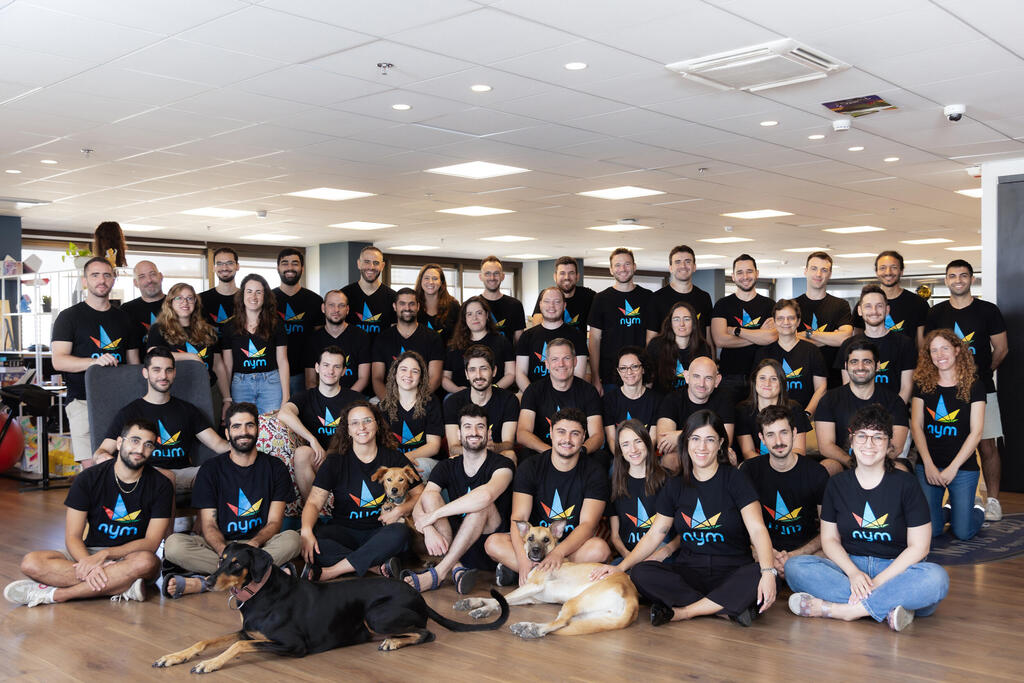
Nym now reports more than 30 health systems and physician groups and more than 400 healthcare facilities. In April 2026 it appointed Lori M. Jones CEO, with adoption and expansion among her stated priorities. Its workforce combines physicians, linguists, engineers and coders - a sensible collection of people for a problem that refuses to belong to one profession.
The useful lesson is modest enough to travel. Pick a task whose output can be checked. Make the acceptance test explicit. Keep the explanation attached to the result. For Nym, the object moving through the system is a hospital account. The ambition is to make it move faster without losing the story that makes the bill intelligible.