The trouble with a customer segment is that everyone inside it is supposedly alike. One international marketplace had already tested that proposition. It sent in-app promotions through Braze, ran A/B tests by segment and saw usage rise. Yet the number it cared about, lifetime value across product categories, scarcely moved. Customers clicked. They did not become meaningfully more valuable customers. This is where Auxia enters the story, with an impertinent question: what if the segment was the wrong unit of thought?
- Auxia connects first-party signals and decides what each customer should see, where and when.
- Its marketplace case reports 200-plus content variations and an 84% lift in cross-category lifetime value over four months.
- Its newer Agent Studio also helps teams plan, build and ship campaigns across existing tools.
The Palo Alto company calls itself an agentic marketing platform. That phrase risks making a fairly precise business sound mystical. Its older product, Auxia Decisioning, selects an experience for a particular person from a set of possibilities. Its newer product, Agent Studio, helps marketers research, draft, check and deploy the campaigns that create those possibilities. One product works on the campaign; the other works on the instant a customer meets it.
The click was a false friend
In the marketplace case, the starting setup was ordinary enough: a promotion, an audience, a test. The failure was specific. Segment-level experiments improved usage without producing substantial growth in lifetime value. The company also wanted more control over its app interface than its existing SDK setup allowed. Auxia linked events, customer attributes and transaction data into a real-time feature store. It then tested more than 200 content variations - about 20 times the previous campaign capacity - and could adjust multiple goals at once.
Marketplace case study · reported outcomes after four months
The integration reportedly went live in under six weeks. The decision response took less than 100 milliseconds. Neither figure explains the entire outcome; they explain why the experiment could run in a live product. A recommendation that arrives after the screen loads is a philosophical position, not a customer experience.
“With Auxia, it’s like you have a data scientist focused on each individual customer.”
That is co-founder and CEO Sandeep Menon’s analogy. It is vivid, if slightly unfair to data scientists, who may object to being compared with a machine that never asks for coffee. The useful point is scale. A human team can design the objective and the guardrails. It cannot hand-select the best next message for millions of people at the moment each opens an app.
Two kinds of work, one loop
Auxia was founded in 2022 by Menon, CTO Ravi Desu and Cole Stuart. Menon had worked on growth at Google; the broader team includes people from Meta and Lyft. The platform launched in early 2024, then attracted $23.5 million in combined seed and Series A financing announced in March 2025. VMG Technology Partners led, with MUFG Innovation Partners, Incubate Fund and others participating. That money bought time to build the less glamorous part of personalization: data plumbing, model serving, experimentation and enterprise sales.
On its current site, Agent Studio is the workspace for marketing agents that research, plan, build, quality-check and ship. It can work across tools such as Braze and Salesforce Marketing Cloud, route approvals and generate performance write-ups. A marketer still supplies the brief, access rights, brand rules and final approval. Decisioning then ranks content, offer, channel, timing and frequency for the person in front of the screen. Auxia records each decision and the reason behind it, creating a feedback trail for the next one.
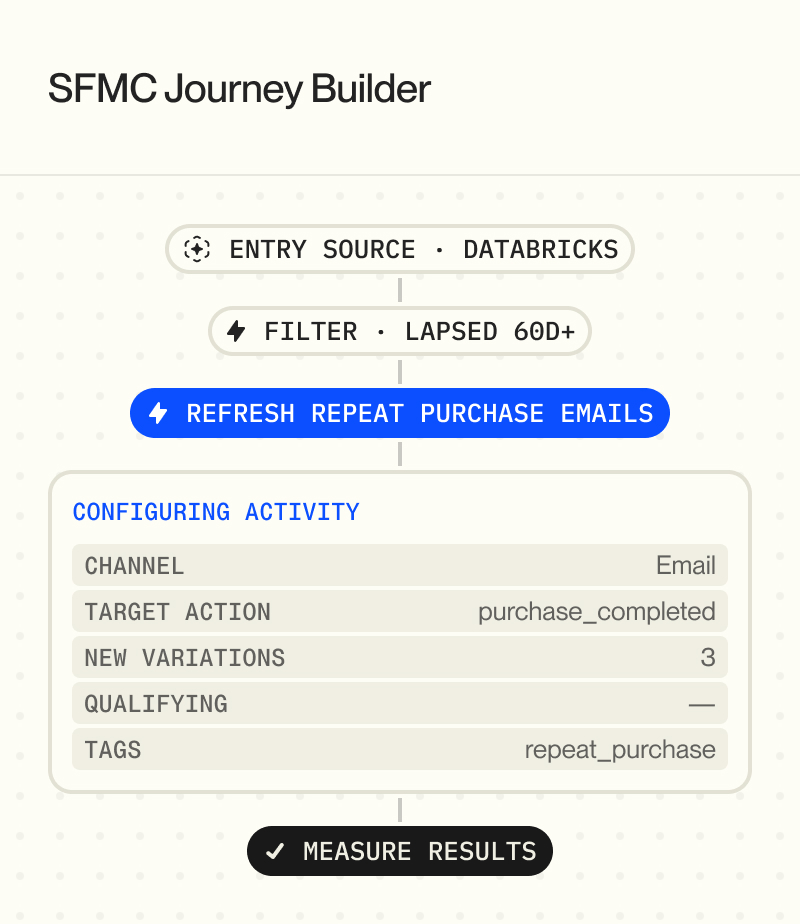
The commercial arrangement reflects that split. Agent Studio is sold on team size and usage, while Decisioning is priced by decision volume. Both sit in an enterprise package with integrations, access controls and support. The buyer is usually a marketing or product team with considerable customer traffic and first-party data, not a small shop looking for an email template.
Where a tiny surface earns its keep
A second case gives the abstraction a human-sized shape. A language-learning app wanted to know whether a learner needed another lesson, a feature prompt or a paid-plan invitation. Auxia began on one home-screen content card, tested more than 20 variations and later added over 50. The reported result was a 40% lift in its primary engagement measure and a 7% lift in free-to-paid conversion. A single rectangle on a screen had become a laboratory for the next useful action.
At a financial-services institution, the problem was unfinished sign-ups. Auxia selected three places in the product to intervene and used signals including referral source and recently read articles. The team tested more than 175 variations, introduced over 40 new treatments per month and reported a 50% lift in sign-up completion. It also ran 22 times as many experiments per month as before. Here the scarce resource was not creative ideas. It was the machinery to test them before the opportunity vanished.
The company now names Atlassian, Comcast, The Guardian, Assurant, Mercari, MUFG, NTT Docomo and Konami among customers shown on its site. Its platform reports 200 billion automated decisions and more than 70 million end users served. Those are scale figures, not proof that every decision helped. The case results are more informative because they attach a decision system to a business measure. They are company-reported outcomes, and any buyer would still need its own holdout group and economics.
The experiment worth stealing
Auxia’s distinction from ordinary campaign software is not that it can send more messages. Braze and Salesforce Marketing Cloud already help enterprises do that, and Agent Studio is designed to work with such systems. Its claim is that it can coordinate the work around a campaign and make an individual decision at delivery time, balancing several goals instead of optimizing one blanket segment. Its alternative is an in-house stack assembled from analysts, data pipelines, models and tests. That may be sensible for a company with enough talent, traffic and patience; Auxia sells the assembled system.
A team can copy the method without buying the product. Find one moment with a measurable loss, such as abandoned sign-up or a missed second purchase. Choose a business outcome rather than a flattering click metric. Gather the signals available at that moment, create several honest treatments and keep a control group. Then ask what changed for the customer and the business. If the data are sparse, the audience small or the goal poorly defined, a fast decision engine will merely make uncertainty arrive sooner.
The old campaign asked which group should receive a message. Auxia asks what this person should encounter next. It is a smaller question, repeated an extraordinary number of times. In marketing, as in manners, attention becomes more convincing when it is particular.