The best way to understand Satisfi Labs is to picture a fan under a stadium concourse sign, phone in one hand, asking where to find a gluten-free hot dog. In 2016, food and beverage was the product's first job. It was a sensible wedge: specific question, physical place, perishable answer. Then the teams using it began asking for more. Could it explain parking? Could it find a gate? Could it answer a ticket question, recognize buying intent and hand the customer to a seller?
The customers, CEO and co-founder Don White has said, effectively wrote the roadmap. The food finder stretched into fan experience, commerce and integrations with the peculiar stack of software that runs a venue. A narrow search tool became what Satisfi now calls an Agentic Platform - a managed collection of specialized AI agents for sports, entertainment, tourism and campuses.
That history matters because “AI agent” has become a loose label. Satisfi's version is less science-fiction colleague than tireless, tightly briefed shift worker. It sits on a team or destination website, reads approved material and live feeds, answers in more than 50 languages, sends the awkward case to a person and, when the plumbing allows, closes a ticket sale without making the guest leave the chat.
01 / The wedgeThe questions arrive all at once
A generic support bot lives in an orderly world. A venue bot does not. Thirty thousand people may arrive within an hour. The parking rule changed this morning. One ticket provider handles the playoff page and another handles memberships. A parent needs an accessibility answer; a tourist has changed languages; a customer who began by asking about the weather is suddenly ready to buy four seats.
Satisfi's market position comes from accepting that mess. Its customers include teams such as the Minnesota Vikings, Houston Astros and Dallas Stars; attractions such as Ripley's and Riverbanks Zoo; destination marketers; ski resorts; and universities. In January 2025, the company said it connected more than 715 client organizations to AI agents and inbound and outbound messaging.
Mississippi State Athletics offers the cleanest demonstration. It connected Satisfi's agent to FEVO so fans could buy single-game tickets inside the conversation. In 2025, the school reported more than $10,000 in new ticket revenue, with chat producing 30 to 35 percent of warm leads. Roughly one in four ticket purchases attributed to chat finished there. Crucially, the transcript told sales staff what a lead wanted before anyone picked up the phone.
“We're actually making money even when we're not here.”Ashley Williams · Mississippi State Athletics
The sneaky number is 33 percent: that was the share of buying questions that began as something else. The parking question is not a nuisance to be deflected. It may be the opening line of a sale. Software that merely posts a ticket link misses the plot; useful conversational commerce keeps listening long enough to discover intent.
02 / The productThree engines and a human escape hatch
The platform has three working parts. The AI Agent Engine handles inbound conversations and tasks. The Live Agent Engine escalates the delicate or valuable cases to human teams without discarding context. The Marketing Engine, added after Satisfi bought Factoreal in June 2024, turns expressed interest into permissioned email, SMS or WhatsApp follow-up.
Factoreal changed the company's scope. A chat used to end when the answer arrived. Now a visitor can ask to be notified about a show, opt in and enter an outbound campaign built around that interest. The April 2024 merger with Broadway concierge specialist Broadw.ai added another layer of live-entertainment operating knowledge. These were not model acquisitions. They filled gaps around the conversation.
The difference from low-cost bot builders is service as much as software. Satisfi designs, deploys and tunes agents with industry specialists. It connects ticketing, CRM, content and messaging systems. The tradeoff is price and complexity. Its fees are set in enterprise order forms rather than a public menu, and the company openly describes its high-touch approach as more expensive than $99-to-$299 monthly self-serve tools.
03 / The proofBoring work makes a convincing graph
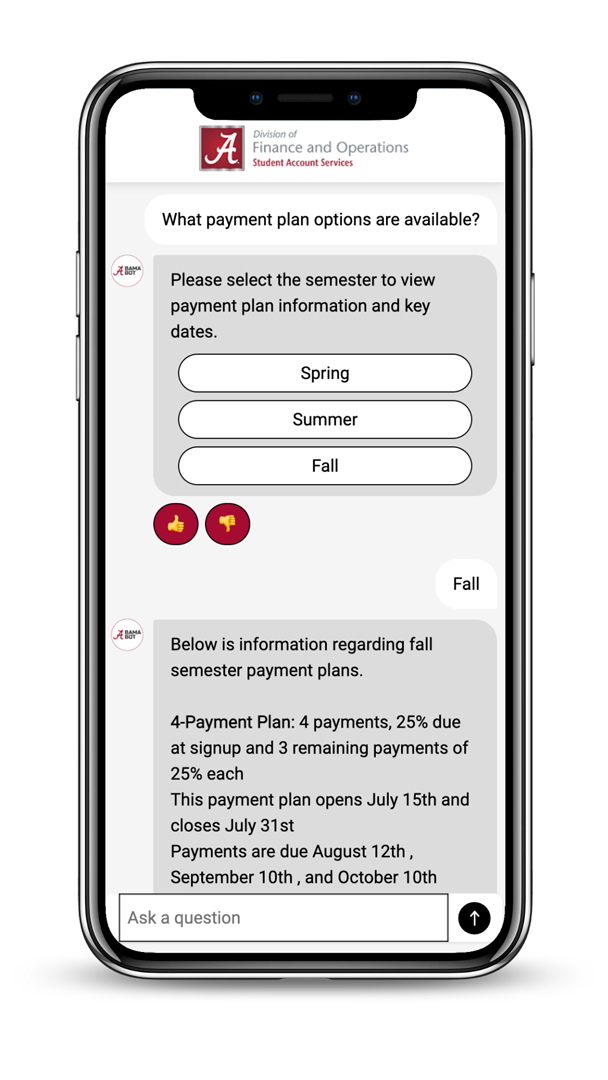
Higher education shows the service side. The University of Alabama's student accounts operation had watched support staffing fall from 36 people to 24 while inquiries grew. It had tried another chatbot vendor in 2019, but later wanted greater reliability, easier deployment and tighter control over answers. With Satisfi, the university reported average daily calls falling from about 1,800 to 400 - a 78 percent reduction. From July through December 2024, it counted 142 staff hours saved.
Daily calls, before and after AI support
UNIVERSITY OF ALABAMA CASE STUDY · 44.7% OF CHAT CONVERSATIONS OCCURRED AFTER STAFFED HOURS
The first failure is instructive. Alabama did not reject conversational support; it rejected a version that lacked the dependability and controls the job required. Satisfi's own first product faced a softer version of the same correction. Food search worked, but customers revealed a larger job. In both cases, the answer was not a more eloquent bot. It was a better-scoped system with more operational context.
04 / The businessThe moat is nine years of unglamorous plumbing
Satisfi was founded by White and chief product officer Randy Newman in 2016. Early customers included the New York Mets, Macy's and the US Open. Strategic capital followed the market: Major League Baseball led a 2019 round that brought total funding then to $6 million; Google's Assistant investment program invested later that year; Florida Funders backed a $3 million Series A in 2021. In 2025, Level Structured Capital supplied undisclosed growth financing for international expansion and product work.
The company is small enough for focus - roughly 57 employees in the supplied company record - but its competitive field is not. A buyer can choose a self-serve chatbot, support software from Intercom or Zendesk, an enterprise platform such as Ada or Kore.ai, or an internal stack built on a general-purpose model. Satisfi has no monopoly on language models. Its defense is narrower: years of venue questions, live-experience specialists, established integrations and a willingness to own deployment.
Its culture reads like a company built for that kind of unglamorous work. Satisfi publishes six values - selflessness, excellence, authenticity, boldness, accountability and resourcefulness - and describes itself as remote-oriented. The useful word is accountability. A conversational product can look busy while doing very little, and a distributed team can do the same. Both need visible outcomes. The company was ranked second on Quartz's 2022 list of workplaces for remote employees, an accolade Satisfi still displays, but its product direction says more than the plaque: keep the human experts close to the customer, then make the software show its work.
In 2026 it pushed the employee metaphor further with an Agent Performance Console. Each agent gets objectives, key results and “campaigns,” such as selling tickets or improving guest service. The interface uses green, yellow and red signals and benchmarks drawn from deployments across seasons and venue types. It is an overdue move away from the easiest chatbot statistic - conversation volume - toward the one an executive actually wants: did it change revenue, workload or service?
What to copy - and when to walk away
Copy the sequencing. Start with one repetitive, costly job. Give the agent approved knowledge and access to the system where action happens. Preserve context when a human takes over. Measure the business result, not the novelty of the conversation.
Do not copy the managed-enterprise model for a tiny site with static FAQs, low traffic and no systems to connect. A basic help center or inexpensive bot will do. Satisfi earns its premium when information changes, demand spikes, brand errors matter and the next step can produce a sale or spare a staff member.
05 / Next shiftFrom answering to doing
The company's recent products assign clearer jobs. A Ticketing Agent connects to Ventrata for live tourism inventory, pricing and checkout. Satisfi says City Sightseeing New Orleans saw a 20 percent search-to-sale conversion and projects more than $70,000 in incremental 2026 sales without buying more traffic. An August 2026 Meetings Agent helps destination teams qualify planners whose requests may represent hundreds of attendees and thousands of room nights.
Those launches mark the real transition from chatbot to agent. The product is no longer judged by whether it can compose an answer. It needs a role, tools, boundaries and a scorecard. Satisfi's mission is “make AI hirable,” a neat phrase with a practical burden: a hire has to be managed, and eventually it has to pay for the shift.