In June 2009, an iPhone game wanted to send a push notification. Apple had just opened the pipes. Tap Tap Revenge 2 had millions of players, and the four people behind a new Portland startup were asked a question that was equal parts opportunity and prank: could they make the system work in three days? They said yes. Urban Airship powered what it calls the first commercial push notification from a third-party iPhone app on June 17. A company was born in the tiny gap between a platform shift and everybody else realizing the shift had happened.
The origin is satisfyingly scrappy. Steven Osborn, Scott Kveton, Adam Lowry and Michael Richardson started the business in May. By August, their system had sent more than a million production notifications. By August 2011, the counter had passed five billion and the infrastructure was tracking roughly 300 million app installations. The code had escaped the whiteboard and found an avalanche.
The first thing to fail was the invisible thing
Push looked simple to the recipient: a few words appeared on glass. Behind the glass, Airship had to register device tokens, store metadata, target groups and turn one customer request into millions of writes. Its original PostgreSQL setup used surrogate keys that created extra joins and bloated indexes. Storage performance on Amazon EC2 and EBS struggled. Even devices that might never receive a push produced regular writes. Lowry later described the system with admirable understatement: it was “a little naive.”
The team went shopping for a magic database. MongoDB was easy to set up and flexible, but the versions Airship used came with durability concerns, a global read-write lock and ugly fragmentation. Cassandra promised redundancy and scale, but its young ecosystem brought changing APIs, buggy drivers and cascading failures. The fashionable answer kept changing. The requirement did not: deliver on time, every time, while customers were watching the election or the World Cup.
“Back to what we trust - Postgres.”Adam Lowry, co-founder, describing the early infrastructure reversal
That was the change of mind. Airship returned to PostgreSQL, but not to its old habits. It stored tokens more efficiently, used composite keys and partial indexes, built a shared data layer, manually sharded by application and eventually moved the database onto real hardware in a data center beside AWS. One hundred and twenty gigabytes in Mongo became 70 gigabytes in Postgres. Performance still needed work. The point was not that one database won. It was that a better-understood tool plus a better model beat a glamorous tool asked to erase a design problem.

Push was the wedge, not the whole door
A push notification can win a glance. It cannot make the screen behind it useful. Airship followed that realization outward. It added persistent in-app messaging, mobile wallet passes, customer data, analytics, email and SMS. The 2012 acquisition of Tello brought tools for Apple’s Passbook. Accengage expanded its position in Europe in 2019. Apptimize, bought later that year, added feature flags and experimentation. Gummicube, acquired in 2022, reached back to the moment before installation with app-store optimization.
The company even dropped “Urban” from its name in 2019. The old name sounded like an artifact from the push era because it was. Airship wanted to sell a customer-experience platform, not rent a particularly loud doorbell. The rebrand followed the product expansion rather than trying to invent it.
The journey Airship actually sells
Today the Airship Experience Platform connects push, in-app experiences, websites, email, SMS, RCS, MMS and mobile wallet. Marketing and product teams can build onboarding screens, surveys, stories and preference centers without waiting for an app release. Real-time events can trigger a journey. Segments can change with behavior. Tests can compare not just two messages but the destinations those messages open.
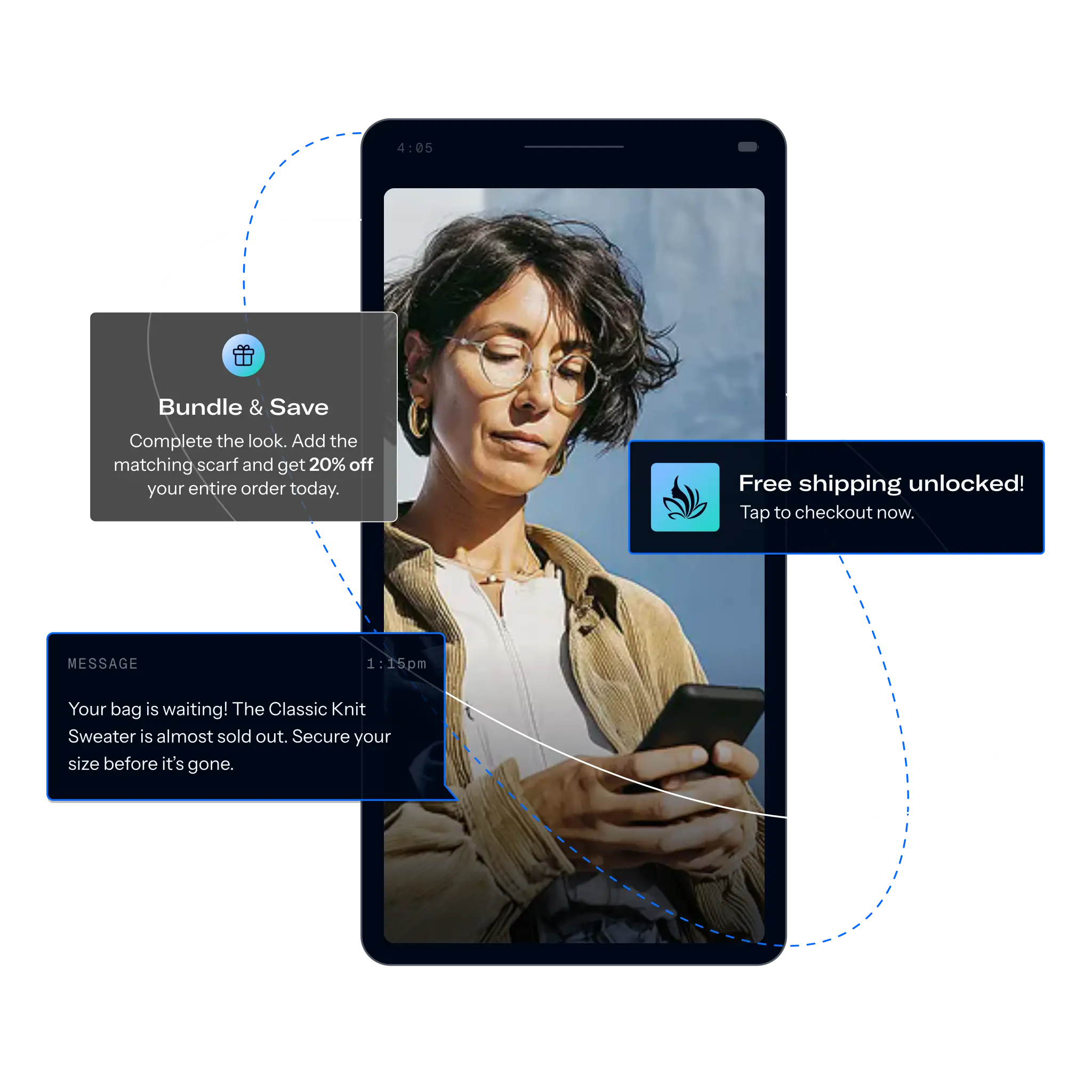
Tiny moments, enterprise consequences
Its customer list explains the shape of the product. Alaska Airlines uses mobile wallet technology for the day of travel. AccuWeather needs alerts to arrive quickly. Media companies want readers back for a specific story. Retailers such as Ulta Beauty want an abandoned browse to become a purchase. Vodafone has used Airship’s open-channel approach for RCS campaigns with fallback to SMS. These are consumer businesses where a delayed update, irrelevant offer or broken handoff can turn useful attention into irritation.
Orange offers the cleanest illustration. It moved customer surveys into no-code native experiences across its apps. Airship says Orange gathered as many responses in a day as it previously received in a month, lifted the monthly response rate 30-fold and improved its net promoter score by nine points. The clever part was not another request for feedback. It was removing the browser detour and asking at a moment when the customer was already present.
Removing the detour
The new interface is AI. The old test remains.
Airship’s current pitch adds a fleet of specialized AI agents. One drafts cross-channel campaigns. Another builds native experiences from a prompt or image. Others assemble journeys, recommend a next action, check accessibility and police brand guidelines. The agents can work together, while people remain in the loop. This is a sensible application of AI to a workflow full of variants, rules and repetitive assembly.
It is also easy to produce more mediocre messages faster. Airship’s defense is the closed loop: connect creation to an explicit goal, run an experiment, read real behavior and recommend the next change. The company says a commissioned Forrester study, built from interviews with six enterprise customers, calculated a 476 percent return for a composite organization. That number belongs to a modeled study, not every buyer. Airship’s new results guarantee is more interesting because it attaches the sales promise to predefined business outcomes.
The business model matches the enterprise ambition. Airship sells subscription software through quote-based contracts, with price shaped by channels, active audiences or usage, data features, integrations and strategic services. It does not publish a simple enterprise tariff. That opacity is common in martech and still annoying. The company raised more than $100 million publicly reported by 2018; the last disclosed round was $25 million led by Foundry Group. At the time, Airship said it was breaking even. The capital was framed as fuel for faster global and product expansion, not oxygen.
What a smaller team can copy
You do not need an enterprise contract to borrow the operating idea. Start with one high-intent moment: a first order, delayed flight, expiring subscription or unfinished onboarding step. Define the behavior that triggers contact. Choose one channel based on consent and urgency. Make the destination complete the promised task. Instrument the conversion. Test one meaningful variable. Only then add channels.
The portable Airship playbook
- Find a customer moment where timeliness changes the outcome.
- Collect only the first-party data needed to recognize that moment.
- Treat message and destination as one product surface.
- Measure the business event, not merely the open.
- Earn complexity through experiments instead of buying it in advance.
That last line matters. Airship is not automatically the right tool. A small app that needs inexpensive basic push may be better served by OneSignal or direct platform services. A company without clean event data cannot personalize its way out of confusion. A team that cannot maintain consent, segments, tests and destinations will purchase a very capable control room and leave most switches untouched.
Mobile interactions are central, timing matters, first-party data is usable, and a team can run ongoing experiments across channels.
The need is only basic messaging, data is unreliable, conversion events are vague, or implementation effort outweighs the likely lift.
Airship’s durable advantage is less romantic than invention. Plenty of competitors now send a push. Braze, Iterable, Salesforce, Adobe, CleverTap, MoEngage, Insider and others sell overlapping versions of engagement and orchestration. Airship’s claim is accumulated mobile scar tissue: lock screens, wallets, app releases, permission prompts, message spikes and the awkward place where marketing ambition meets engineering reality.
That puts Airship in an interesting middle layer of the market. It is not a customer-data platform that wants to become the master record for everything, though it can enrich profiles and activate data. It is not merely a campaign sender, though it delivers across the familiar channels. And it is not an app-development framework, though its SDKs and no-code tools alter what users see. Airship sits where data becomes a timed interaction. Its best buyer has already invested in a CRM, analytics and an app, but still watches teams stitch the final experience together by ticket, spreadsheet and release calendar. Airship sells the removal of that organizational lag.
The company began by making a notification appear. It grew by noticing all the ways that notification could disappoint. That is the useful lesson after 17 years: attention is rented for a second. The product must earn what happens next.