Andrew Bialecki could write the code only after he had answered the customers. In Klaviyo’s early years, the support inbox came first. Some mornings it took half an hour; others, considerably longer. The new feature, the clever improvement, the satisfying stretch of engineering all had to wait. Someone had a question, and the person who could fix the software was also the person who had to explain it.
It is a rather effective arrangement for discouraging an engineer from making the same mistake twice. Every confusing button can become tomorrow morning’s correspondence. Every unnecessary step has a chance of returning as a politely worded interruption. The product’s shortcomings arrive with names attached.
Bialecki and his co-founder, Ed Hallen, spent their first three years keeping the company lean and handling the work themselves. The support routine forced a choice: keep answering the same questions, improve the product, or use their own software to send useful guidance before customers needed to ask. They did the latter two. A help desk became part of the development process.
Today, Bialecki is co-CEO and chairperson of a publicly traded company. His attention is increasingly devoted to AI products that can understand a customer and act on that understanding. There is a recognizable line between those ambitions and the old inbox. He has spent much of his career trying to make personal attention less dependent on how many hours one person has available.
An education in things that have to work
Bialecki studied physics, astronomy and astrophysics at Harvard, graduating in 2007. The degree offers an entertaining opening for a founder biography: begin with the universe, finish with an abandoned shopping cart. But the more useful part of his preparation happened inside software companies, where an elegant idea still has to survive contact with somebody’s working day.
He worked as a lead engineer at Applied Predictive Technologies, then as a senior engineer at Performable. In 2011, he became chief technology officer at RockTech, a sales and marketing software company. By the time he started Klaviyo in 2012, he had worked across business analytics and marketing technology. The tools changed; the problem of turning information into something useful kept recurring.
Entrepreneurship was also familiar from home. Bialecki grew up in a family of small business owners. That background matters to the kind of independence he talks about: a business whose owner can make decisions, know the customers and keep building. His public ambition gives that ordinary proprietorship an internet-sized setting.
In interviews, he keeps returning to the builder’s point of view. He wants engineers to care about design and the product, and to talk to customers. It is a broad job description. It also explains why the early help desk suited the company he was trying to make. The engineering problem and the customer’s problem were allowed to sit at the same desk.
Give the database a voice
Klaviyo began as a customer database. Email marketing followed in 2013. That order is revealing. Before there was a message to send, Bialecki wanted a place to keep the information that would make the message worth receiving. A business might know plenty about a customer and still struggle to put that knowledge to work.
An early tailoring customer helped make the next step clear. Bialecki asked about expanding into marketing and messaging. The customer said it would triple its spending. A database that could also communicate had a more immediate place in the business. The conversation gave the founders a concrete reason to connect the information they stored to the experiences their customers wanted to deliver.
A friend selling quilts then introduced Bialecki to Shopify. The integration brought Klaviyo toward retail and commerce. These are agreeably modest characters for a software origin story: a tailor, a quilt seller, a couple of engineers. They make the commercial problem easier to see. Someone has made a thing. Someone else may want it. Keeping that relationship going takes work.
Remember. Understand. Respond.
The point has stayed recognizable as the product has expanded. Marketing, service and analytics now sit together in Klaviyo’s B2C CRM. For the customer, those categories are less interesting than whether the business remembers what just happened. A sales message sent during an unresolved service conversation can be impeccably targeted and still sound like it has wandered into the wrong room.
Three years on their own receipts
Bootstrapping occupies a prominent place in Bialecki’s story. He has described his admiration for earlier technology businesses, including Microsoft and Oracle, that reached the public markets as profitable companies. He wanted to build something that customers would pay for and that could support itself. Investors eventually joined Klaviyo, but they entered a business that had already spent years working within its own limits.
That early constraint helped shape the work. Hiring was expensive. Founders needed to cover several jobs, and a solution that required another person had a cost beyond the software itself. Bialecki still talks about the value of people who are good at several things. In his account, engineers who understand customers and design can make better decisions about what to build.
There is a less glamorous side to this than the word “bootstrap” sometimes suggests. A small team has fewer people to absorb an awkward task. The inconvenience travels directly to the founders. The attraction is that they get to see it clearly. The risk is that they have only so much time to respond.
“We’re 1% done.”
Andrew Bialecki
Bialecki’s way of talking about progress leaves plenty of room for more work. The company’s “1% done” phrase was already part of his public outlook before the IPO. It is an unusual souvenir to carry into the stock market: a declaration that nearly everything remains ahead. For a product builder, though, it is easy to understand. Finishing one version mainly gives customers the opportunity to ask for the next.
The bell rang. The inbox remained.
Klaviyo began trading on the New York Stock Exchange on September 20, 2023, under the ticker KVYO. The company that had started with Bialecki and Hallen now had a public price, public reporting and a very public milestone. Bialecki marked the occasion by writing about ownership, the company’s culture and the customers who had trusted it with their businesses.
He said more than 300 employees came to New York and over 1,000 others watched from around the world. The scale had changed. His description of the next morning still centered on the customer. The bell gave the company a date for its history; the work continued to arrive on a less ceremonial schedule.
Black Friday makes that schedule particularly vivid. Bialecki has called the holiday shopping period his favorite week of the year. He has written about watching dashboards and sitting with teams while customers face a commercially important stretch. If you sell software to retailers, your own holiday traditions acquire a certain dependence on server performance.
Klaviyo Attributed Value reported for the Black Friday/Cyber Monday period.
Customer sales attributed to Klaviyo-powered interactions. This is not Klaviyo revenue or a measure of incremental sales.The holiday figures describe the reach of the system, but the practical unit remains a business trying to get something done. Nearly 20,000 customers recorded their best sales day during the 2025 holiday period, according to Klaviyo’s tally. Beneath a large platform number sit many separate owners and teams, each with its own inventory, promises and reasons to keep checking the screen.
A different division of the day
In January 2026, Bialecki’s job changed again. Chano Fernández joined him as co-CEO. Fernández took responsibility for go-to-market, operations and general and administrative functions, while Bialecki focused on AI vision and products. Sharing the title gave the founder a more explicit allocation of attention.
Fernández brought experience at SAP, Workday and Eightfold, along with time on Klaviyo’s board. The arrangement recognizes how much work fits inside three small letters. Building products, selling them globally and running the organization can each fill a calendar. A co-CEO model gives those demands two people to address.
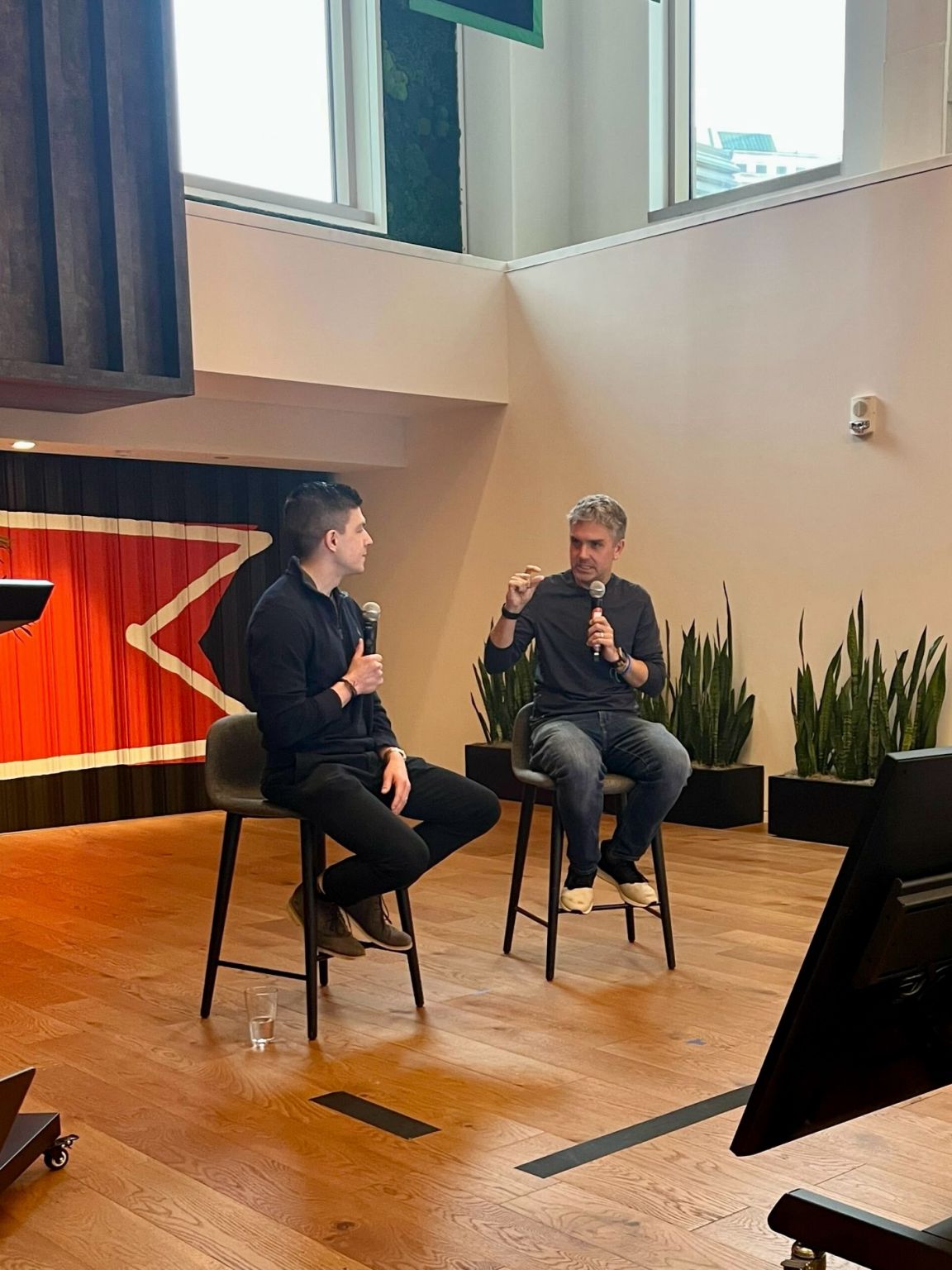
Another working relationship came back into view in August. Klaviyo announced an agreement to acquire Agency’s team and technology, with Elias Torres to become chief product officer after closing. Torres had hired Bialecki as one of Performable’s early engineers. The former engineering hire and the person who hired him were preparing to work together in a different configuration.
The connection gives this phase of the story some human continuity. Product teams are assembled from résumés, but also from judgments formed while doing difficult work together. In the announced arrangement, Torres would lead the agent product line and report to Bialecki. A career that began inside other people’s software companies had made room for an old colleague inside his own.
The next reply may come from software
At Klaviyo’s September 2026 conference, Bialecki’s product argument centered on customer context. An AI agent needs information about the brand and the person it is helping, access to that information, and the ability to act. Fluent language alone cannot supply a missing order history or remember a preference the system has never been given.

The September releases opened Klaviyo’s platform to agents and other AI interfaces, introduced SQL querying in preview, and expanded personalization and agent capabilities. Bialecki put the interface choice plainly: “You shouldn’t have to work where we decide you work.” A company that sells software was making more of that software usable without opening its own familiar screen.
His aspiration carries a practical burden. To make automated attention feel personal, the system has to understand enough, respond appropriately and remember what happened afterward. The customer will encounter the result as a reply, a recommendation or a resolved question. They are unlikely to admire the architecture while waiting for an answer.
That is why the old support routine remains such a useful way into Bialecki’s story. The person with the question set the terms of the morning. The founder had to live with the product he had made. Now, with more people, more channels and increasingly capable software, he is working on the same demanding assignment: give the next customer an answer that helps.
Keep the conversation going
Writing, conversations and the latest product chapter.
- Klaviyo website The company
- Andrew on LinkedIn Posts and professional profile
- Andrew on X @abialecki
- Andrew on GitHub Public software projects
- Andrew’s Klaviyo essays Product news and perspective
- Watch: the 20VC conversation Bootstrapping and going public · 2024
- Watch: K:BOS opening keynote Customer context and AI · 2026
- Listen: Spotlight On with Ping Li Boston, partnerships and the evolving founder role
- The co-CEO appointment How the responsibilities divide
- September 2026 product announcement The latest chapter
- Klaviyo’s leadership biography Education and career
- The Startup Project conversation Early customers and product decisions
- The Business of Marketing conversation The early support-inbox routine
- The Agency agreement and Elias Torres The Performable connection
- The 2025 holiday shopping report Customer sales and attribution