At 22, Andrew Boni had a prescription for Boston: stop letting the people who might build its next important technology company leave town. He had spent four years at Boston College, come to love the local startup scene, and developed an opinion about what it needed. There was one awkward detail. He had already accepted a job at Google in Silicon Valley.
His 2011 Boston Globe op-ed came with a promise to return and help. Two years later, he co-founded Iterable in San Francisco. The geographical argument held up rather better than the travel plans. Looking back in 2026, Boni cheerfully acknowledges the discrepancy. A young founder can diagnose an ecosystem accurately and still find himself becoming its latest export.
That small contradiction makes a useful opening to a career full of changes in perspective. Boni went from student programmer to Google strategist, from startup president to chief executive, and then back toward technical work as Iterable’s Chief Scientist. Along the way, the company passed $200 million in annual recurring revenue. His latest public work includes an AI agent, an open-source software connector, and a security flaw in Chrome. The job titles tell one story. The problems he chooses tell another.
The summer before the Google badge
Before Google, there was GigaOm. In 2009, Boni joined the first class of True Ventures’ True Entrepreneur Corps, a summer fellowship placing college students inside portfolio companies. He worked on GigaOm Pro, its paid research product, and helped with redesigns and bug fixes on the main blog. The materials were ordinary enough: WordPress, PHP, JavaScript. The surroundings were less ordinary for a student considering what to do next.
He later named Om Malik, Tim Young, Jared Kim, Hiten Shah and Brad Garlinghouse among the people whose example encouraged him toward entrepreneurship. This was a practical education in the existence of possible careers. People were building companies nearby; a student could meet them, ask questions and discover that starting something belonged among his own options.
The following summer brought a Google internship and, eventually, a full-time offer. Boston College supplied a combination that would matter throughout his career: business, computer science and information systems. His degree was a B.S. in Management with concentrations in Computer Science and Information Systems. The combination put commercial questions and software questions on the same desk.
His early advice to students was correspondingly simple: meet people and discover what interests you. He did not restrict the acceptable destination to a startup. An established technology company or a nonprofit could also be the right place. For someone whose own route led through both a small publishing company and Google, that breadth was earned.
A very large company, a very familiar problem
Boni worked on Google’s AdSense team before leaving in 2013. His account of Iterable’s origins begins with a mismatch: businesses wanted to communicate personally with customers, but the resources to do it well were unevenly distributed. Large organizations could afford the money and staff. Smaller ones faced the same basic job with fewer people available to assemble the machinery.
Even inside Google, he recalled, crafting messages and delivering timely notifications across different products could be difficult. An organization’s size did not automatically make communication simple. Software could hold customer information without making that information easy for a marketer to use. Between knowing something about a customer and acting on it sat a considerable amount of work.
Justin Zhu, who had worked at Twitter, became his co-founder. Iterable began in 2013 in a small downtown San Francisco office. Its early proposition was concrete: make personalized, data-driven customer messaging available without requiring every business to build its own engineering operation around it. Email offered an initial place to put that proposition to work.
There is a modest comedy to this particular entrepreneurial ambition. The founders left companies with enormous technical resources to help other companies depend less on enormous technical resources. But the commercial reasoning was straightforward. A marketer should be able to build and run a campaign through an interface, rather than negotiate a new engineering project every time a customer interaction needed improving.
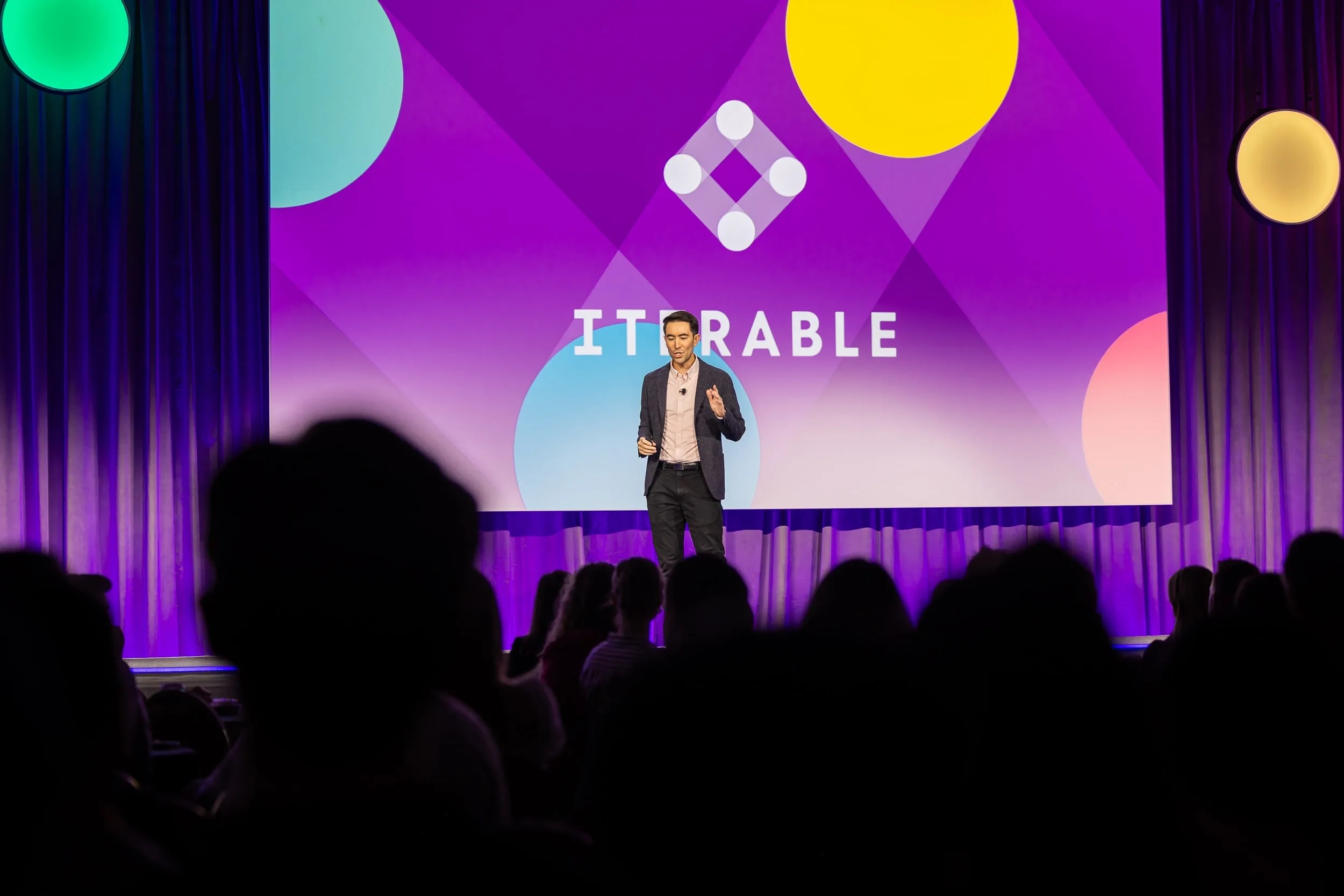
From eight people to a different scale
The company announced $1.2 million in seed funding in January 2015. By early that year, it had eight people. The early funding announcement described email growth and marketing automation for ecommerce companies. There was no need to pretend the opening product had arrived with every capability that would follow. A company can have a broad ambition and a fairly specific first instrument.
By 2017, Iterable was adding direct mail, web push, richer mobile push messages and integrations with social audiences. The practical question had expanded: how could a business coordinate customer communication when the customer might encounter it in several places? A message arriving through one channel should have some relationship to what happened through another.
Boni was president during those early years. In a November 2016 reflection on his fellowship, he described a team of 34 that had raised its Series A. Five years later, his June 2021 funding announcement described more than 450 employees, with hubs in San Francisco, New York, Denver and London. The customers then spanned more than 30 countries. A small office had become a distributed organization.
- 2013Iterable begins in San Francisco
- 201634 people, after Series A
- 2021450+ people at the Series E announcement
- 2025Boni moves from CEO to Chief Scientist
In May 2021, Boni wrote about taking the CEO role. A month later, he announced a $200 million Series E that valued Iterable at $2 billion. Those figures described the financing and the company’s valuation at that time. Later in 2021 came a different milestone: $100 million in annual recurring revenue. By early 2024, Iterable had passed $200 million in ARR.
For Boni, the expanding organization also raised a question of conduct. Iterable’s four stated values were trust, humility, balance and a growth mindset. He singled out humility as his favorite. It is an unusual word to emphasize in a funding announcement’s neighborhood, where the customary furniture includes rocket imagery and ambitious forecasts.
“As many of you know, I’m a glass half-full person.”
Andrew Boni, on becoming CEO in 2021
His optimism came with an insistence that leaders keep listening and learning as the company grew. In that first CEO message, product and engineering remained prominent. He wanted marketers to spend less time assembling campaigns and more time on their strategic aims. The administrative burden had been there at the beginning. A larger business gave him more ways to tackle it.
The CEO job changes hands
In July 2025, Iterable announced that Sam Allen would become CEO, effective August 1. Allen came from Salesforce, bringing experience in enterprise operations and growth. Boni would become Chief Scientist, work with product and engineering on the AI roadmap, and remain on the board. The arrangement separated the operating leadership from a founder’s more concentrated technical work.
It also put a name to Boni’s main project: Nova, Iterable’s AI agent. His description of the ambition is specific. Campaign building, audience segmentation and decisions about when to send messages involve mechanical work. He wants an agent to take on more of that work while people retain strategy and taste. The task is familiar; the proposed instrument has changed.
The title Chief Scientist can suggest a comfortable distance from the daily business. Here it came with a named product and a development remit. By then, Iterable was serving more than 1,200 brands across over 50 countries. Boni’s work had to fit inside software that customers already used, with real campaigns and real expectations attached.
How much machinery should a marketer have to operate before a useful message can reach a customer?
Messaging tools2025 onward
AI agents
A question instead of another dashboard
One public piece of this technical chapter is Iterable’s official MCP server, which Boni helped build. MCP, or Model Context Protocol, lets an AI assistant connect with external tools. In this case, the connector gives an assistant access to Iterable. Someone can ask about campaigns in ordinary language instead of opening another dashboard or writing code.
The project makes the ambition tangible. It can retrieve campaign information and work with templates and journeys. More consequential capabilities, including changing resources and sending messages, sit behind explicit permissions. Its default setup is read-only. Asking a question and dispatching a campaign are different actions, and the software treats them differently.
Boni’s October 2025 write-up dwells on those permissions. Connecting an agent to an account is only part of the engineering. Deciding what it may do is another part. This is a useful detail in a career often described through funding rounds: he is now discussing the rules of access inside an actual tool. The connector is open source and MIT licensed. The work can be inspected.
The browser bug and the guestbook
Then came a project outside marketing. On April 21, 2026, Boni reported a flaw in Chrome’s FileSystem component to Google’s vulnerability program. Google credited him in its June 2 release bulletin and rated CVE-2026-10886 Critical. The fix shipped in Chrome 149. It was a use-after-free bug, involving software accessing memory after that memory had been released.
The security finding makes his return to technical problems unusually literal. His former employer appeared again, this time receiving a report from him. In his write-up, he expressed surprise at seeing his name in the Chrome release news. The achievement sits alongside his work on agents, without needing to be folded into an invented grand plan.
His personal website supplies a lighter accompaniment. It has Netscape references, a guestbook, terminal jokes and a claim of Y2K compliance. The person building AI software has decorated his own corner of the web with artifacts from an earlier internet. A browser bug and a browser nostalgia joke can coexist quite happily.
In June 2026, he explained that he wanted somewhere to write in his own voice after years of company communications. He described a notebook with no publishing schedule and no analytics directing what performs. It leaves room for unfinished ideas and the occasional mistake. The student who once published a prescription for Boston now has space to think aloud about whatever keeps his attention.
There is continuity underneath the changes in title and geography. Boni keeps returning to the work between an intention and its execution: a marketer’s idea and a campaign, a question and an answer, a piece of software and the rules that make it dependable. In San Francisco, the promise he is working on now is easier access to that machinery. Boston’s promised return visit can wait.