Jeff Liu and Jon Wang began their working relationship with an introduction and a questionnaire. There were less bureaucratic ways to meet a future co-founder, of course. But the questions mattered. Before Assort Health existed, Liu wrote down an ambition: a company worth $100 million would be an incredible outcome. In June 2026, Assort announced a valuation of $1.2 billion. The original answer had acquired an extra digit.
It is an appealing origin detail because it gives the big number a human scale. Here was an engineer trying to imagine what he and someone he had recently met might build together. The questionnaire preserved that early horizon. Three years later, he could look back at it and see how much the horizon had moved.
The intervening story contains less elegant paperwork. It includes a temporary Chicago office, a rejected product test, a second test that accidentally ran the wrong version, and the practical business of deciding which of two chief executives would own which problems. Liu’s career is easiest to understand through these moments. He builds software, but much of his work concerns how people build together.
A partnership with a continent in the middle
A venture investor introduced Liu and Wang while both were exploring ideas. Liu was in San Francisco; Wang was in New York. Liu remembers the introduction as the “most valuable cold email ever.” For a relationship that would eventually share a CEO title, it began with the ordinary inconvenience of living on opposite sides of the country.
They gave collaboration a trial. Wang came to San Francisco, stayed at Liu’s apartment, and the two spent time together as friends and prospective partners. By May 2023, they had incorporated Assort. There is something refreshingly practical about that sequence: meet, spend time together, try working, then decide whether to make the arrangement official.
They also used First Round’s co-founder questionnaire. A company can give two people the same impressive title without discovering whether they want the same future. Written answers bring the future into the room early. In Liu’s case, one answer would later become a marker of the distance travelled. The company itself has become much larger than the figure he originally imagined.
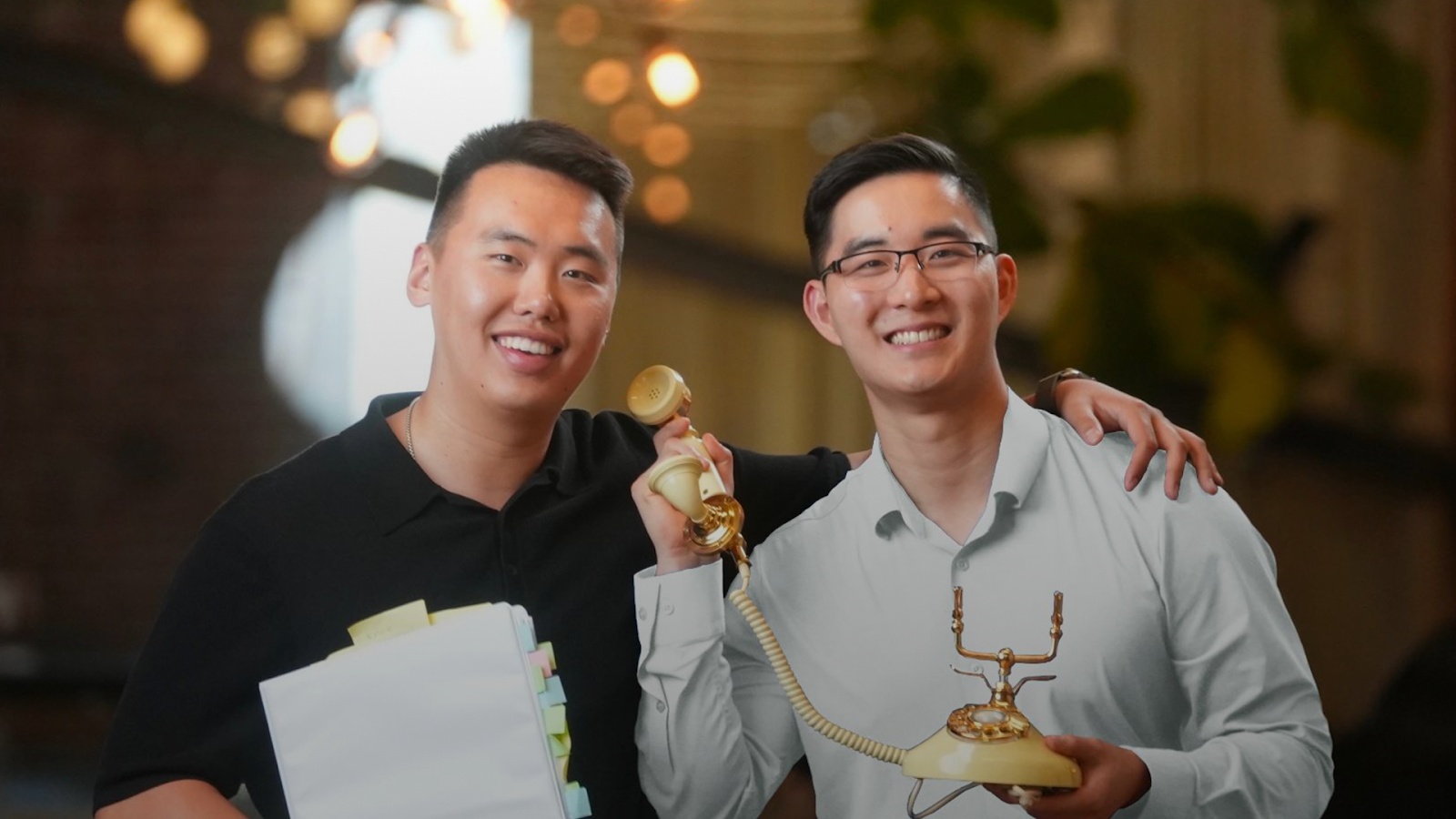
The signature that splits the job
The co-CEO arrangement has a clear dividing point: the customer contract. Wang leads the work that brings customers and capital into the business, including sales, marketing, growth and financing. Liu leads what follows the agreement, including product, engineering, implementation and customer operations. A signature on a page becomes a useful boundary in an otherwise complicated organization.
That gives Liu a job with a long tail. His responsibilities extend from deciding what to build to making the software work for a customer and supporting it afterwards. The distance between an engineering decision and its consequences stays relatively short. A product promise eventually arrives in his part of the company as work that has to be delivered.
The division also leaves room for overlap. Liu describes the founders helping one another and investing in their relationship. As senior leaders join, the founders can spend more time on hiring and direction. Their arrangement is therefore more flexible than a neat organizational drawing might suggest. The drawing is useful; the people still have to talk.
Sales · Marketing
Growth · Financing
CONTRACT↓
Product · Engineering
Implementation · Customer operations
For Liu, the arrangement fits a career spent close to software and product development. It also makes the shared title more concrete. The question becomes less about which founder occupies the larger chair and more about whether the handover works. Furniture, mercifully, is easier to buy than trust.
The fighter pilot who chose code
Liu grew up in Northern Virginia and wanted to become a fighter pilot. The F-22 Raptor figured in his childhood imagination. That is a pleasingly specific ambition: a machine, a cockpit, a job whose appeal requires very little explanation to a child.
His eventual education took him to Duke University, where he discovered a preference for the coding and engineering side of his coursework. He changed direction toward computer science and economics, earning a Bachelor of Science. The useful detail is his own explanation of what attracted him: assembling things through logic. He wanted to build.
His résumé later included the early engineering team at Cameo, a senior software engineering role at Meta, and leadership of product engineering at Athelas. Those jobs gave him experience in different company settings before he took on the responsibilities of a founder. The current title sits on top of a technical career, rather than replacing it.
There is an easy temptation to make the childhood aircraft predict the adult company. It is more interesting to leave the two ambitions at their actual scale. A boy wanted to fly a particular jet. An undergraduate found work he liked doing. An engineer eventually met a complementary partner. A career can change direction without needing every earlier choice to announce its destination.
A demo with very little charm
The company’s first Chicago launch effort in late 2023 produced a blunt rejection. The team revised the software. Then another test used an outdated deployment. After doing the work to improve the product, they had presented a version that did not contain the improvements. Anyone who has shipped software will recognize the peculiar irritation of losing an argument with yesterday’s code.
Liu and the team asked for another opportunity. They checked the deployment and tried again. The launch was approved on November 13. These are small events beside a later funding announcement, but they reveal the conditions under which the company had to earn confidence: a working version, a real test and somebody willing to judge the result.
The episode gives the co-CEO division another dimension. Liu owns the side of the business where promises encounter implementation. An agreement may start that process, but confidence depends on what happens afterwards. In Chicago, it depended on a team being able to absorb criticism and return with software that behaved differently.
“We do not expect people to have every answer on the first try.”
Jeffery Liu, on Assort’s working culture
His later account makes ownership the point. An employee can respond to a difficult customer situation, improve a first version or address a problem outside their immediate assignment. The idea gives the early launch a purpose inside a growing company: remember how responsibility felt when there were fewer people available to pass it to.
A company introduces its next employee
By August 2025, Liu’s public presence included a steady stream of welcome posts for new colleagues. That month, the team numbered roughly 50 in San Francisco’s Financial District. In the office, Liu gave engineers direct, practical feedback and brought an energetic presence to the team.
That observation adds texture to the title. Product and engineering leadership can sound like a sequence of decisions made behind a meeting-room door. Here, Liu was also visible in the ordinary social work of a growing office: welcoming people, responding to their work and helping set its pace. Hiring had become part of the story readers could watch unfold.
The company’s next year brought more experienced executives. In July 2026, Assort announced Jon Corn as chief revenue officer, Kristina Kemp as vice president of customer success and Emil Yeargin as senior vice president of people. Liu described the goal plainly: “Building an enduring company means raising the bar with every hire.”
A founder who once worked through a small team’s deployment now has to build an organization that can handle more work through more people. Those are related skills, but they ask different things of him. Adding experienced leaders changes who can make decisions and where the founders’ attention is most useful. The welcome post has an organizational consequence.
The extra digit
Assort’s financing gives that change a dated outline. Its $22 million Series A was announced in April 2025. A $76 million Series B followed in September, led by Lightspeed. In June 2026, Menlo Ventures led the $120 million Series C at a reported $1.2 billion valuation. Assort put its total funding at more than $222 million.
Announced round sizes. The June 2026 company valuation was $1.2 billion.
By September, Liu was discussing the company with Greenfield Partners’ Olivia Levine, whom he knew from Duke. The conversation paired a present-day founder with someone whose connection to him preceded Assort. In the public life of a startup, old acquaintances offer a different clock. They can remember the person before the company supplied the introduction.
The questionnaire offers another clock. Its $100 million answer captures an ambition before the outcome made it look modest. Liu has publicly returned to that answer with surprise. The detail matters because it preserves uncertainty inside a story now told through large numbers. At the beginning, he and Wang had a possible partnership and a set of written expectations.
What stays with the engineer
Liu’s current technical ambition includes reducing the effort required to configure and change customized AI agents. He has discussed an internal agent composer called R2D2, with testing, previewing and controlled deployment built into the process. The name adds a small piece of science fiction to a practical engineering problem.
It also brings the story back to the working version. A tool that helps teams make changes still needs a way to check those changes and know what will be deployed. The Chicago episode sits neatly beside that ambition. The engineer who saw a test run the wrong software now leads a company trying to make complicated software easier to configure at scale.
There is plenty of room between those two points for the less photogenic parts of a founder’s job: allocating responsibility, recruiting leaders, supporting customers and making another decision after feedback arrives. Liu’s story has a fighter jet, a consequential email and a questionnaire whose numbers aged unusually well. Its recurring scene is simpler. Someone has built something. Now it has to work.
Continue the conversation
Find Liu online and watch the conversations behind this profile.