The doctor listened to the machine. The machine tried to schedule an appointment. Then came the sort of verdict that can turn a demo room into a freezer: the product was unacceptable and could not speak to patients in its present form. Jeffery Liu and the small Assort Health team had come to Chicago to win over an orthopedic clinic. Instead, their first serious deployment had introduced itself by falling over in public.
It was late October 2023. Early snow and Halloween decorations sat outside the Airbnb the team had turned into a temporary office. Inside were monitors bought at Best Buy with the practical intention of returning them later. The days ran for 16 hours. The software had to understand a caller, navigate a thicket of provider rules, talk to an electronic health record and produce an appointment that made sense.
The team revised the flow around the clinicians' criticism. One suggestion was deceptively simple: let callers choose a time before asking them to surrender a procession of demographic details. Then the second test arrived, and Assort accidentally served an old deployment without many of the fixes. Liu's team asked for one more chance. On November 13, the clinic approved the agent for new patients. Its first-day resolution rate was 55.56 percent.
“We do not expect people to have every answer on the first try.”Jeffery Liu, on Assort's Day 1 culture
That awkwardly exact number is a better entrance to Liu's story than the round figures that arrived later. By June 2026, Assort had handled 190 million patient interactions. It had raised more than $222 million. A $120 million Series C valued the company at $1.2 billion. Those numbers suggest altitude. The Chicago number shows the climb.
A pilot, redirected
Liu grew up in Northern Virginia wanting to become a fighter pilot. The F-22 Raptor, visible in the orbit of Andrews Air Force Base and the Air and Space Museum, supplied the boyhood machinery. His parents were less enchanted by the career plan. During high school he volunteered at Inova Health System, transporting patients, running lab materials and delivering gifts from families.
He found the work meaningful enough to arrive at Duke University as a biomedical engineering pre-med student. Then the curriculum clarified his temperament. He liked building logical systems; dense biological memorization held less appeal. Liu switched to computer science and economics, graduating in 2019. The destination changed, while the interest in how people move through healthcare stayed put.
His early engineering career became a quick tour through different forms of human coordination. He joined Cameo's early team, then worked at Facebook, now Meta. At Athelas, later part of Commure, he moved from senior software engineer to head of product engineering. There he worked on remote monitoring, administrative software and an early generative AI medical scribe that would be used by more than 100,000 physicians.
Before ChatGPT became a household noun, Liu had access to early language and speech models. The possibility he noticed was less glamorous than synthetic poetry: software might finally manage the phone call at the front of a medical practice. A friend on a tennis court connected him with an uncle whose practice was losing about 60 percent of calls. The abstraction acquired a ringing telephone.
The most valuable cold email
Jon Wang was looking at the same intersection from another lane. He had studied at Stanford, entered medical school at UCSF, left and built in healthcare. A venture capitalist introduced the two aspiring founders. Wang lived in New York; Liu was in San Francisco. Liu has described the beginning as long-distance dating and the introduction as the most valuable cold email ever.
They did some of the unromantic work early. A First Round Capital co-founder questionnaire pushed them into questions about power, pressure and whether one founder could fire the other. They tried working together, found their skills complementary and incorporated Assort in May 2023. The same questionnaire later became part of hiring early employees, a quiet admission that small-company colleagues inherit founder-sized consequences.
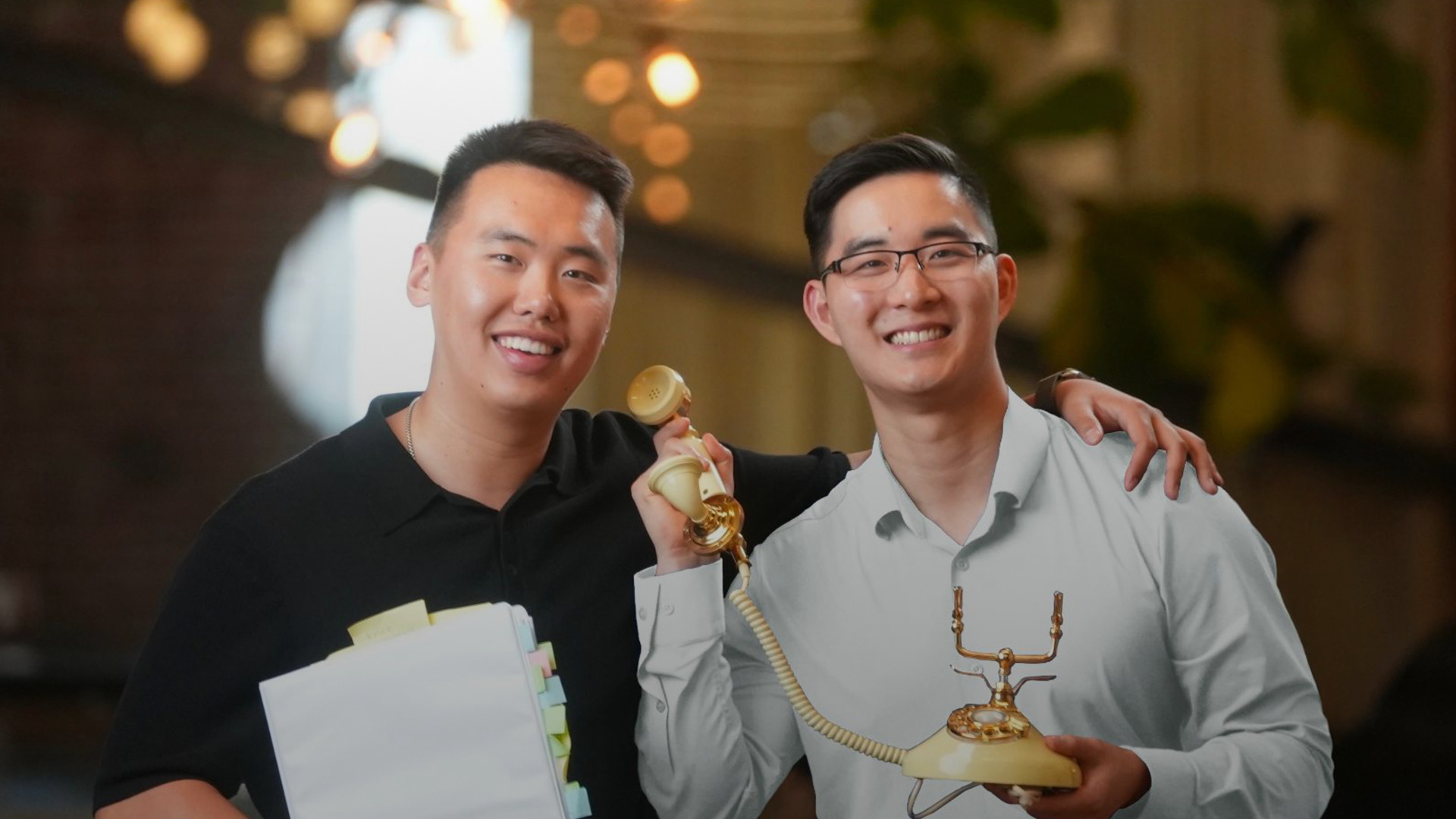
Their co-CEO arrangement is striking mainly for its legibility. Wang oversees the road to a contract: sales, marketing, growth and financing. Liu runs the country beyond the signature: engineering, product, customer operations and implementation. There is overlap, and they invest time in the relationship, but the interface is explicit. It lets a customer promise travel quickly toward the people responsible for making it true.
The company did not enjoy an effortless financial birth. Liu and Wang approached roughly 45 investors before Quiet Capital led a $3.5 million seed round announced in March 2024. Even the investor who introduced them passed. “Most people passed on us because they didn't believe in us,” Liu later recalled. Rejection has since become a polished founder genre. In Assort's case, it rhymes usefully with the Chicago demo: permission arrived only after the work had begun.
Choose the difficult phone tree
Assort began in orthopedics, where scheduling can behave like an oral exam. A sports medicine doctor, hand surgeon and joint replacement specialist occupy different branches. The correct appointment can depend on where it hurts, what happened, whether imaging exists, which insurance applies and which exceptions a particular doctor accepts. Some rules live in an EHR. Others sit in binders, spreadsheets, sticky notes or the memory of an experienced scheduler.
Starting there forced Liu's product organization to confront the awkward truth about applied AI: fluent conversation is only the visible layer. Reliability lives underneath, in the rules that determine what the conversation is allowed to accomplish. The team had to encode universal steps, specialty logic and practice-specific preferences, then evaluate countless edge cases before a caller ever heard the agent.
From first call to learned system
The first live system resolved a little over half its calls without a human. Later deployments moved above 95 percent. That improvement is the essence of Liu's operating argument. A model becomes useful through the unfashionable accumulation of corrections: a misheard request, a provider preference, an insurance wrinkle, a referral requirement, a name pronounced badly and fixed.
Assort's financing followed the product's widening scope. A $22 million Series A arrived in April 2025. The company announced a $76 million Series B that September. In June 2026, Menlo Ventures led the $120 million Series C. Around 15,000 physicians were using the product by then, primarily in specialty groups, and Assort had signed its first health system customer.
The phone call was only the foyer
Liu's current ambition extends well past answering phones. He and Wang describe healthcare as a collection of disconnected moments that repeatedly forget the same person. A scheduling vendor knows one call. An intake tool knows one form. A referral system knows one handoff. Staff members become the human glue, reconstructing context while callers repeat themselves.
Assort now works across scheduling, intake, referrals, document processing, outreach, medication refills and payments. Its Synapse system is intended to learn both operational intelligence, meaning how a practice actually functions, and patient intelligence, meaning how people describe what they need. Liu's phrase for the larger goal is pleasingly plain: “Healthcare should remember.”
In August 2026, the company appointed health-system executive Sunny Eappen as its first chief medical officer. Liu framed the hire around whole-system consequences: a decision in one department can determine whether a patient reaches the right clinician and whether scarce capacity is used well. It also showed the changing scale of his own job. The engineer who once camped beside a clinic now has to build an organization capable of understanding many clinics at once.
“If we earned the front door, we could earn the rest of the patient journey.”Jeffery Liu and Jon Wang, on Assort's starting point
A hat, a habit and an old mistake
Liu and Wang have acquired cowboy hats. They wear them at events, board meetings and funding conversations. Liu's explanation is admirably unserious: he liked the look and the vibe. He has also called healthcare the wild west. The visual joke became a team ritual, useful in the way mildly ridiculous things can be useful when a company needs a shared language.
The hats attract cameras. The more revealing cultural artifact remains the failed demo. Liu turned it into a story about “Day 1,” the company's name for ownership, direct response and incremental improvement. A teammate should notice a problem outside a formal job boundary, care about the outcome and make the next version better. The doctrine lands because its author can point to a morning when the team served the wrong build and could offer no dignified explanation.
There is a tidy arc available here: hospital volunteer discovers code, meets complementary co-founder, fixes the phone and builds a valuable company. Liu's own material resists tidiness. It contains a fighter jet he did not fly, a degree path he abandoned, investors who said no, returnable monitors, a humiliating test and a first-day percentage that would look terrible in a victory lap.
Those details make the larger outcome intelligible. Assort did not begin by knowing every answer. It began by choosing a problem with too many answers, listening when the first ones were wrong and returning for another test. The company now wants its software to remember every handoff. Liu's most practical advantage may be that he remembers the first one.