The origin story of 100ms begins with an indignity familiar to anyone who has tried to make complicated software look simple: four months vanished into an integration. Kshitij Gupta and his future co-founders were at Disney+ Hotstar, working on a feature that would let friends watch a live match together while talking over video. They chose an existing video software kit. Then came the settings, edge cases, and stubborn work required to make it behave like a native part of the product. By the time it worked, the delay had become more interesting than the feature.
Gupta had spent much of his career in the machinery underneath digital media. His path ran from software roles at Infineon and Texas Instruments through Cadence, Dilithium Networks, Dialogic, iCelero, and Shoppin. At Facebook, now Meta, he worked on video infrastructure for Facebook Live. At Hotstar, where he became vice president of engineering, his brief was wonderfully plain: keep video working. The sentence fits on a Post-it. The engineering does not.
His public profile traces the foundation back to a Bachelor of Engineering at Madan Mohan Malaviya University of Technology, completed in 2000. What followed was not a fashionable sprint through job titles. It was a long apprenticeship in the layers of communication: semiconductor software, adapted media, codecs, server infrastructure, engineering management, product decisions, and finally company building. One of his patents concerns delivering media adapted to a receiving device; another concerns synchronizing an online gaming environment with a live event stream. The language is dry enough to preserve food, but the idea underneath is lively. Media should arrive in a form the person can use, and separate experiences should feel as if they are happening together. Years later, those same concerns would reappear in classrooms, watch parties, patient calls, and the name 100ms itself.
Live communication punishes pretense. A screen can look polished while a bad network turns the speaker into a cubist portrait. A recording can seem routine until somebody's laptop disconnects. Ten people can become ninety network relationships if a naive peer-to-peer architecture asks every participant to upload to everyone else. Good infrastructure disappears, which is both its triumph and its public-relations problem.
“The first level thing is make my video work with high reliability.”Kshitij Gupta, 2022
The four-month itch
In October 2020, Gupta founded 100ms with two Hotstar colleagues, Aniket Behera and Sarvesh Dwivedi. The proposition was direct: give ordinary product teams the real-time communications infrastructure that large technology companies had built for themselves. Let a classroom, telehealth service, community, fitness app, or live event embed the experience instead of throwing users into a Zoom link and hoping they returned.
The team did not rush the reveal. It stayed in stealth for roughly nine months, working on unreliable networks, modest Android devices, Chromium behavior, WebRTC, and distribution. Gupta later described the goal in capital letters: make live video work on every kind of device, regardless of the connection. The company launched publicly in August 2021. Its SDK usage grew twentyfold over the following months, and more than 2,200 businesses had tried the infrastructure by early 2022.
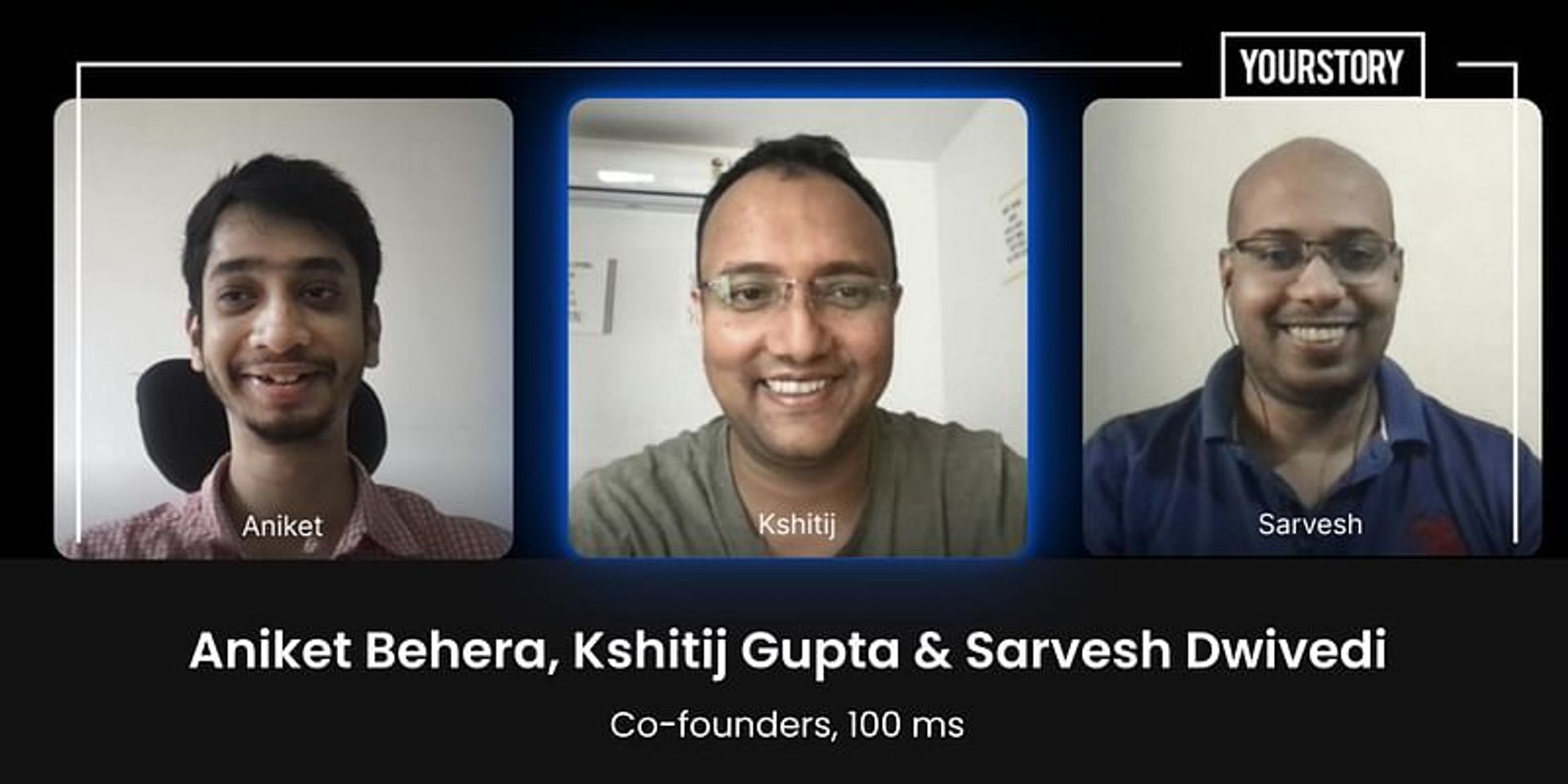
The founding team became its own test lab. During its remote beginning, 100ms employees used their product for internal calls instead of Zoom or Google Meet. Every meeting was also a bug report waiting to happen. It is a charmingly economical arrangement: office rent zero, quality assurance perpetual.
Investors followed the technical argument. Accel and Strive joined a $4.5 million seed round in 2021. In March 2022, Alpha Wave Incubation led a $20 million Series A with Matrix Partners India, LocalGlobe, Accel, and Strive participating. The total reached $24.5 million. Capital bought the company more engineers and more time with the unruly physics of browsers, phones, networks, and impatient humans.
A founder who draws circles
Gupta explains technical systems with ordinary places. His neatest image is an auditorium divided into three circles. The first is the stage, where a small group talks with sub-second latency. The second is the audience in the room, listening in real time and able to raise a hand. The third is everyone watching remotely, where scale is high and a longer delay is acceptable. A developer should be able to move a person between those roles without rebuilding the theatre.
The metaphor reveals something about his operating style. Gupta likes abstractions, but only when they preserve control. 100ms did not force a finished interface on developers. It offered templates, roles, hooks, webhooks, and APIs, leaving the customer to decide what a classroom or front-row ticket should look like. The hidden machinery was the product; the visible experience belonged to the builder.
He also kept pointing outward. In a 2022 interview, Gupta said the company thrived on developer feedback. Customers had pulled the product from small video calls toward recordings, broadcasts, green rooms, large classrooms, and hybrid events. Feedback was not a ceremonial survey after launch. It was part of the architecture.
“We thrive on developer feedback.”Kshitij Gupta, on building 100ms
The pivot beneath the pivot
By 2024, 100ms had started a second life. The company launched AI agents for healthcare operations and narrowed its attention toward patient access, intake, scheduling, benefits investigation, prior authorization, and telehealth coordination. On a slide, the move from a horizontal video API to healthcare voice AI looks like a sharp turn. Through Gupta's career, it looks more like a transfer of craft.
A live video engineer learns that conversation is a systems problem. Speech must travel quickly enough to feel natural. Noise and interruptions are normal. Every device and network brings a new failure mode. Integrations matter because the conversation is rarely the whole workflow. When the software falters, recovery must feel composed rather than catastrophic. Healthcare adds firmer boundaries: data protection, careful escalation, auditability, and respect for staff judgment.
100ms says its agents use real-time guardrails, red-team testing for edge cases, and instant escalation to human staff in emergencies. It presents them as support for care teams, not substitutes for them. The company also says it has powered 100 million interactions and reached one billion minutes of conversation in a month. Those figures are less a victory lap than a reminder of the surface area: at scale, the peculiar case is not peculiar for long.
The receipt matters
Gupta's more recent public writing has moved from what an AI agent can say to what an organization can prove it did. In May 2026, he argued that capability without accountability leaves a fragile operation. 100ms logs recommendations, agent decisions, and call transcripts so a team can reconstruct a case later. His question was pointed: if every decision cannot be audited, how can the system earn trust?
That emphasis is recognizably an infrastructure engineer's. A model demonstration lives in the present tense. An operational system must leave a receipt. It needs timestamps, state, handoffs, and reasons that survive the meeting where everyone remembers the incident differently. The discipline is unromantic and extremely useful.
He has also written about joining fragmented patient-access data so operators can ask plain-language questions about stuck cases, payer patterns, and provider friction. The ambition is not merely to have a pleasant voice answer a phone. It is to connect the conversation to the administrative path around it, then show staff where the path has jammed.
This is where two old Gupta instincts meet. The first is to remove infrastructure complexity from the person trying to get work done. The second is to keep the application in control. In the video years, that meant APIs instead of a prescribed user interface. In healthcare operations, it means customization, guardrails, audit trails, and a human available for exceptions.
Still listening for the edge case
Gupta's résumé now spans more than a quarter century, yet the through-line is not a particular protocol or market. It is a preference for hard, invisible systems whose quality is measured by how little the user has to think about them. The Facebook Live viewer does not want a lecture on bitrate. The Hotstar fan does not wish to meet the media server. A patient calling about an appointment or coverage wants an answer, a sensible next step, and a person when the situation exceeds the software.
The danger in making difficult things look easy is that people begin to believe they are easy. Gupta appears temperamentally suited to the opposite belief. His public comments return to reliability, feedback, process, and the awkward cases that arrive after the demo. He has two patents connected to media delivery and synchronized live experiences, but his reusable invention may be an operating habit: listen closely, abstract carefully, and assume reality will find the seam.
100ms is now testing that habit in a domain where a smooth conversation is only the beginning. The call must reach the right workflow. The workflow must preserve context. The system must know when to stop. Someone must be able to inspect what happened afterward. Speed matters, but so does the grace of the handoff. For an engineer who named his company after a sliver of latency, the next chapter is less about talking faster than making sure the conversation actually goes somewhere.