Justin Zhu was eating pho in San Francisco’s Chinatown when a photographer caught him on the phone. The call belonged to a day crowded with calls. He was helping coordinate an eleven-city commemoration of the Atlanta spa shootings, and lunch had acquired a second job as an organizing desk. A year earlier, he had been running a marketing software company. Now he was trying to persuade people to break their silence.
When the photograph appeared on the front page in June 2022, Zhu recounted the moment with some surprise. Before March 2021, he had never imagined being described as an activist or a civil rights leader. He had spent eight years as the CEO of Iterable, the company he founded with Andrew Boni. The unfamiliar title came with rather familiar work: recruit people, get a message out, keep the operation moving.
A startup founder learns to ask. Customers must try something unproven. Employees must leave something comfortable. Investors must put money behind a future that exists mostly in conversation. Zhu’s next undertaking would ask business leaders to put something else on the line: their names.
A small company with a large inbox
Born in Shanghai, Zhu studied computer science at Carnegie Mellon, whose alumni listings identify him with the class of 2010. He went to Twitter as a software engineer in 2011. His work on user growth gave him a close view of an unglamorous but consequential part of the internet: the messages that bring people back.
Email is easy to underestimate. It lacks the theatre of a new device or a social network launch. Yet a useful message at the right moment can make the difference between a customer returning and a customer forgetting you exist. The difficulty was getting those messages built without turning every marketing idea into an engineering assignment.
Zhu and Boni, who came from Google, founded Iterable in March 2013. They had seen what sophisticated technology companies could do with personalized communications. They wanted marketers elsewhere to have access to those capabilities. Their starting problem was specific: why should testing an email or tailoring a campaign require so much technical help?
By January 2015, Iterable had seven people and $1.2 million in seed funding. It had gone through AngelPad and was already serving customers including EAT24 and Dot & Bo. Its plans extended beyond email into push notifications and text messages. The ambition was to give engineers something straightforward to integrate and marketers something they could actually operate.
That division of labor matters. The engineer should not have to become a permanent translator for the marketing department. The marketer should not need to acquire a second profession to test a sensible idea. Iterable’s early proposition put the two colleagues closer together, while allowing each to get on with the work they had been hired to do.
In January 2016, Zhu announced an $8 million Series A. The company reported that recurring revenue had grown more than tenfold during 2015 and its customer base eightfold. It had also been cash-flow positive in the fourth quarter. Those are company-reported figures, and they describe a particular period, but together they explain why this modest-looking corner of software attracted attention.
The product was expanding across email, push and SMS. Its customers collectively reached hundreds of millions of users. A company that had begun with an inbox problem was becoming a system for deciding how a business should speak to its customers across several channels. The conversation had grown considerably larger than the founding team.
The room gets bigger
Growth creates a peculiar management problem. A founder can remember what it felt like when everyone fit in one room; new employees have only heard the story. In December 2016, Zhu sat down with former Twitter CEO Dick Costolo at Iterable’s first fireside chat. More than fifty people attended. David Cancel, then CEO of Drift, also featured in the event.
Costolo spoke about Twitter’s expansion from dozens of employees to thousands and the need for open internal communication. The lesson was about reducing the perceived distance between employees and executives. For Zhu, who had worked inside Twitter before building his own company, this was a conversation with both a professional ancestor and a possible preview of the future.
Iterable had tripled its staff that year, moved into a new San Francisco office and raised its Series B. The questions were changing. Building software remained essential, but so did building a place where people could keep building software together. A growing company acquires more meetings, more titles and more opportunities for a message to lose its way.
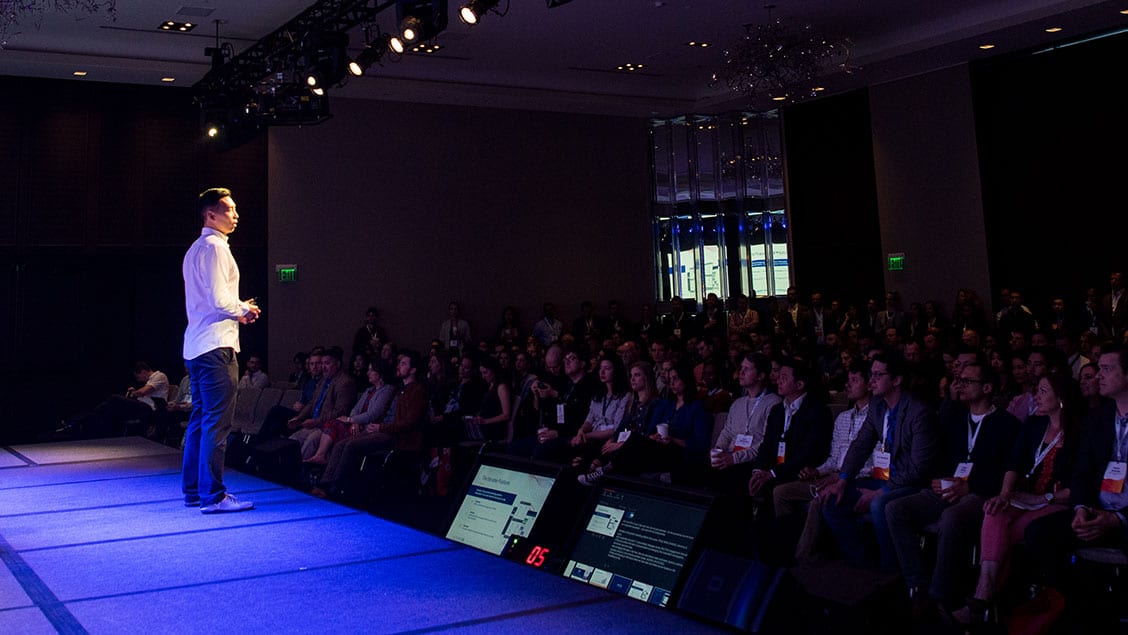
By December 2019, Zhu was announcing another $60 million in funding and discussing expansion across offices in San Francisco, New York, Denver and London. His agenda included a broader core platform, emerging engagement technologies and a larger global team. In the accompanying photographs, the distance from the first office to a conference stage was plain enough.
He was also talking about artificial intelligence and long-term customer relationships. The technical vocabulary had changed since the early email days, but the operating question persisted: could a business make better use of what it knew about a person, and communicate more usefully as a result? A notification is a small thing. Multiply it across a customer base and it becomes a relationship, or a nuisance.
Zhu’s stated management values included trust, humility and balance. In April 2020, as Iterable received another workplace award, he described investing in employees as central to a sustainable company. It was a public statement about what he wanted the business to embody, rather than simply what he wanted it to sell.
A name at the bottom of a letter
The Atlanta spa shootings in March 2021 changed the direction of his work. Zhu joined Dave Lu, Wendy Nguyen and volunteers in organizing an open letter against anti-Asian violence and discrimination. The letter went into The Wall Street Journal. Executives accustomed to speaking for companies were being asked to speak together about their community.
The signatory list crossed industries and ranks: Zoom’s Eric Yuan, Alphabet’s Sundar Pichai, DoorDash’s Tony Xu, YouTube co-founder Steve Chen and former president George W. Bush, among many others. It included founders, employees and allies. Names that normally appeared on competing corporate announcements occupied the same page.
A signature is a small public act. It can also be the beginning of an obligation. Once a person has attached a name to a demand, someone can ask what happens next. Stand with Asian Americans gave that question an organizational home. Zhu’s co-founders brought their own business experience, and volunteers helped turn an expression of outrage into continuing work.
“For me, it was personally the first time speaking up on social issues.”
Justin Zhu, June 2021
In a June 2021 interview, Zhu described entrepreneurship as preparation for advocacy. Asking for customers, employees and investment had trained him to speak publicly. He also noticed practical gaps around nonprofit work: an out-of-date website or a missing donation button. A cause could have committed people and still need the basic tools that make participation possible.
That observation brings his two careers into focus. His contribution was partly the willingness to speak and partly the habit of asking how an organization works. Attention needs somewhere to go. People need a way to join. Good intentions, however abundant, do not update a website by themselves.
After the CEO title
Zhu’s tenure as Iterable CEO ended in April 2021, when the board replaced him with Boni. By then, the business he had helped build had reached a $2 billion valuation. The public dispute over his departure occupied plenty of attention. His subsequent work gave him another set of responsibilities, with a different constituency and a different measure of usefulness.
His nonprofit biography records national mobilizations including a six-city commemoration of Vicha Ratanpakdee and the eleven-city anniversary of the Atlanta shootings. It also lists work around the anniversaries of the Los Angeles riots and Vincent Chin’s killing. Those occasions connected present organizing to earlier chapters of Asian American history.
The Chinatown lunch photograph fits this period precisely. Public life was arriving through ordinary logistics. Someone had to coordinate an event in one city with people in ten others. Someone had to take the next call. The civil rights title might have surprised Zhu; the crowded working day would have been easier to recognize.
A career in four turns
- Engineering at Twitter
- Co-founds Iterable with Andrew Boni
- Co-founds Stand with Asian Americans; leaves Iterable’s CEO role
- Publicly listed as founder and CEO of Mithra
A fund, a board seat, another venture
In July 2024, Stand with Asian Americans announced a $1 million Workplace Justice Fund and new leadership. Zhu moved from executive director to a board role. The organization was concentrating on legal advocacy for Asian Americans facing workplace discrimination, giving its public mission a more specific institutional form.
The change matters in a founder’s story. An organization that continues through a leadership handoff has a life beyond the person who helped start it. The current team page lists Zhu as co-founder and board chair. The letter had become an organization with people, roles and work that could continue after its first burst of attention.
He has also returned to company building. Audacious Ventures lists Mithra alongside his name, describing it as an AI marketing and persuasion platform. In October 2026, StreamNative’s conference publicity identified him as Mithra’s founder and CEO and listed a conversation with Sijie Guo called “Agents as the New Customer.” The subject brings him back to communications, with a different technology in the foreground.
There is a tidy biography available here: engineer, founder, activist, founder again. It misses the work between the commas. Zhu has spent these chapters dealing with a recurring difficulty: having something to say does not guarantee that anyone will hear it. Software can help a marketer reach a customer. An organization can give a community a way to act together. Both require people willing to make the next request.
The next request may arrive in a boardroom, on a conference stage or halfway through lunch. Zhu’s story has room for all three.
Continue the conversation
- Stand with Asian Americans - the organization he co-founded.
- Justin Zhu on LinkedIn · Twitter / X
- Watch the Carnegie Mellon entrepreneurship conversation, with Eugene Marinelli and Justin Zhu.
- Zhu’s account of the Chinatown photograph.
- Explore Iterable’s company profile.