The first thing Chatfuel built was a nearly empty shop. Telegram had just opened its bot platform in 2015, and co-founder Dmitry Dumik woke Artem Ptashnick at two in the morning with an idea: make a directory. Their StoreBot was reportedly the eleventh bot on Telegram. Its inventory was the other ten. It looked tiny because it was tiny - and that was the point. In a market with no established playbook, a directory could become an observation deck.
Telegram’s founder included it in a launch post, sending the first 15,000 users. Then the traffic ebbed. There was no discovery mechanism for the discovery mechanism, a pleasingly circular startup problem. Chatfuel’s fix was equally circular: creators who wanted their bots ranked higher asked users for ratings; rating required activating StoreBot. The products supplied their own distribution.
That loop is the origin of the company’s more durable skill. Chatfuel has never owned a messaging network. It has survived by watching how attention moves inside other companies’ networks, then turning the repetitive parts of a conversation into software.
The first failure was an empty doorway
What failed first? Discovery, not the bot thesis. StoreBot’s initial publicity spike disguised a product with no reliable path back into it. When that became obvious, the founders did not buy a larger megaphone. They changed the product mechanics so every builder had a reason to bring an audience.
The founders then made a small acquisition: an existing Telegram bot builder whose creator joined the team. Proceeds from Dumik’s earlier news-app sale helped finance it. Directory, builder, and ad network formed a compact ecosystem. In March 2016, TechCrunch reported that people had used the platform to create more than 120,000 bots serving five million users.
If you don’t own the messenger, you don’t own the platform.Dmitry Dumik, describing the Telegram-era constraint
That constraint changed their mind about scale. Telegram was useful enough to learn on, but too small to carry the venture outcome that Y Combinator and the founders imagined. Chatfuel joined YC’s Winter 2016 batch while preparing for Facebook to open Messenger. A Forbes news bot attracted other publishers and put Chatfuel in contact with Facebook. The team built a TechCrunch bot for the Messenger launch period and shipped a second version of its self-service builder with lessons already learned on Telegram.

The bot became a sales employee
Early Chatfuel was a canvas. A publisher could deliver stories; a brand could answer prompts; anyone could assemble a flow without code. Today the product is more opinionated. Chatfuel describes an “AI Coworker” that catches leads from comments, ads, direct messages, and website chat; answers from a business knowledge base; qualifies the shopper; schedules an appointment; sends reminders; and moves the useful conversation into a shared inbox or CRM.
The customers are correspondingly practical: clinics, salons, fitness coaches, e-commerce shops, educators, agencies, creators, restaurants, and real-estate teams. These businesses often conduct a sale in fragments - a comment asking “price?”, a DM about availability, a WhatsApp exchange, then a calendar link. The problem is not a lack of messages. It is that intent cools while the inbox waits.
Chatfuel’s published case studies put numbers around that claim, with the usual vendor-case-study caveat. Nissan’s campaign was credited with $380,000 in its first month and 3.5 times more qualified leads. An Instagram bot for a resale platform was credited with a 37 percent conversion lift. An agency said it automated 70 percent of repetitive inquiries for an e-commerce client. These examples do not guarantee a fresh customer the same return; they do show the product’s chosen unit of value. Chatfuel is trying to be measured in qualified leads, bookings, sales, and support avoided - not in how charmingly a bot says hello.
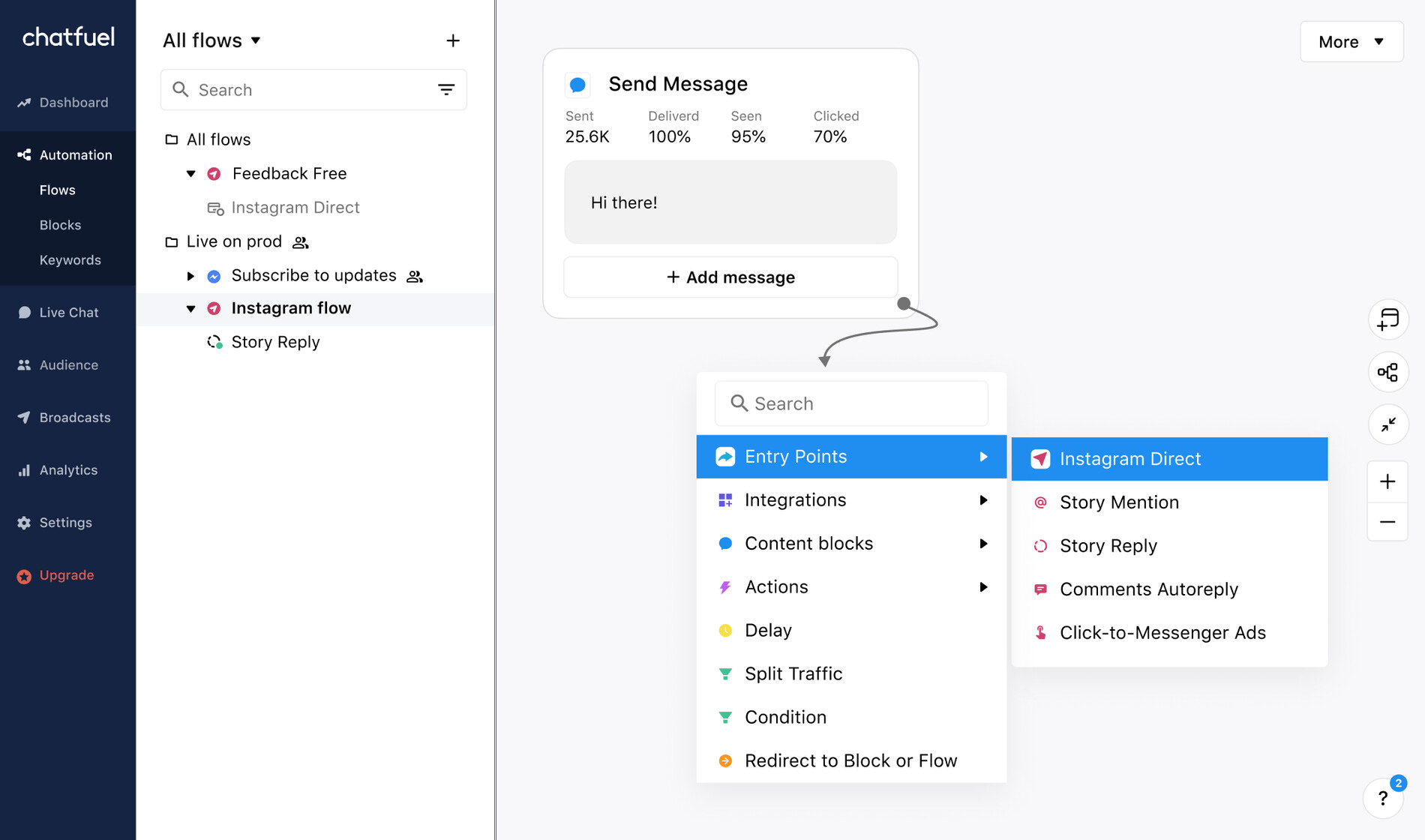
The visual flow builder still handles deterministic work: a keyword triggers a reply, an order number is saved, a message branches, a tag is applied. AI handles fuzzier language and knowledge retrieval. Live chat handles judgment. That mix is more credible than the fantasy of a bot that never needs supervision.
The price of answering now
Chatfuel’s current pricing makes the model plain. Light is free and includes Instagram, Facebook, and WhatsApp automations, a shared inbox, visual flows, contacts, segmentation, and templates. AI Pro is advertised at $49 a month, with a lower monthly equivalent on annual billing and usage limits. Larger setups and message volume can cost more. Meta’s WhatsApp charges are separate economics even when Chatfuel folds them into one bill.
That is a freemium SaaS wager: give away the plumbing that proves the workflow, then charge when inference and business outcomes enter the picture. The purchase makes sense when a missed response is worth more than the subscription. It is harder to justify for an account with light message volume, low-value inquiries, or no repeatable sales path.
Different where it matters, familiar where it doesn’t
Manychat is the obvious comparison, with respond.io, SleekFlow, Wati, Intercom, Tidio, and custom Meta-API stacks surrounding the same territory. Chatfuel’s distinction is not that nobody else can send an automated DM. It is the accumulation of channel approvals, visual tooling, templates, inbox behavior, integrations, and a decade’s worth of conversation patterns - then packaging those pieces around a sales outcome instead of a bot-building hobby.
Its AI architecture also reveals some welcome pragmatism. Chatfuel said it once relied solely on GPT-4 models for agent work. In a 2025 project with Nebius AI Studio, it deployed a cascade of Llama-405B models and a custom SDK. The company reported that the new setup improved its routing of user inputs to the correct agent by 24 percent versus GPT-4o, while lowering language-model cost. The important idea is not “Llama beat GPT.” It is that routing, classification, constrained generation, and open-ended conversation are different jobs. Benchmark each job.
There is also a measurement wrinkle. Chatfuel says more than seven million businesses have chosen it since 2015, while its current pricing page says 150,000-plus businesses trust the product, and LinkedIn has used still another active-customer figure. Those numbers can all describe different cohorts - lifetime sign-ups, current workspaces, or focused customers - but they should not be treated as interchangeable.

What to copy - and what not to expect
The copyable lesson is not “build on the newest messaging API.” It is to find an information advantage inside the new market. Chatfuel’s directory let the team see what creators made. Reviews repaired its distribution. Publisher projects provided recognizable proof. Telegram supplied practice for a Facebook opening that had not happened yet.
- Start with the ten questions customers repeat most.
- Automate the low-judgment path, not the whole relationship.
- Give every thread a named human escape hatch.
- Tag outcomes: answered, qualified, booked, bought, lost.
- Read the failures weekly and update the knowledge source.
- Keep contact records portable across channels and vendors.
It will not work under every condition. Automation cannot repair weak demand, a confusing offer, stale inventory, or a team that never honors the handoff. It can become risky in regulated conversations where a plausible wrong answer is expensive. It is less useful when customers do not live on supported channels. And because the channels belong to Meta and TikTok, policy shifts can turn a perfect flow into a disabled one.
The company’s own remote-team gallery includes someone working from a kitchen, laptop open, feet propped near the oven. It is a fitting picture. Chatfuel’s grand subject is conversational commerce, but the daily product is domestic and mundane: the question that arrives during lunch, the lead that appears after closing, the appointment request nobody saw. The bot earns its keep by being there. The company earns its keep by noticing where “there” moves next.